
Birding 123 Bird Guide Gear Guide Attracting Birds Conservation Studying Birds

Bird Guide

Species Accounts

Video Gallery

Black-chinned Hummingbird

Archilochus alexandri Order APODIFORMES - Family TROCHILIDAE - Subfamily Trochilinae
Summary Detailed
For complete Life History Information on this species, visit Birds of North America Online.

enlarge
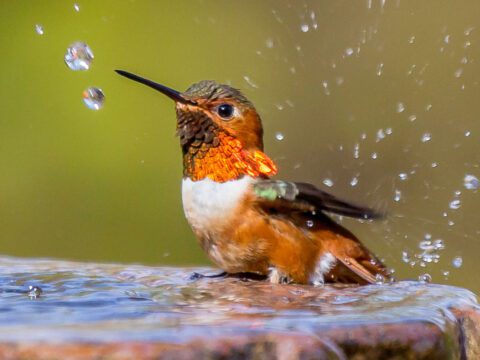
Black-chinned Hummingbird, male; Portal, AZ
About the photographs
enlarge
Black-chinned Hummingbird, female; Portal, AZ
Menu
  1. Cool Facts
  2. Description
  3. Similar Species
  4. Sound
  5. Range
  6. Habitat
  7. Food
  8. Behavior
  9. Reproduction
  10. Conservation Status
  11. Other Names

A hummingbird of relatively modest appearance, the Black-chinned Hummingbird is common throughout much of the western United States. It occupies a range of habitats, from urban areas to desert, and from sea level to over 2,500 meters (8,200 ft).

Cool Facts

  • In cold weather, a Black-chinned Hummingbird may ingest three times its body weight in nectar in one day.
  • The Black-chinned Hummingbird's nest can expand as nestlings grow. The spider and insect silk holding it together stretches and allows the nest to grow along with the growing chicks.

  • The male and female Black-chinned Hummingbird may use different habitats during the nesting season, with the male in somewhat drier areas. In a study in Arizona and New Mexico, nesting females spent most of their time in canyon bottoms but often relied on nectar sources on nearby hillsides. Males occupied and defended territories on the hillsides but rarely ventured into the canyon bottoms.

  • The eggs of a Black-chinned Hummingbird average about 13 mm (0.5 in) long and 8 mm (0.3 in) across, about the same size as a whole coffee bean.

Description

  • Size: 9 cm (4 in)
  • Wingspan: 11 cm (4 in)
  • Weight: 2-5 g (0.07-0.18 ounces)

  • Tiny bird.
  • Back iridescent green.
  • Underparts dirty white.
  • Hovers at flowers.
  • Male with black chin bordered by thin strip of iridescent purple, visible only in the right light.

  • Rather grayish underneath.
  • Long, thin, rather flat bill.

Sex Differences

Male with black and purple throat, female with white. Female with white tips to tail feathers. Female larger.

Male

Gorget (throat) black with lower half iridescent purple, visible only in the right light. White collar below dark throat. Dull metallic bronze-green on back and top of head. Underparts dull grayish white. Sides darker, glossed with green. Tail mostly black with two green central feathers.

Female

Dull metallic bronze-green on back and top of head. Chin and throat whitish, with thin dark streaks and spots. Breast and belly dull grayish white. Tail greenish or blackish, with broad white tips on the three pairs of outermost feathers.

Immature

Similar to adult female. Young male can have a few black or purple throat feathers.

Similar Species

  • All male hummingbird throats look black when the light is not right. Female hummingbirds are difficult to distinguish.
  • Male Ruby-throated Hummingbird has red gorget.
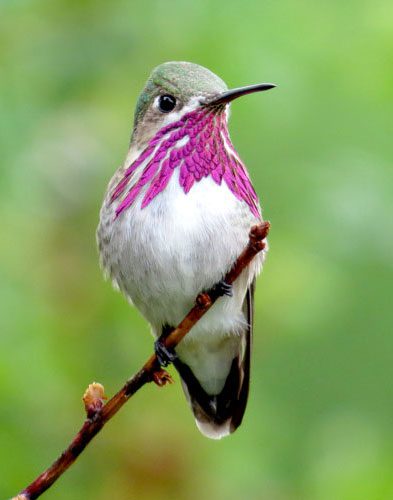
  • Male Costa's Hummingbird has entire throat purple, as well as the forehead, and has broad extensions off the side of the gorget. Females can be distinguished only by shape of wing feathers.

Sound

Call notes include various high chips and ticks. Male's dive display produces a zinging sound.

»listen to songs of this species

Range

Range Map


© 2004 Cornell Lab of Ornithology

Summer Range

Breeds from southern British Columbia to southeastern Arizona, southern Texas, and northern Mexico; also breeds in the Central Valley and along the southern coast of California.

Winter Range

Winters in Mexico, in the interior and the Pacific slope. Individuals occur to the Gulf Coast of the United States.

Habitat

Breeds in a wide range of habitats, including riparian corridors in arid areas, piñon-juniper woods, and urban areas with tall trees and flowering ornamental shrubs and vines.

Food

Nectar from flowers of at least 90 species of plants. Visits hummingbird feeders. Eats some insects.

Behavior

Foraging

Takes nectar while hovering, sticking tongue into flower.

Displays

Male performs dives of about 20 to 30 meters (66-99 ft) in courtship and aggression.

Reproduction

Nest Type

Neat, deep cup made primarily of plant down, held together with spider webs and cocoon fibers. Placed in trees, about 2 meters (6.6 ft) off the ground.

Egg Description

White.

Clutch Size

Usually 2 eggs. Range: 1-3.

Condition at Hatching

Helpless, naked, and dark gray.

Conservation Status

Populations have increased with introduction of exotic plants and feeders by humans.

Other Names

Colibri à gorge noire (French)
Colibrí barba negra (Spanish)

Sources used to construct this page:

Baltosser, W. H., and S. M. Russell. 2000. Black-chinned Hummingbird (Archilochus alexandri). In The Birds of North America, No. 495 (A. Poole and F. Gill, eds.). The Birds of North America, Inc., Philadelphia, PA.


Home | Contact Us    ©2003 Cornell Lab of Ornithology