
Menu
- Cool Facts
- Description
- Similar Species
- Sound
- Range
- Habitat
- Food
- Behavior
- Reproduction
- Conservation Status
- Other Names
A familiar sight at bird feeders, the boldly patterned Blue Jay is unmistakable. It is abundant in the East and is extending into the West, using food and shelter provided by humans.
Cool Facts
- Although the migration of Blue Jays is an obvious phenomenon, with thousands moving past some points along the coast, much about it remains a mystery. Some jays are present throughout the winter in all parts of the range. Which jays move and which stay put? Although young jays may be more likely to migrate than adults, many adults do migrate. Some individual jays may migrate south in one year, stay north the next winter, and then migrate south again the next year. Why do they migrate when they do?
- Many people dislike the Blue Jay because it is known to eat the eggs and nestlings of other birds. However, in an extensive study of Blue Jay feeding habits, only 1% of jays had evidence of eggs or birds in their stomachs. Most of the diet was composed of insects and nuts.
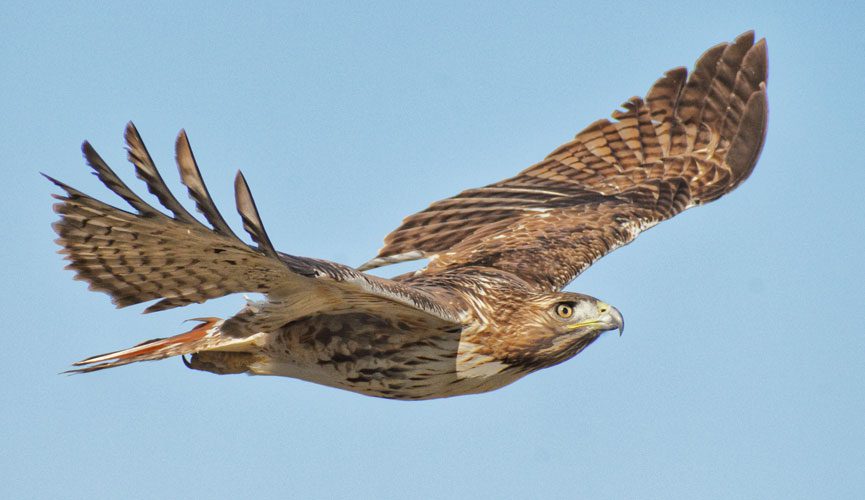
- The Blue Jay frequently mimics the calls of hawks, especially the Red-shouldered Hawk. It has been suggested that these calls provide information to other jays that a hawk is around, or that they are used to deceive other species into believing a hawk is present.
- Tool use in birds is rare. Although no tool use has been reported for wild Blue Jays, captive jays used strips of newspaper to rake in food pellets from outside of their cages.
Description
- Size: 25-30 cm (10-12 in)
- Wingspan: 34-43 cm (13-17 in)
- Weight: 70-100 g (2.47-3.53 ounces)
- Large songbird.
- Crest on head.
- Upperparts various shades of blue.
- Wings and tail marked with black bars and white tips.
- Underparts and face grayish white.
- Black collar across upper chest, extending up sides of neck to rear of face and connecting to black eyeline.
- Tail fairly long and graduated.
Sex Differences
Sexes alike.
Immature
Juvenile similar to adults except blue areas are grayer and the black is slightly browner.
Similar Species
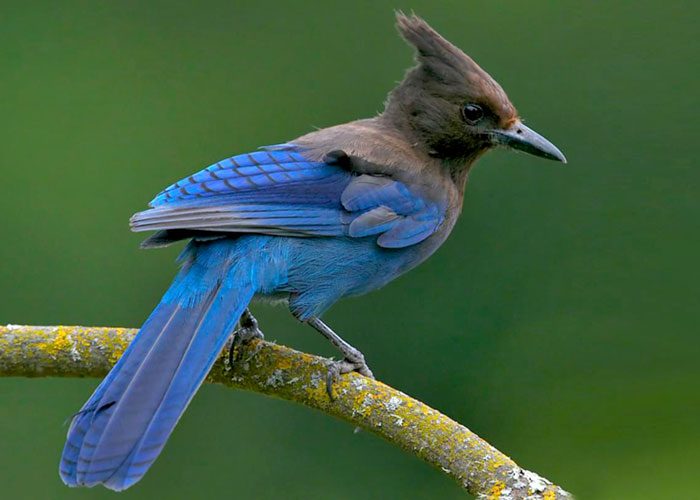
- Steller's Jay is similar in size and shape (including crest), but has a black head and chest and dark underparts.
- Western Scrub-Jay is called Blue Jay in some areas, but it does not have a crest or the black-and-white barring in the wings and tail.
Sound
Very vocal; make a large variety of calls. Most frequent call is a harsh "jeer." Also clear whistled notes and gurgling sounds.
»listen to songs of this species
Range
Range Map
© 2003 Cornell Lab of Ornithology
Summer Range
Resident from southern Canada through eastern United States to Gulf Coast, westward to central Texas. Small, local, expanding populations westward to Washington.
Winter Range
Partially migratory: some birds migrate out of northern portion of range, but some jays remain in all parts of range.
Habitat
- Found in deciduous, coniferous, and mixed forests and woodlands.
- Found more along forest edges than in deep forest.
- Common in urban and suburban areas, especially where large oaks are present.
Food
Arthropods, acorns and nuts, fruits, seeds, small vertebrates.
Behavior
Foraging
Gleans insects from trees, shrubs, and ground. Harvests and hides (caches) thousands of acorns and other nuts. Holds food under feet to peck at it.
Reproduction
Nest Type
Nest an open cup of twigs, grass, and sometimes mud, lined with rootlets. Typically located in crotch or outer branches of decidious or coniferous trees, 5-50 feet above ground, most commonly 10-25 feet.
Egg Description
Color: Bluish or light brown with brownish spots concentrated near large end.
Egg size: 25.2?32.8 mm x 18.8?22.4 mm.
(1.0-1.3 in x 0.7-0.9 in)
Incubation period: 17-18 days.
Clutch Size
2-7 eggs.
Condition at Hatching
Naked and helpless.
Chicks fledge in 17-21 days.
Conservation Status
Breeding Bird Survey data show a slight but significant decline in Blue Jay numbers across the United States, with most of the decline in the East. Some have implicated it in the decline of some Neotropical migrant species because it is a nest predator and prefers forest edges, but little direct evidence has been found.
Other Names
Geai bleu (French)
Sources used to construct this page:
Tarvin, K. A., and G. E. Woolfenden. 1999. Blue Jay (Cyanocitta cristata). In The Birds of North America, No. 469 (A. Poole and F. Gill, eds.). The Birds of North America, Inc., Philadelphia, PA.