
Birding 123 Bird Guide Gear Guide Attracting Birds Conservation Studying Birds

Bird Guide

Species Accounts

Video Gallery

Brown-headed Cowbird

Molothrus ater Order PASSERIFORMES - Family ICTERIDAE
Summary Detailed
For complete Life History Information on this species, visit Birds of North America Online.

Brown-headed Cowbird,	adult	male
enlarge
Brown-headed Cowbird, adult male
About the photographs
Brown-headed Cowbird,	adult	female
enlarge
Brown-headed Cowbird, adult female

Brown-headed Cowbird, juvenile
enlarge
Brown-headed Cowbird, juvenile
Menu
  1. Cool Facts
  2. Description
  3. Similar Species
  4. Sound
  5. Range
  6. Habitat
  7. Food
  8. Behavior
  9. Reproduction
  10. Conservation Status
  11. Other Names

The Brown-headed Cowbird is the only brood parasite common across North America. A female cowbird makes no nest of her own, but instead lays her eggs in the nests of other bird species, who then raise the young cowbirds.

Cool Facts

  • The Brown-headed Cowbird is the only brood parasite common across North America. A female cowbird makes no nest of her own, but instead lays her eggs in the nests of other bird species, who then raise the young cowbirds.
  • The Brown-headed Cowbird lays eggs in the nests of many different species of birds. Recent genetic analyses have shown that some female cowbirds will use a number of different hosts, but most females specialize on one particular host species.
  • Social relationships are difficult to figure out in birds that do not build nests, but male and female Brown-headed Cowbirds are not monogamous. Genetic analyses show that males and females have several different mates within a single season.

Description

  • Size: 17-22 cm (7-9 in)
  • Wingspan: 28-36 cm (11-14 in)
  • Weight: 38-50 g (1.34-1.77 ounces)

  • Medium-sized songbird.
  • Medium-long tail.
  • Bill stout and pointed.
  • Male shiny black with brown head and neck.
  • Female dull gray-brown.

  • Eyes black.
  • Wings rather long and pointed.
  • Legs black.

Sex Differences

Male shiny black with brown head and neck, female plain gray-brown.

Male

Body, wings, and tail shiny black. Head, nape, and chest dull dark brown. Bill black. Legs black.

Female

Entirely grayish brown. Chest with dull streaks. Throat whitish. Suggestion of faint pale eyestripe. Bill gray.

Immature

Juvenile similar to female, but more distinctly streaked below. Males molting in fall may be patched black and brown.

Similar Species

  • Bronzed Cowbird is larger, has longer bill, larger head, shorter tail, and red eyes. Male lacks brown hood.
  • Shiny Cowbird male is entirely glossy black, but female is extremely similar to female Brown-headed Cowbird, except bill is slightly longer.
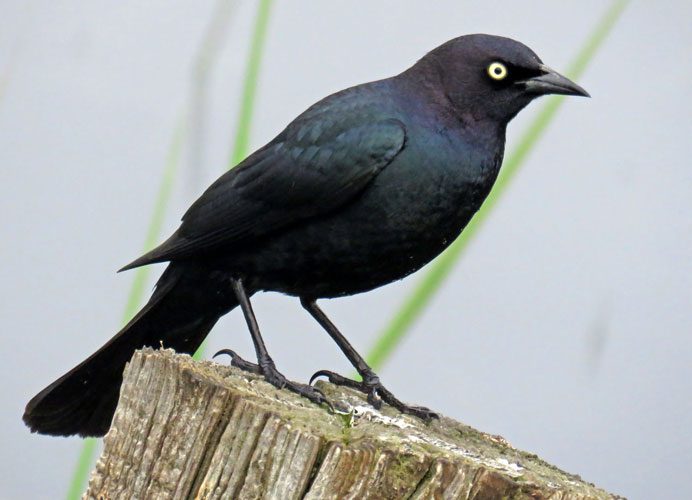
  • Brewer's Blackbird female darker brown, has dark around the eyes, and has a thinner, more pointed bill.
  • Female and juvenile Brown-headed Cowbird resemble sparrows, but are larger, completely dull gray-brown, and have unstreaked backs.

Sound

Song a pair of low "glug, glug" notes followed by slurred whistles ending on a very high pitch. Calls include a chatter and a whistled "fee-bee."

»listen to songs of this species

Range

Range Map
Brown-headed Cowbird

© 2003 Cornell Lab of Ornithology

Summer Range

Breeds from central British Columbia, southeastern Yukon, and Newfoundland southward to central Mexico and northern Florida.

Winter Range

Winters along Pacific Coast of United States and southern and eastern United States southward to southern Florida and southern Mexico.

Habitat

Breeds in areas with grassland and low or scattered trees, such as woodland edges, brushy thickets, fields, prairies, pastures, orchards, and residential areas.

Food

Seeds and arthropods.

Behavior

Foraging

Forages on ground, often in association with cows or horses. Outside of breeding season, forages in large flocks with other blackbirds.

Reproduction

Nest Type

None. Lays eggs in nests of other bird species.

Egg Description

Whitish with brown or gray spots.

Condition at Hatching

Helpless with some whitish down.

Conservation Status

Originally a bison-following bird of the Great Plains, the Brown-headed Cowbird spread eastward in the 1800s as forests were cleared. It is a common bird across most of North America, but numbers are declining in most areas. Its habit of nest parasitism can cause the decline of species with small populations, such as Kirtland's Warbler and Black-capped Vireo. You can help scientists learn more about this species by participating in the Celebrate Urban Birds! project.

Other Names

Vacher à tête brune (French)
Tordo negro (Spanish)

Sources used to construct this page:

  1. Lowther, P. E. 1993. Brown-headed Cowbird (Molothrus ater). In The Birds of North America, No. 47 (A. Poole, and F. Gill, eds.). The Academy of Natural Sciences, Philadelphia, PA, and The American Ornithologists' Union, Washington, D.C. 
  2. Woolfenden, B. E., Gibbs, H. L., and Sealy, S. G. 2002. High opportunity for sexual selection in both sexes of an obligate brood parasitic bird, the brown headed cowbird (Molothrus ater). Behavioral Ecology and Sociobiology 52: 417 425.
  3. Woolfenden, B. E., Gibbs, H. L, Sealy, S. G, and McMaster, D. G. 2003. Host use and fecundity of individual female brown-headed cowbirds. Animal Behaviour 66: 95-106.


Home | Contact Us    ©2003 Cornell Lab of Ornithology