
Birding 123 Bird Guide Gear Guide Attracting Birds Conservation Studying Birds

Bird Guide

Species Accounts

Video Gallery

Round Robin, the Cornell Blog of Ornithology

Golden-winged Warbler

Vermivora chrysoptera Order PASSERIFORMES - Family PARULIDAE
Summary Detailed
For complete Life History Information on this species, visit Birds of North America Online.

Golden-winged Warbler,	male,	breeding plumage
enlarge
Golden-winged Warbler, male, breeding plumage
About the photographs
Golden-winged Warbler, pair at nest
enlarge
Golden-winged Warbler, pair at nest
Menu
  1. Cool Facts
  2. Description
  3. Similar Species
  4. Sound
  5. Range
  6. Habitat
  7. Food
  8. Behavior
  9. Reproduction
  10. Conservation Status
  11. Other Names

The Golden-winged Warbler is a small, strikingly marked warbler of eastern early successional habitats. Its population increased for over 100 years as forests were cut down. Now, however, it is losing ground, both because of reforestation and displacement by the spreading Blue-winged Warbler.

Cool Facts

  • The Golden-winged Warbler prefers early successional habitats for nesting. Recently abandoned farms and clearcuts are ideal. These habitats, however, do not last long, and the warbler often quickly disappears from an area. The warbler benefited from the extensive deforestation of the last several centuries, especially as farms were abandoned in the 20th century. Current reforestation is reducing available breeding habitat.

  • The Golden-winged Warbler hybridizes extensively with the Blue-winged Warbler, giving rise to the distinctly plumaged "Brewster's" and "Lawrence's" warblers. Brewster's looks like a Blue-winged Warbler with a white chest, and Lawrence's looks like an all-yellow Golden-winged Warbler. Backcrosses of hybrids to pure parental types result in many intermediate-appearing birds.

  • Hybrids do not sing intermediate songs but sing either normal Blue-winged Warbler or Golden-winged Warbler songs. Some birds sing both. Occasionally pure-looking parental types sing the "wrong" song.

  • For more information on the Golden-winged Warbler, check out the Cornell Lab of Ornithology's Golded-winged Warbler Atlas Project.

Description

  • Size: 13 cm (5 in)
  • Weight: 8-11 g (0.28-0.39 ounces)

  • Small songbird.
  • Black or gray mask and bib.
  • Yellow crown.
  • Bright yellow patch on wings.
  • Back gray.
  • Underparts whitish.

  • Black face patches separated by white moustache stripe.
  • White stripe above eyes.
  • Undertail white.
  • Eyes black.
  • Tail gray.
  • White patches in outer tail feathers.
  • Bill black.
  • Legs black.
  • Palms of feet olive to yellow.

Sex Differences

Female similar to male, but mask and bib gray instead of black, wing patch smaller and sometimes two wingbars instead of patch.

Immature

Similar to adult.

Similar Species

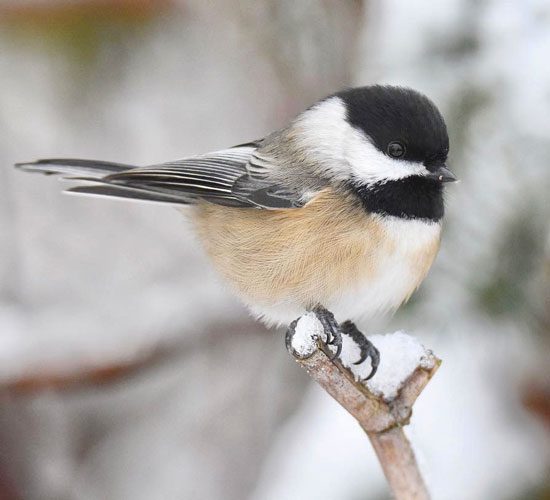
  • Chickadees have similar black bib and similar hanging-upside-down foraging tactics, but lack white eyestripe and any trace of yellow.
  • Hybrid "Lawrence's Warbler" has yellow underparts and separate wingbars.

Sound

Song a high buzzy "zee bee bee bee."

»listen to songs of this species

Range

Range Map
Golden-winged Warbler

© 2003 Cornell Lab of Ornithology

Summer Range

Breeds from southeastern Manitoba and northern Minnesota eastward to southern New Hampshire, and southward to southern Illinois and northern Georgia.

Winter Range

Winters in Central America and northern South America from Guatemala southward to Columbia and western Venezuela.

Habitat

Breeds in patchy shrubland and forest edge, such as shrubby fields, marshes, and bogs. Winters in canopy of tropical forests.

Food

Insects and spiders.

Behavior

Foraging

Forages mostly in upper half of trees and shrubs. Probes dead leaf clusters in winter, spreading bill to open curled leaves. Often hangs upside down.

Reproduction

Nest Type

Open cup of grasses, bark, and dead leaves. Leaves may form cap over eggs. Usually on or near ground.

Egg Description

Whitish with small streaks of brown near large end.

Clutch Size

3-6 eggs.

Condition at Hatching

Helpless.

Conservation Status

The Golden-winged Warbler is declining dramatically in the Northeastern United States, and is listed as a Federal Species of Special Concern. Although populations are declining in many areas, it is spreading its range to the northwest where farmland abandonment and clear cutting are common. Declines correlate with loss of shrub habitat and the expansion of Blue-winged Warbler.

Other Names

Paruline a ailes dorees (French)
Verdin alidorado (Spanish)

Sources used to construct this page:

Confer, J. L. 1992. Golden-winged Warbler (Vermivora chrysoptera). In The Birds of North America, No. 14 (A. Poole, P. Stettenheim, and F. Gill, eds.). The Academy of Natural Sciences, Philadelphia, PA, and The American Ornithologists' Union, Washington, D.C.


Home | Contact Us    ©2003 Cornell Lab of Ornithology