
Birding 123 Bird Guide Gear Guide Attracting Birds Conservation Studying Birds

Bird Guide

Species Accounts

Video Gallery

Indigo Bunting

Passerina cyanea Order PASSERIFORMES - Family CARDINALIDAE
Summary Detailed
For complete Life History Information on this species, visit Birds of North America Online.

Indigo Bunting male
enlarge
Indigo Bunting male
About the photographs
Indigo Bunting, female
enlarge
Indigo Bunting, female
Menu
  1. Cool Facts
  2. Description
  3. Similar Species
  4. Sound
  5. Range
  6. Habitat
  7. Food
  8. Behavior
  9. Reproduction
  10. Conservation Status
  11. Other Names

A brilliantly blue bird of old fields and roadsides, the Indigo Bunting prefers abandoned land to urban areas, intensely farmed areas, or deep forests.

Cool Facts

  • The Indigo Bunting migrates at night, using the stars for guidance. It learns its orientation to the night sky from its experience as a young bird observing the stars.
  • Experienced adult Indigo Buntings can return to their previous breeding sites when held captive during the winter and released far from their normal wintering area.

  • The sequences of notes in Indigo Bunting songs are unique to local neighborhoods. Males a few hundred meters apart generally have different songs. Males on neighboring territories often have the same or nearly identical songs.

  • Indigo and Lazuli buntings defend territories against each other in the western Great Plains where they occur together, share songs, and sometimes interbreed.

Description

  • Size: 12-13 cm (5-5 in)
  • Wingspan: 19-22 cm (7-9 in)
  • Weight: 12-18 g (0.42-0.64 ounces)

  • Small songbird.
  • Short, thick bill.
  • Male brilliant dark blue all over.
  • Female dull brown.

  • Eyes dark brown.
  • Legs blue-gray to blackish.
  • Sex Differences

    Male in breeding plumage brilliant blue, female dull brown.

    Male

    Breeding (Alternate) Plumage: Blue all over, deepest on head. Black in front of eyes. Occasionally with some brown on back, wing, breast, or under tail, or whitish on belly. Wing feathers dark, edged in blue. Upper bill blackish, lower mandible blue-gray.
    Nonbreeding (Basic) Plumage: Brown, with some blue edges to scattered feathers; some birds may be more blue than brown. Often whitish on lower belly and under tail. Blackish in front of eyes. Bill whitish to blue-gray. Gape yellowish.

    Female

    All brown. Unstreaked or with indistinct streaks on chest. Faint buff wingbars. May have some blue-tinged feathers on wing, tail, or rump. Upper bill brown to blackish, lower mandible pale.

    Immature

    Similar to adult female, with brighter buff wingbars. First-year male shows variable amount of blue and brown, may have distinct wingbars.

    Similar Species

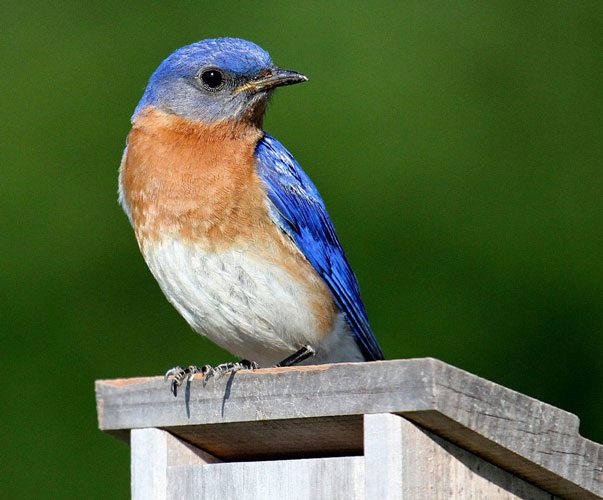
    • Eastern Bluebird had reddish chest and white belly.
    • Blue Grosbeak larger, with much thicker bill and obvious rufous wingbars.
    • Female Lazuli Bunting similar, but has more uniform pinkish buff breast and throat, and more conspicuous wingbars.
    • Female Varied Bunting more uniformly brown, without trace of wingbars, and a slightly more stubby bill.

    Sound

    Song a musical series of warbling notes, each phrase given in twos. Call a sharp, thin "spit." Flight call a high buzz.

    »listen to songs of this species

    Range

    Range Map
    Indigo Bunting

    © 2004 Cornell Lab of Ornithology

    Summer Range

    Breeds from southern Manitoba to Maine, southward to northern Florida and eastern Texas, and westward to southern Nevada.

    Winter Range

    Winters from southern Florida and central Mexico southward through Caribbean and Central America to northern South America.

    Habitat

    Breeds in brushy and weedy areas along edges of cultivated land, woods, roads, power line rights-of-way, and in open deciduous woods and old fields. Winters in weedy fields, citrus orchards, and weedy cropland.

    Food

    Small insects, spiders, seeds, buds, and berries.

    Behavior

    Foraging

    Gleans insects off of branches. Feeds in flocks in winter.

    Reproduction

    Nest Type

    Open cup of soft leaves, coarse grasses, stems, and strips of bark, held in place with spider web, lined with fine grasses or deer hair. Placed in shrub or herbaceous plant close to ground.

    Egg Description

    Unmarked white; a few have brownish spots.

    Clutch Size

    Usually 3-4 eggs. Range: 1-4.

    Condition at Hatching

    Helpless with sparse down.

    Conservation Status

    Abundant. May be declining slightly in Southeast.

    Other Names

    Passerin indigo (French)
    Azulito, Gorrión, Ruicito (Spanish)

    Sources used to construct this page:

    Payne, R. B. 1992. Indigo Bunting (Passerina cyanea). In The Birds of North America, No. 4 (A. Poole, Peter Stettenheim, and F. Gill, Eds.). Philadelphia: The Academy of Natural Sciences; Washington, DC; The American Ornithologists' Union.


Home | Contact Us    ©2003 Cornell Lab of Ornithology