
Birding 123 Bird Guide Gear Guide Attracting Birds Conservation Studying Birds

Bird Guide

Species Accounts

Video Gallery

Ringed Turtle-Dove

Streptopelia risoria Order COLUMBIFORMES - Family COLUMBIDAE
Summary Detailed
For complete Life History Information on this species, visit Birds of North America Online.
Menu
  1. Cool Facts
  2. Description
  3. Similar Species
  4. Sound
  5. Range
  6. Habitat
  7. Food
  8. Behavior
  9. Reproduction
  10. Conservation Status
  11. Other Names

The Ringed Turtle-Dove has been domesticated for so long that its wild origins are not known for certain. It frequently escapes from captivity, and feral populations have become established in some cities in the southern United States.

Cool Facts

  • Just what is the wild parent species for the Ringed Turtle-Dove has been debated for years. Currently it is believed to be a domesticated form of the African Collared-Dove (Streptopelia roseogrisea), which is found across northern Africa and western Arabia.
  • The Ringed Turtle-Dove seems to have had the fear of large, strange, or moving creatures bred out of it more than any other domesticated bird, and individuals are readily made hand-tame. The recognition of predatory birds remains, however, and it shows standard hawk-escaping dove behavior. One common response to a hawk is to "freeze" motionless. This behavior undoubtedly worked well with its normal, darker plumage in its natural habitat, but the pale domesticated form stands out conspicuously against green lawns.

Description

  • Size: 26-27 cm (10-11 in)
  • Wingspan: 45-50 cm (18-20 in)
  • Weight: 130-166 g (4.59-5.86 ounces)

  • Medium-sized bird.
  • Small head.
  • Pale buff to white body and head.
  • Black half-collar on back of neck.
  • Medium-long square tail.

  • Narrow black collar on back of neck edged with white.
  • Outermost wing feathers drab gray.
  • Undertail coverts whitish.
  • Tail with broad white edge underneath.
  • Underside of outermost tail feathers black at base.
  • Bill black.
  • Eyes ruby red.
  • Skin around eyes pale grayish.
  • Legs and feet purplish red.
  • Occasionally pure white all over.

Sex Differences

Sexes look alike.

Immature

Juvenile paler and duller, with gray feet and eyes that gradually change to adult color. Eyes become yellowish, then orange, then adult red.

Similar Species

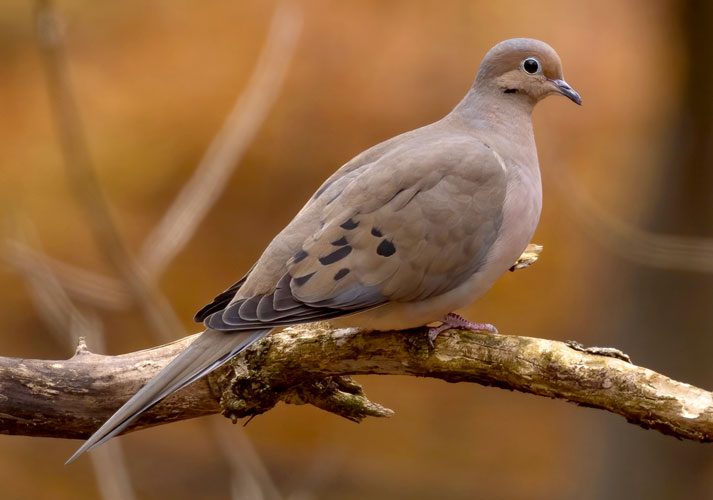
  • Mourning Dove is darker, has pointed tail with white outer tail feathers, and a spot, not a collar, on its neck.
  • Eurasian Collared-Dove similar, but has dark gray undertail coverts, extensive black on underside of tail feathers, and is darker.
  • White-winged Dove has large white patch in wing, a black band above the white tail tip, and has a teardrop-shaped spot on face.
  • Introduced Spotted Dove is darker, and has a broad collar of black and white spots on back of neck.

Sound

Song is a mellow "koo, kooroo." Call a high-pitched "heh-heh-heh."


Range

Range Map
Ringed Turtle-Dove

© 2003 Cornell Lab of Ornithology

Summer Range

Domesticated. Escapes from captivity can occur anywhere. Established breeding in local areas in Florida, Texas, and Alabama.

Habitat

Open woodland and parks around people.

Food

Seeds.

Behavior

Foraging

Feeds mostly on ground.

Reproduction

Nest Type

Flimsy platform of twigs, in tree or bush.

Egg Description

White.

Clutch Size

2 eggs.

Condition at Hatching

Helpless with creamy buff down.

Conservation Status

Feral populations do not seem to be able to maintain themselves without being provided food by people.

Other Names

Tourterelle rieuse (French)
Ringed Turtle Dove, Barbary Dove, Ringdove, Domestic Ringdove (English)

Sources used to construct this page:

  1. American Ornithologists' Union. 1998. Check-list of North American Birds, 7th ed. American Ornithologists' Union, Washington, D.C.
  2. Cramp, S., et al. 1985. The Handbook of the birds of Europe, the Middle East, and North Africa: The Birds of the Western Palearctic. Volume IV: Terns to Woodpeckers. Oxford University Press.
  3. Goodwin, D. 1983. Pigeons and doves of the world. Cornell University Press, Ithaca, New York.


Home | Contact Us    ©2003 Cornell Lab of Ornithology