
Birding 123 Bird Guide Gear Guide Attracting Birds Conservation Studying Birds

Bird Guide

Species Accounts

Video Gallery

Summer Tanager

Piranga rubra Order PASSERIFORMES - Family THRAUPIDAE
Summary Detailed
For complete Life History Information on this species, visit Birds of North America Online.
Menu
  1. Cool Facts
  2. Description
  3. Similar Species
  4. Sound
  5. Range
  6. Habitat
  7. Food
  8. Behavior
  9. Reproduction
  10. Conservation Status
  11. Other Names

The only entirely red bird in North America, the Summer Tanager is a bird of southern forests. It specializes in eating bees and wasps, both in the summer and on its wintering grounds in Central and South America.

Cool Facts

  • The Summer Tanager is considered a bee and wasp specialist. It usually catches a bee in flight and then kills it by beating it against a branch. Before eating the bee, the tanager removes the stinger by rubbing it on a branch. The tanager eats bee and wasp larvae too. It first catches the adult insects and then perches near the nest to tear it open and get the grubs.

  • Like most birds that migrate long distances, the Summer Tanager puts on large amounts of fat to fuel the long flight. Tanagers arriving in Panama had enough fat to fly an estimated additional 890 km (553 mi).

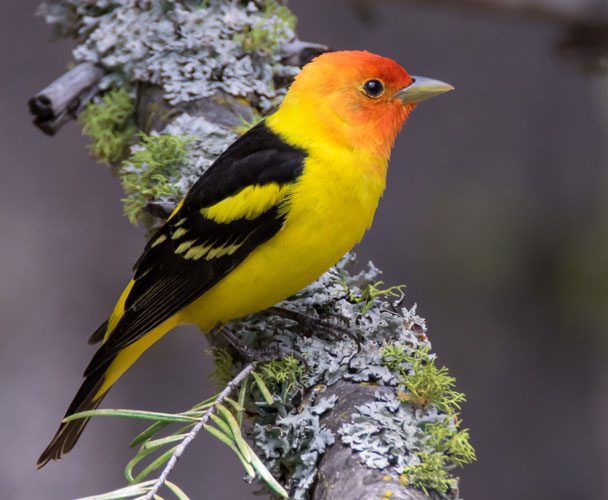
  • Where Summer and Scarlet tanagers occur together, the Summer Tanager prefers to breed in shorter and more open woodlands. In the West, the Summer Tanager breeds in lowlands along streams while the Western and Hepatic tanagers use coniferous forests at higher elevations.

Description

  • Size: 17 cm (7 in)
  • Weight: 30 g (1.06 ounces)

  • Medium-sized songbird.
  • Male entirely red; female dull yellow.

  • Bill stout, rather long, and pointed.
  • Bill light brownish, with lighter cutting edges.
  • Eyes dark.
  • Feet yellowish brown.

Sex Differences

Male bright red, female greenish yellow.

Male

Entirely bright red. Wings slightly darker or more gray, especially in winter (Basic Plumage).

Female

Upperparts plain yellowish olive green. Brighter yellow on crown and rump. Underparts dull yellow, with olive green wash on sides. Wing feathers grayish brown with yellow edging. Some females have red feathers. The red may be as a wash on body feathers, splotches of red feathers, or, rarely, the bird may be entirely red.

Immature

Immature resembles adult female. First spring male with variable amount of red and yellow feathers; may have only a few red feathers on head, or may be entirely red except for the wing feathers.

Similar Species

  • Scarlet Tanager male is brilliant red and has black wings. Scarlet Tanager female is greener and the wings are darker than the body.
  • Hepatic Tanager male has dusky gray face patch, is duller grayish red overall, has dark bill and legs, and darker wings and tail. Hepatic Tanager female has a darker bill, has a gray face patch, and gray sides.
  • Female orioles have white wingbars and more pointed bills.

Sound

Song a series of slurred, whistled notes interspersed with short pauses. Usually contains one set that can be interpreted as "peanut-butter." Call a harsh, clicking "pit-i-tuck."

»listen to songs of this species

Range

Range Map
Summer Tanager

© 2003 Cornell Lab of Ornithology

Summer Range

Breeds in southern United States and northern Mexico, northward in East to southern Iowa and New Jersey.

Winter Range

Winters from southern Mexico southward to northern South America.

Habitat

  • Breeds in deciduous forests in eastern part of range, especially open woods and near gaps.
  • In Southeast, breeds in pine-oak forests.
  • In West, uses riparian woodlands.
  • Winters in wide range of open and second-growth habitats.

Food

Insects, especially bees and wasps. Fruit outside of breeding season.

Behavior

Foraging

Captures insects by taking short flights from a perch after flying insects, plucking them from leaves while hovering, and picking them from leaves. Beats prey against branch to kill it.

Reproduction

Nest Type

Nest an open cup of dried grasses and other vegetation. Placed among cluster of leaves or in fork of branches on horizontal branch, often hanging over road or other opening.

Egg Description

Pale blue to pale green, marked with dark spots and blotches.

Clutch Size

Usually 3-4 eggs. Range: 2-5.

Condition at Hatching

Helpless with patches of down.

Conservation Status

Considered a Species of Special Concern in California. Most populations stable.

Other Names

Tangara vermillon (French)
Cardenal veranero, Cardenal rojo, Tángara de Paso, Tángara rojo, Tángara veranera, Candelo unicolor (Spanish)

Sources used to construct this page:

Robinson, W. D. 1996. Summer Tanager (Piranga rubra). In The Birds of North America, No. 248 (A. Poole and F. Gill, eds.). The Academy of Natural Sciences, Philadelphia, PA, and The American Ornithologists' Union, Washington, D.C.


Home | Contact Us    ©2003 Cornell Lab of Ornithology