
Birding 123 Bird Guide Gear Guide Attracting Birds Conservation Studying Birds

Bird Guide

Species Accounts

Video Gallery

Varied Thrush

Ixoreus naevius Order PASSERIFORMES - Family TURDIDAE
Summary Detailed
For complete Life History Information on this species, visit Birds of North America Online.
Menu
  1. Cool Facts
  2. Description
  3. Similar Species
  4. Sound
  5. Range
  6. Habitat
  7. Food
  8. Behavior
  9. Reproduction
  10. Conservation Status
  11. Other Names

A large, robin-like thrush of the Pacific Northwest, the Varied Thrush is a characteristic bird of the mature, dark coniferous forests. Wandering individuals turn up regularly far from home, wintering around feeders in the midwestern states.

Cool Facts

  • Males, but only rarely females, defend and maintain small feeding territories around bird feeders. They are aggressive and dominate many other feeder bird species.

  • To defend a territory a male may first give a Tail-Up display where the bird faces away from the intruder and holds its tail up to show off the gray-and-white patterned undertail coverts. If the intruder keeps coming the male may turn around and give the Head-Forward display with the wings fanned to show off the orange wing stripe and the tail cocked up over the head showing the white corners.

  • Data from Project Feeder Watch show that populations go up and down every other year. Go here for a discussion.

Description

  • Size: 19-26 cm (7-10 in)
  • Wingspan: 34-38 cm (13-15 in)
  • Weight: 65-100 g (2.29-3.53 ounces)

  • Large thrush.
  • Burnt orange throat, chest.
  • Dark face mask and back.
  • Dark V-shaped breast band.
  • Buffy orange wingbars and stripe above eye.

  • Orange visible in flight feathers at rest.
  • In flight has a pale orange stripe in the wing.
  • Has white on tips on inner vane of outer tail feathers that are not often seen.

Sex Differences

Female duller and slightly smaller than male.

Male

Back, nape, and crown gray to blue-gray. Throat and breast bright burnt orange. Black to slate-gray V on chest. Buffy orange eyestripe, wingbars, and patches in wings. Bill brown-black; straw-colored at base of lower mandible. Tan legs. Eyes dark. Belly white. Undertail coverts slate gray at base, with white or tawny tips.

Female

Upperparts brown to brownish gray. Wing feathers brown. Breast band indistinct brown to gray. Throat and chest burnt orange. Buffy orange eyestripe and wingbars.

Immature

Juvenile with brown head and neck tinged with buff. Indistinct orange eyebrow. Throat buff. Breast feathers buff with brown tips. Back and wings brown. Two orange wingbars and orange patches in wing.

Similar Species

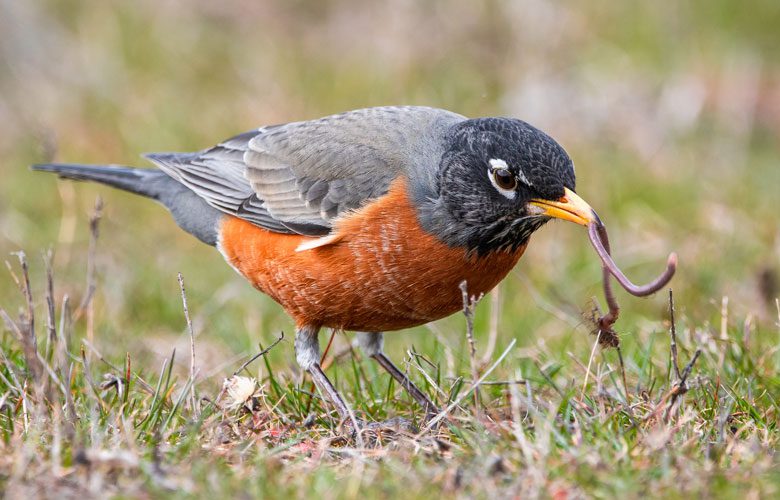
  • American Robin lacks the orange eyestripe, black or gray breastband, and pale wingstripe.

Sound

Strong whistled tone on a single pitch, usually buzzy in quality. Call note a dry "chup."

»listen to songs of this species

Range

Range Map
Varied Thrush

© 2003 Cornell Lab of Ornithology

Summer Range

Breeds throughout Alaska eastward to western Northwest Territories, southward to central Idaho and very northern California.

Winter Range

Winters along coast of Alaska and British Columbia to northern Idaho and southward to southern California. Numbers vary considerably from year to year in parts of winter range. Wanders widely across North America, including regularly to Midwest in winter.

Habitat

  • Breeds in wet coniferous or mixed forests. Prefers mature forests with a closed canopy, but found in second growth forests.
  • Winters in forests, parks, and gardens.

Food

Arthropods, fruit, acorns.

Behavior

Foraging

Feeds primarily on ground for litter-dwelling arthropods; grabs litter in bill, hops back, tosses litter aside, then examines cleared area.

Reproduction

Nest Type

Open cup with an outer layer of twigs and leaves; a middle layer of rotten wood, moss, and mud; and an inner layer of fine grass and moss. Nest on branches of small conifer in understory of forest.

Egg Description

Light sky blue, usually with small dark brown spots.

Clutch Size

1-6 eggs.

Condition at Hatching

Helpless and with small patches of down.

Conservation Status

Breeding populations in United States are declining, perhaps because of logging of mature forests. Not listed. May benefit from reserves established for Spotted Owl.

Other Names

Grive à collier (French)
Zorzal pechicinchado, Mirlo pecho cinchado (Spanish)

Sources used to construct this page:

George, T. L. 2000. Varied Thrush (Ixoreus naevius). In The Birds of North America, No. 541 (A. Poole and F. Gill, eds.). The Birds of North America, Inc., Philadelphia, PA.


Home | Contact Us    ©2003 Cornell Lab of Ornithology