
With a Wing and a Prayer
Mastering the art of photographing flying birds
By Bobby Harrison
Birds are one of the most popular subjects in nature photography.
It’s easy to understand why. Birds have inspired humans since we first
started painting their images on the walls of Paleolithic caves. Surely
the power of flight, more than any other quality that they possess, has
fueled our fascination with birds throughout the ages.
Although
capturing birds in flight is probably the most challenging form of bird
photography, learning a few simple techniques can vastly improve your
flight han ever for photographers to capture sharp images of flying
birds.
Choosing a camera
Important functions to look for in an autofocus camera include track focusing, dynamic or multisensor focusing, matrix metering, and a motordrive or autowinder that allows you to shoot at least six frames per second. Track focusing is a vital function for photographing birds in flight—it locks onto a moving subject, detects its direction and speed, anticipates where the subject’s new position will be, and keeps it in perpetual focus. Of course the camera’s focus selector switch must be set in the continuous servo mode for track focusing to work. Perhaps more than any other, this bit of technology has increased the number of sharply focused flight images a photographer gets per roll of film.

Sandhill Crane
Dynamic focus is also essential. This function activates all the focusing sensors in the viewfinder, one having been preselected by the photographer as the prime sensor. Once the prime sensor locks on the flying bird, the correct focus is maintained, even if the primary sensor slips off the subject. In dynamic focus mode, the secondary sensors keep the camera focused on the bird as it flies toward you, unless the subject moves completely out of your viewfinder. A great feature of dynamic focus is that once you get the bird in focus, you can frame it anywhere you want in the viewfinder. You don’t have to keep the subject dead center to keep it in focus. Being able to frame the bird to the left or right in the viewfinder with empty space in front of it allows you to create a compositionally sound image—one that doesn’t look like the bird is about to crash into the side of the picture.
Motordrive
Shooting multiple frames per second is critical for great flight photographs, and the more frames you shoot, the better. Why? Wing position is everything with birds in flight. Your images may be sharp and perfectly framed, but if the wing is too high, too low, or casts a shadow on the bird’s head, the image is less effective. Using a motordrive and shooting at multiple frames per second increases the odds of getting an image with wings in the perfect position, capturing peak action.

Purple Galllinule
Shooting with a high-speed motor-drive will significantly increase the amount of film you use, but that’s what it takes to get the best flight images. Film is cheap compared with the cost of buying camera equipment or traveling to an exotic location. Shooting a few more rolls of film improves your chances of getting that great shot with little added cost.
Lenses
Telephotos in the 300mm to 400mm range are
the best overall lenses for flight photography. This range provides
frame-filling images of large birds with extended wings. I prefer using
a 300mm as a basic lens and add a 1.4x teleconverter if I need more
magnification. When selecting a lens, be sure it has a limited focus
range switch, which keeps the lens from having to search back and forth
from infinity to its minimal focus distance if the autofocus sensors
slip off the subject. Focusing all the way to one extreme or the other
wastes vital time as the sensors attempt to lock on the subject again.
Limiting the focus distance to between 5 and 10 meters, or 10 meters to
infinity, reduces the amount of time the lens needs to focus or refocus
on the bird. For larger birds such as cranes, herons, raptors, swans,
and geese, the 10-meters-to-infinity range works best; for most
waterfowl and small birds, the 5-to-10-meters range is better.
Vibration
reduction or image stabilization lenses are becoming increasingly
popular with bird photographers—particularly those who enjoy taking
flight shots. Using these lenses, you can achieve a level of crispness
in your pictures that would require a shutter speed three stops faster
with a non-vibration-reduction lens. Built-in floating lens elements
compensate for your movements and maintain as steady an image as
possible without a tripod. These lenses also usually have an automatic
sensor that detects when the lens is panning and compensates for the
motion.
Camera mounts
I take a lot of flying bird
images with my camera mounted on a tripod, because I happen to be
shooting other subjects when a bird flies past. I use a ball head,
which makes swinging the lens toward the passing subject quick and
easy. If you plan on doing most of your flight photography with a
tripod, a Wimberley head is an even better choice. The Wimberley
head is like an altazimuth mount with the lens balanced on the
vertical tilt. It allows you to make smooth horizontal and vertical
sweeps with little effort, while keeping the lens perfectly balanced.
Some
photographs are nearly impossible to take from a tripod. You can often
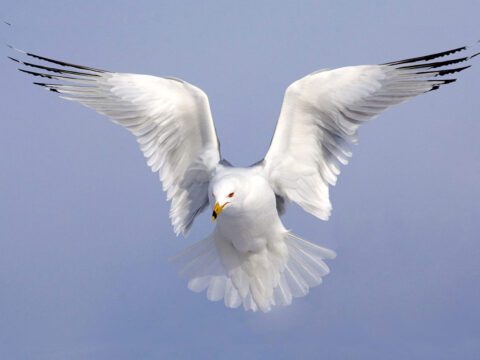
photograph terns and gulls hanging in the air almost directly
overhead—a situation in which a tripod will only inhibit your range of
movement and speed. The camera can be handheld for these types of
shots, and also when you’re shooting down on flying birds from atop a
cliff.
Another option for this kind of photography is a gunstock
mount. Holding a camera and lens like a rifle keeps everything steady
while allowing you a degree of movement unattainable with a
tripod—provided that you take a firm stance and hold the gunstock
tightly against your shoulder. I also attach a strap to the lens and
loop it around my upper arm. I make the strap tight so that when my
upper arm and elbow are placed against my body, it strengthens my upper
forearm, which acts as a brace. I have never seen a commercial gunstock
mount that I particularly like. Mine was custom-made by a friend and
fits me perfectly. But regardless of whether you buy or make a gunstock
mount, it should have a comfortable feel and a trigger to activate the
autofocus and shutter release. With an autofocus lens and
automatic-exposure camera, basically all you have to worry about is
pointing the lens, composing the picture, and shooting. If you combine
a gunstock mount with a vibration-reduction lens, you’ll have a
powerful tool for photographing birds in flight without a tripod.

Least Tern
Determining the correct exposure
Trying
to set your f/stop and shutter speed as a bird flies toward you is a
good way to lose a flight shot. For that reason I suggest using matrix
metering set in shutter-priority, autoexposure mode. Shutter priority
allows you to preset a fast shutter speed to freeze wing motion or a
slower shutter speed to blur wing movement; at the same time an
aperture is automatically selected to render a proper exposure. When
you choose a fast shutter speed, a correspondingly larger aperture is
selected and depth of field (the area in sharp focus) is sacrificed.
(Remember, the lower your f/stop number, the larger your camera’s
aperture will be and the shallower the depth of field.) On the plus
side, however, having less depth of field often renders distracting
background elements pleasingly out of focus and puts more emphasis on
your subject. Compositionally, this is called selective focus. If you
choose a slower shutter speed, your camera automatically selects a
correspondingly smaller aperture setting. Depth of field increases, but
so does the possibility of getting a blurry image due to camera shake
and subject movement.
It is important to note that matrix
metering works great most of the time. But be aware that no metering
system will properly expose white or black subjects unless you override
your light meter to compensate. (See article "White Birds Exposed.")
White clouds and other light areas in the sky may also affect the
accuracy of your camera’s exposure metering and require exposure
compensation.
Technique
Cameras, lenses, motordrives, and
mounting systems are important, but technique is what makes it possible
to use all that technology to its fullest potential.
For a
beginner, one of the most difficult aspects of flight photography is
sighting the bird in the viewfinder and keeping it there. A technique
that works well for me is to prefocus my lens at the distance I expect
to pick up the flying bird in my viewfinder. That distance will vary
with the speed at which the bird is flying, but about 300 to 350 feet
is a good average focus distance. To accomplish this, prefocus on the
ground or another object at the given distance, then choose a flying
bird to photograph and sight it in the viewfinder. Sighting on the bird
while it is farther away makes it easier to pick up in your viewfinder.
As the bird flies toward your camera, it will begin to come into focus.
When the image appears almost sharp, depress the shutter release
halfway. The track focus sensor will activate and lock onto the flying
bird, bringing it into and keeping it in focus as it continues to fly
toward you. Although it sounds like a considerable amount of time
passes when you use this technique, be forewarned: the whole thing
takes place in a matter of seconds.
The technique for keeping
flying birds in the viewfinder is called panning. You pick up the bird
in your viewfinder and simply follow it in a horizontal plane, sweeping
the lens along smoothly in the direction the bird is flying. This is
where dynamic and track focusing become most effective, keeping the
bird in constant focus as you pan. When you begin shooting, gently
squeeze the shutter release, keeping the lens steady and avoiding jerky
motions, and continue panning until you finish the sequence.
Panning
works because it achieves a relative speed of zero between the camera
lens and the subject. Panning with a fast shutter speed freezes the
subject as well as the background. A slow shutter speed blurs the wings
and background while most of the bird’s body remains sharp. For most
large birds, shutter speeds of 1/250 of a second or faster freeze wing
motion. Slower shutter speeds will cause wing blurring in your images,
but blurred wings are not a bad thing in flight photography. The
blurring effect shows movement and action, lending visual support to
the feeling of flight. Don’t be afraid to experiment with slow shutter
speeds while panning. Some of the most creative and artistic bird
images are made in this way.
Many excellent images of flying
birds
are made as they take off or land. Waterfowl, herons, egrets, cranes,
birds of prey, shorebirds, and seabirds generally fly into the wind
when they’re first becoming airborne and when they’re descending to
land. Although taking pictures at this time usually requires panning
with your camera, the birds are moving much slower and more predictably
than usual, and they are easier to follow.
Having knowledge of
your subject is important in any type of photography, but with birds it
is essential. If you always observe birds closely and learn as much as
possible about their behavior, you’ll develop an almost intuitive sense
of when a bird is going to fly. Before a bird takes flight, it often
stands very alert, turning its head in many different directions,
checking out its surroundings. It also turns into the wind. But most
important, right before they fly, birds often defecate, perhaps to
lighten their load. Being aware of these simple clues, you’ll be ready
for action when they take off. Be sure to place the bird in the lower
left or right side of the viewfinder, leaving space for the bird to
jump into the frame as it takes flight. Because birds land into the
wind, make sure the wind is at your back or at a right angle as you
shoot. If the wind is blowing in your face, all you’ll photograph is
the backs of birds.
Where can you go to find flying birds to
photograph? You should be prepared anytime you’re taking pictures in
the field, but your best opportunities will come in places where birds
are flying to or from their feeding grounds. At rookeries you can take
pictures of birds flying near their nests. At seabird cliffs, you can
photograph birds soaring on updrafts. Staging areas along migratory
routes are great places to find cranes, waterfowl, and shorebirds to
photograph. Also check out local city ponds and lakes. Waterfowl
frequent these locations, flying to them in the morning and leaving in
the evening like clockwork.
These are a few basic tips and
techniques that will help you improve your flight photography. As you
work in the field, you will customize these techniques to fit your own
unique style of shooting. So load up the gear, take lots of film, and
with luck and hard work you’ll get some great images of flying birds.
Bobby Harrison is an associate professor of art and photography at Oakwood College in Huntsville, Alabama, and a well-known bird photographer.
This article was originally published in the Spring 2003 issue of Living Bird magazine.