

The Basics: Feather Molt
April 20, 2008
Female Indigo Bunting are brown overall. Juvenile male Indigo Buntings wear a similar plumage. Photo by Kelly Colgan Azar via Birdshare. First-year male Indigo Buntings, and adult males in winter and spring, are a patchwork of brown and blue. Photo by Carlos Escamilla via Birdshare. As spring approaches summer, males become more blue as they finish their "prealternate" molt into their "alternate" plumage. Photo by Cleber Ferreira via Birdshare. By summer, adult males in alternate plumage are brilliant blue. Photo by Norm Townsend via Birdshare.
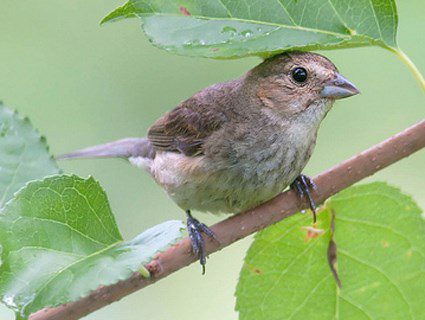
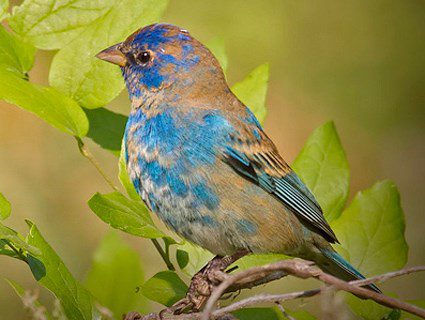
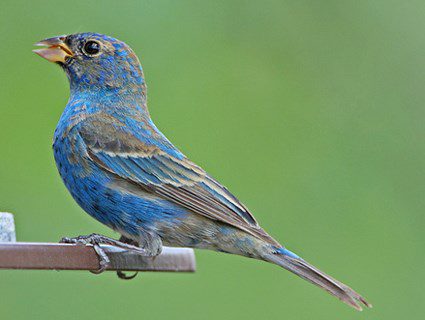
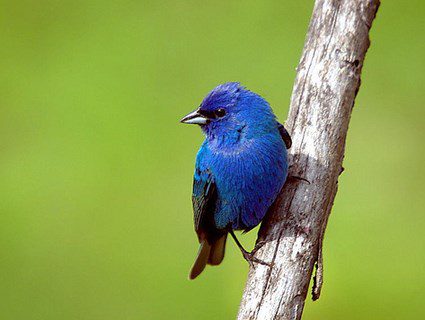
A feather is a “dead” structure, analogous to hair or nails in humans and made of the same basic ingredient, the protein keratin. This means that when they get damaged, feathers can’t heal themselves—they have to be completely replaced. This replacement of all or some of the feathers is called molt. In addition to providing a new set of healthy feathers, molts often provide a new look to the bird’s plumage—new colors or patterns that can indicate the bird’s age, sex, or the season of the year.
Molt is extremely variable. Observed patterns can vary by species, by individual, from year to year, and by individual feathers on the same bird. Molts can be either complete, in which the bird replaces every one of its feathers over the same molt period; or partial, in which the bird replaces only some of its feathers (for example, flight feathers or body feathers).
Molt keeps birds in top flying condition by replacing feathers that have become worn or damaged with completely new feathers. However, if a bird loses an entire feather, that feather will begin growing back immediately rather than waiting for the next molt. (This is why people clip the flight feathers of captive birds rather than plucking them out.)
Molting occurs in response to a mixture of hormonal changes brought about by seasonal changes. The entire process is complex and many questions remain regarding how the process is controlled. A basic understanding of molting patterns can be a useful aid in identifying many species and in determining their age.
Timing
It takes a lot of energy to build new feathers. As a result, timing is important—and birds typically time their molts to avoid other periods of high energy demands, such as nesting or migration. Molt timing can be more complicated for larger birds, because growing larger feathers means that their molt process takes longer than it does for smaller birds. This is one reason why some birds undergo partial molts.
Molt nomenclature
There are three main systems for describing plumages.
The most common approach used by bird watchers is to distinguish between winter (nonbreeding) plumage and summer (breeding) plumage. This approach works fine on a casual basis but is inadequate for detailed analysis of molt.
For that reason, scientists typically use a system known as the Humprey-Parks nomenclature, which can accommodate the variability in molting patterns—especially those of tropical species, seabirds, and other species that do not follow an annual cycle.
The third nomenclatural system is used by bird banders and is not covered here.
Humphrey-Parkes
At the heart of the Humphrey-Parkes system is the concept that all birds have a basic plumage, and many birds also have an alternate plumage. These are often (but not always) analogous to winter and summer plumages, respectively. Humphrey-Parkes can be a little confusing to bird watchers accustomed to thinking of a bird’s bright summer plumage as its main look. In the Humphrey-Parkes system this is called the alternate plumage because the birds spend only a small part of the year in these brighter feathers. The rest of the year they’re in nonbreeding plumage, often following a full molt. This plumage is called the basic plumage.
Species that look the same way on a year-round basis are always in basic plumage.
The more colorful spring breeding plumage seen in many species is referred to as the alternate plumage under the Humphrey-Parkes system.
An advantage of the Humphrey-Parkes system is that it gives the ability to describe molting and plumage patterns throughout the life of a bird. This means the system can help scientists and bird watchers determine how old a given bird is. The ageing section, below, describes this process using the Herring Gull as an example.
The Humphrey-Parkes system was first proposed in the scientific journal The Auk in 1959: Humphrey, P.S., and K.C. Parkes. 1959. An approach to the study of molts and plumages. Auk 76:1–31.
Using Molt Patterns to Determine a Bird’s Age
Some species acquire their adult plumage in a single year. Others require up to 5 years (eagles, for example) to reach full adult plumage. Gulls are often broken into categories such as a “3-year gull” or “4-year gull,” based on how long it takes the bird to reach full adult plumage.
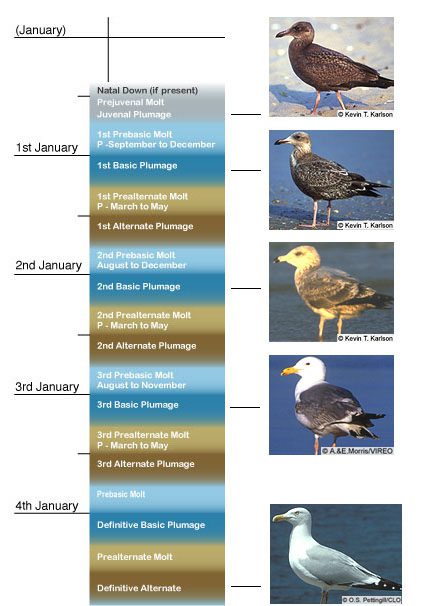
This chart illustrates molting and plumage nomenclature under the Humphrey-Parkes system. The four-year development of a Herring Gull from juvenile to adult is shown on the right. Note that molting periods cover a range as long as 4 months, are specific to the Herring Gull, and are approximations only. Some birds will start molting earlier and others later. Not all feathers are lost at once during the molt, so an individual bird may look quite different from week to week as it molts from one plumage to the next. In Herring Gulls, the second prebasic molt may take as long as 6 months to complete. In the chart, a “P” in front of the molt period indicates a partial molt.
How Many Molt Cycles Per Year?
How often do birds molt? This varies by species, but almost all birds fall into one of the following three categories:
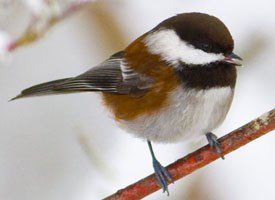 One complete molt per year: examples include chickadees, flycatchers, hawks, hummingbirds, jays, owls, swallows, thrushes, vireos, and woodpeckers
- One complete molt and one partial molt before the breeding season: Birds in this group, such as buntings, tanagers, and warblers, molt all their feathers after nesting and assume their basic plumage. Then, before the next breeding season, they have a partial molt of their body feathers that gives the males their bright alternate (breeding) plumage. Though females don’t typically molt into bright plumage, they do go through this same partial molt
- Two complete molts per year: Only a few species undergo two full molts per year. Most of these live in areas where the environment causes significant feather wear and tear. Marsh Wrens and Bobolinks, two species that move through abrasive vegetation, are examples. These birds have a complete molt into basic plumage and another complete molt into alternate plumage. While Marsh Wrens don’t look very different from winter to summer, male Bobolinks change from brown and streaky basic to a bold, black and cream alternate plumage
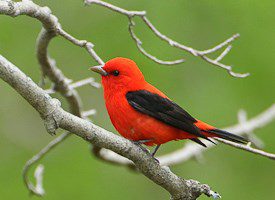 One complete molt and one partial molt before the breeding season: Birds in this group, such as buntings, tanagers, and warblers, molt all their feathers after nesting and assume their basic plumage. Then, before the next breeding season, they have a partial molt of their body feathers that gives the males their bright alternate (breeding) plumage. Though females don’t typically molt into bright plumage, they do go through this same partial molt
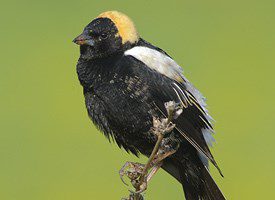 Two complete molts per year: Only a few species undergo two full molts per year. Most of these live in areas where the environment causes significant feather wear and tear. Marsh Wrens and Bobolinks, two species that move through abrasive vegetation, are examples. These birds have a complete molt into basic plumage and another complete molt into alternate plumage. While Marsh Wrens don’t look very different from winter to summer, male Bobolinks change from brown and streaky basic to a bold, black and cream alternate plumage
The Cornell Lab of Ornithology’s Handbook of Bird Biology provides additional molting information. If you really enjoy studying birds, careful observation and recording of molting patterns of even common species can be a valuable addition to the knowledge base of a particular species.
When it comes to molting, there are a lot of “except for the exceptions.” The best resource for details on individual species can be found at Birds of the World.

All About Birds
is a free resource
Available for everyone,
funded by donors like you
American Kestrel by Blair Dudeck / Macaulay Library