

Inside the Massive Winter Irruptions Known as Superflights
By Hugh Powell
January 15, 2013

The first clues started appearing in August across the northern tier of states. They were small but noisy: little slate-gray and cinnamon clues ambling upside down along the tree trunks. They arrived with the first hints of fall, and as those first Red-breasted Nuthatches continued southward more kept following, pouring out of the Canadian boreal forest all the way to central Florida.
At the same time, Red Crossbills made a move eastward across the continent. To a trained ear they had a regional dialect, a slight scratchiness to their calls that confirmed they had come from the Pacific Northwest. A few weeks later, a tide of streaky Pine Siskins began rolling down out of the north.
And that was just the beginning. “Everything’s going to be moving this winter,” said Matt Young, an audio engineer and finch expert at the Cornell Lab’s Macaulay Library. By October 2012, it was “already the largest Red Crossbill movement ever recorded at Minnesota’s Hawk Ridge,” he said. “And there will be grosbeaks, siskins, redpolls, Purple Finches, nuthatches. It’s a superflight like we haven’t seen since 1997–98.”
Every couple of years, food scarcities send one or a few irruptive species south of their normal ranges—redpolls in one year, for example, and siskins or Red-breasted Nuthatches in another. But that’s not a superflight. It’s only once a decade or so that climatological patterns and bird numbers combine for a superflight that sends six, seven, or eight northern species deep into the central and southern United States.
Superflights are the stuff of birding legends—that one winter when Evening Grosbeaks blanketed your neighborhood; the time Common Redpolls showed up in Las Vegas. It’s a great time to be a bird watcher.

Red-breasted Nuthatch by Daniel Behm. Red Crossbill by Tim J. Hopwood. Evening Grosbeak by Corey Hayes. Pine Grosbeaks by Stuart Oikawa. Common Redpoll by Raymond Lee. White-winged Crossbill by Kirchmeier. Purple Finch by Larry Hennessy. Pine Siskin by Ed Schneider.
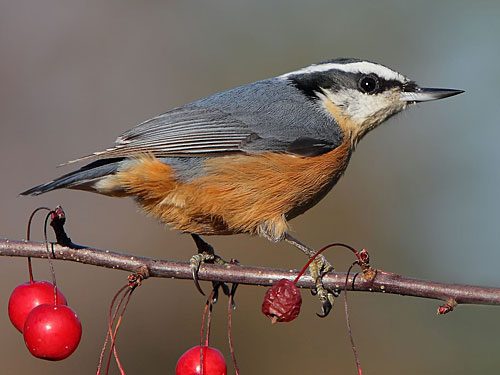
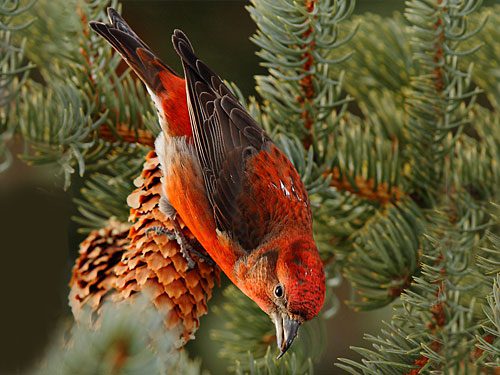
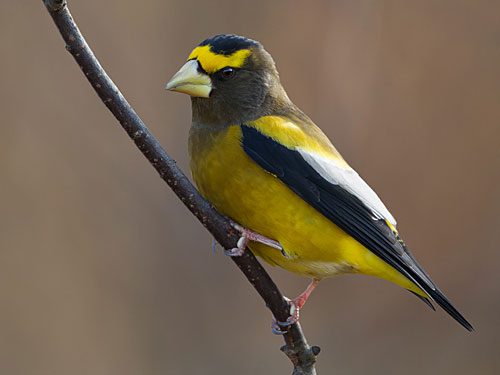
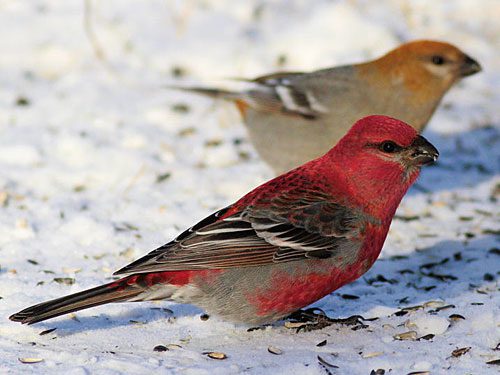
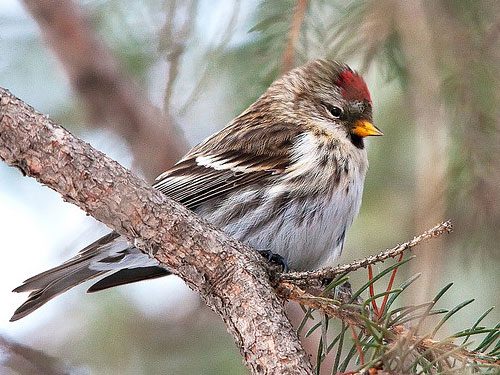
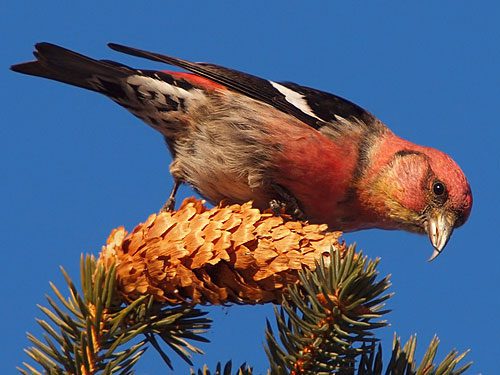
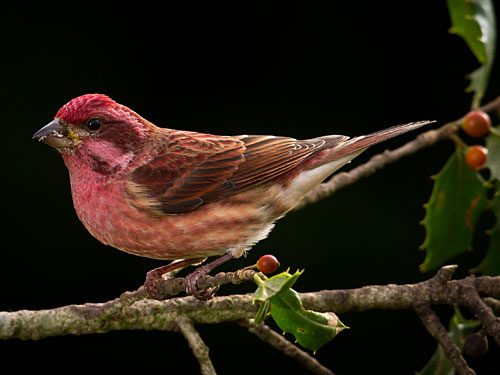
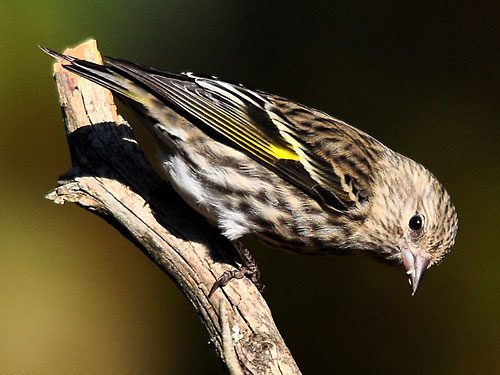
It’s also a great time to be a researcher, because superflights offer clues about what causes fluctuations in bird numbers and distribution. To get beyond anecdotes and into the realm of usable data, Cornell Lab researchers compile citizen-science reports and employ technological aids such as “smart” feeders and sound-analysis software.
By October, eBird was receiving Red-breasted Nuthatch reports with a frequency nearly double that of any time in the last five years. In Minnesota, Hawk Ridge Bird Observatory reported an extraordinary August flight of Red Crossbills—more than 3,700, breaking the state’s high-count record three times in a single week. Pine Siskin reports made the eBird maps light up like holly bushes, the red map pins indicating thousands of sightings in the previous 30 days. Evening Grosbeaks were already in Maryland and New Jersey by Halloween.
Related Stories
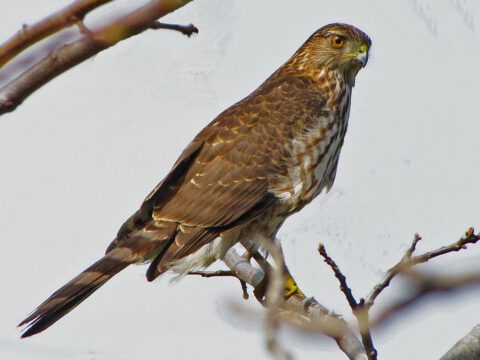
Winter finches come south not so much out of choice but because the trees force them to. From a seed’s point of view, finches are deadly—every bit as predatory as a Sharp-shinned Hawk is to a finch. So the trees fight back by controlling the food supply. They save up to produce massive amounts of seeds in one year and very few the next. In years with lots of seeds, finches have more than they can eat, so some survive to germinate; in years without seeds, they must take to the skies to find better pickings.
Of course, these large patterns are the result of many individual birds each making its own decisions about how to survive the winter. To get down to that level of detail, Project Feederwatch leader David Bonter uses special leg tags that record every visit a bird makes to an array of computerized feeders. Since 2010, he has banded more than 200 birds and recorded some three million feeder visits.
The first year of the project opened his eyes to the true scale of seed caching. Many bird watchers notice an uptick in feeder traffic in fall, but Bonter’s huge dataset offered hard numbers. Starting in August 2010, Bonter’s tagged birds quadrupled their visits to feeders. Individual chickadees and titmice were taking away up to 200 sunflower seeds per day—far more than they could eat. They spent August through October caching sunflower seeds for the upcoming winter.
The next year showed Bonter how seamlessly birds can adjust to changing conditions. “There were berries on everything, seeds on everything, and it was just an amazing summer,” he said. Ash trees went particularly gonzo, turning out a bumper crop of papery brown seeds.
The same birds that had been busy caching sunflower seeds a year earlier were now uninterested. So few came to the feeders that Bonter’s students couldn’t even catch birds to put new tags on them. “It was the most frustrating thing,” he said. “All the chickadees were up at the top of the ash trees just happy as could be.”
To Bonter, this revealed that birds turn first to natural foods and only secondarily to feeders, even ones stocked with high-calorie seeds. And birds pay attention to natural conditions and can radically change their seasonal behavior. This fall, after a widespread summer drought, he saw a return to the intensive caching of 2010.
Although local birds can fall back on backyard feeders, crossbills, grosbeaks, and other superflight species don’t have that option. They live in the vast boreal forests of northern North America, where there are few people and very few feeders. Interestingly, Bonter noted, on their southward irruptions those birds also seem to ignore feeders at first, curtailing their movements only when they find natural food. With the dearth of such foods this winter, he expects birds will stay on the move and visit feeders as they search for natural food.
Bonter’s smart feeders are less help with untagged irruptive birds, such as crossbills, that move widely and don’t habitually use feeders. So to understand this year’s remarkable crossbill flight, Matt Young uses his ears and a helpful quirk in the biology of crossbills.
In the 1980s, researchers began to learn that Red Crossbills consist of 10 distinct types, each with a unique bill shape that fits into the cones of the particular trees the birds feed on. One large-billed type specializes on big ponderosa pine cones, another has a smaller bill and feeds on smaller Douglas-fir cones, and so on. Some of the types are so distinct that they have been proposed as separate species. And each type communicates with an acoustically unique call note.
It was the scratchy, slightly weak-sounding call notes that allowed Young to trace crossbills seen in eastern states such as Michigan, Pennsylvania, Maryland, and Massachusetts back to the Pacific Northwest. Known as Type 3 crossbills, they have smallish bills and typically feed on the soft, diminutive cones of western hemlocks. This year they’re eating eastern hemlock, spruce, and other small eastern cones.
As those sources start to dry up in January and February, look for crossbills to start visiting feeders, Young said. With any luck, they’ll be joining a crowd of siskins, nuthatches, Evening Grosbeaks, Purple Finches, and who knows what other unexpected visitors. It is, after all, a superflight year.

All About Birds
is a free resource
Available for everyone,
funded by donors like you
American Kestrel by Blair Dudeck / Macaulay Library