Knox and Colin Evert
Knox and Colin Evert learned to bird before they learned to read. During the 2007 state-wide youth birding competition in their home state of Georgia, their team identified 53 birds in 24 hours, so they got second place in their age. With teammates Ben and Brian Hays they won first place for money raised for conservation, and spotted a Yellow-headed Blackbird; so rare in Georgia that it hadn't been seen in 10 years!
But in 2008, Knox, Colin, Brian and Ben identified 81 species, raised over $500 for American Bird Conservancy and won first place in both of those categories, plus an award for most improved. Knox and Colin are now 6 and 8 years old, but they were determined to do well in the competition, so they were out birding 'till midnight and woke up and started again at 6 AM! They were rewarded by seeing an American Kestrel and a whole flock of Black Vultures, among the 81 species they identified.
How did Knox become such a good birder? His mom saw that he had a real interest in birds and helped him learn, and his little brother Colin followed right in his footsteps. Molly Evert said she can't keep up with the boys now...they know many more birds than she can remember.
Knox and Colin listened to bird tapes at night when they were lying in bed. They learned that bird calls and sounds can be an important part of identifying a bird. They have a collection of Audubon plush birds which play authentic calls when squeezed, and they played with these toys a lot. Their mother, Molly writes,"The toys are so great, as the boys easily memorize the names and calls,
and each bird has a tag that gives info about it, range maps, etc." And identifying birds by call is what helped them win the 2008 birding competition. They have been birding since 2005!
Knox says he learns a lot about birds while he is waiting for his brothers to get done using the computer. He pores over bird guides...he could understand the range map symbols for each bird before he could read about them, and that's how he knew that the Yellow-headed Blackbird he saw during the birding competition was out of its normal range. The boys have gone beyond the challenge of merely spotting and identifying a bird to learning more about the species, including behavior, habitat, and other needs.
Knox with his grandmother
Colin and Knox are home-schooled by their mother, Molly. Activities and games to help them remember what they've learned. She writes, "As we saw how much they used the Stokes First Guide we had, and the generic "bird sounds" CD we wanted to provide them with some better tools. We got a set of Peterson's Birding By Ear tapes...they LOVED them. They listened to them every night while falling asleep for many months. We eventually got the 2nd set as well. This wasn't good for the field, though, so we eventually purchased 250 Bird Calls book. They loved that, too, but it quickly became dog-eared from being carried around out doors so much.."
The above photo shows Colin with one of his birding tool/toys...The Identiflier. Molly writes,"They both got Identifliers for their birthdays, and that was really helpful and wonderful. Knox wanted more and more cards, but they were so expensive. We did a competition with him that for every time he memorized a certain number of calls we would give him another card. This was very motivating for him. By this time, we had realized that the Stokes First Guide was inadequate for our purposes....someone recommended Ken Kauffman's guide, and it was INVALUABLE to us. The Stokes guide was easy to use as it was color coded....both non-reading boys could easily use it. The Kaufmann guide was also very intuitive....they could look at the bar at the front of the book, see what the bird looked like, and turn to the correct section of the book. This enabled them, as non-readers, to still use the field guide in a way that the Sibley or Peterson would not have done."
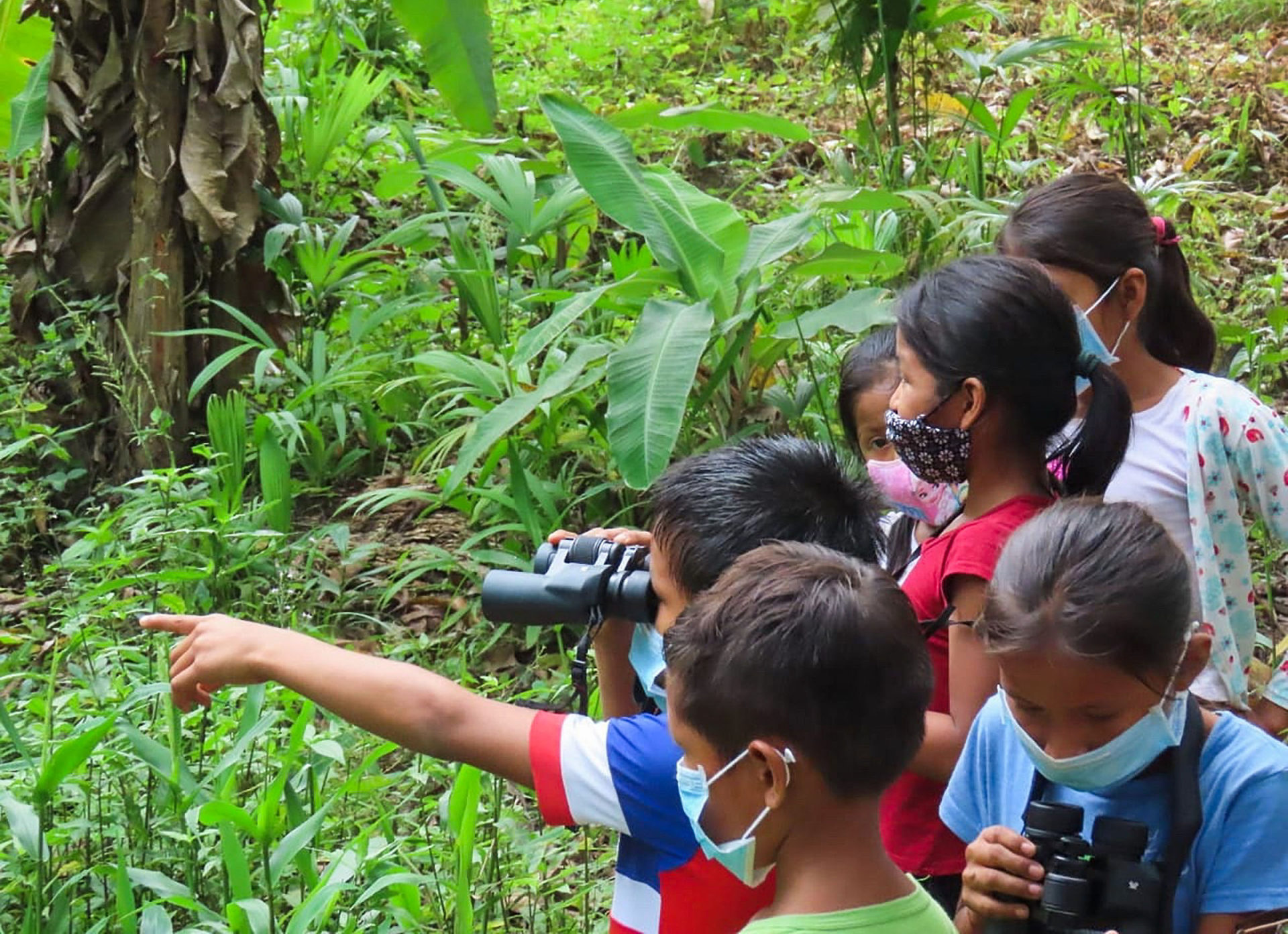
At Celebrate Urban Birds we want people to realize that they can bird without binoculars. It's fine to use the tools at hand; eyes, ears, pencil/notepad. And the boys started without binoculars, but once they got a good pair they had to learn HOW to use them. Molly found ones good for children, " They both use the Leopold Yosemite 6 x 30 binocs, (which are) wonderful....lightweight, strong, water resistant, fairly low price point, and they are able to be adjusted for eyes that are very close set. Their birding really took off once they had access to better binoculars."
Molly and the mother of the other boys on the birding team, Dawn Hays, pooled their resources and created a birding club to help the boys learn. Dawn developed games to help the boys use their binoculars: "We hid lots of Easter eggs and let them practice finding the eggs through the binoculars...they were a non-moving target! As they started spotting them on their own through the binoculars, we would have them say things like "I see a blue egg. It is to the left of the swingset" and then the others would try to find that egg in their binoculars. This was also helpful in training them to give directions about what they had spotted, as initially it was very difficult for them to even spot something, let alone describe its location or what it looked like. In the birding competition, it was required that two children would correctly spot and identify a bird, with no adult intervention (adults could not say "look over there" or help in ANY way)."
Participating in a birding competition engaged the boys and motivated them to keep learning to recognize new birds."When the boys got interested in participating in the Georgia Youth Birding competition we found two other kids who wanted to form a team. My boys were the youngest in the competition, and I just didn't know if 4 year old Colin would be much help to Knox, so I wanted to find another 6 or 7 year old to join his team. We found two brothers, (Ben and Brian Hays) and their mother and I started a "bird club" for her two boys and my two boys, to help them prepare."
And to help improve birding skills, the moms created activities.
"We also had them practicing calls, about 10 per week. We would tape pictures of 10 different birds around the room, play one call, and they would take turns going to the picture that matched the call they heard. We also did "musical chairs" where they walked around a table with pictures on it. When the music stopped, they had to produce the call or mnemonic device for the bird in front of them. We also hid pictures around the room of birds. They would try to spot one with binoculars, then describe its color and markings and location while the other then tried to find it. Both would then try to identify what species it was. We also photocopied silhouettes of birds and had them practice naming the silhouettes. These activities really helped prepare them for going into the field."
There is no question that learning from an experienced birder is a great help, as Molly soon realized,"The competition gave them the opportunity to have a mentor. We were put in touch with a local member of the American Bird Conservancy, Mr. Stephen Johnson. Mr. Johnson is a retired teacher and an active birder. He took the boys out into the field 3 times to help them spot birds, recognize unusual birds, showing them where to look and what to look for. This was very helpful to them and to us parents."
Molly Evert, as a home-schooling mom, realized how crucial it is to find good resources. "(The boys) have a matching game from one of the national parks...they love their bird matching cards, as well as other bird flashcard games. They won some Thayer birding software for Georgia in our competition. It is so fun and so user-friendly that I upgraded it to include all the birds (all 50 states). They have relied a lot on the Cornell All About Birds website to hear calls and see range maps and photos....One of their favorite CD Roms is The Multimedia Bird Book....it is very fun and educational, but I had to get it on ebay as it isn't sold anymore...it's quite old, but worth looking for.
Of course, the MOST helpful thing has been to have a good field guide accessible (we keep them at home and in the car), and decent binoculars. We also keep both seed and hummingbird feeders filled at home, which was instrumental in sparking interest during the early days, and still a great source of pleasure even though now we recognize everything that comes to the feeder (in the early days ALL birds were new and exciting)!"
And the Evert family has a few stories to share...."One funny memory the boys have was when we spilled seed in the basement while filling feeders....the door got left open and a small sparrow came into the house to get the seeds!
We were trying to attract bluebirds last year, so we started our own meal worm farm....we never got bluebirds, though, and when the worms turned into beetles we eventually abandoned our farm. It was kind of gross. Another activity which sparked interest in the early days was having the boys build their own birdhouses and feeders. Nothing has ever nested in our home-made birdhouses, because we have since learned that they were more decorative than functional. Since then, the boys have each built another birdhouse, chosen for a specific type of bird. "
Creating Green Places for Birds
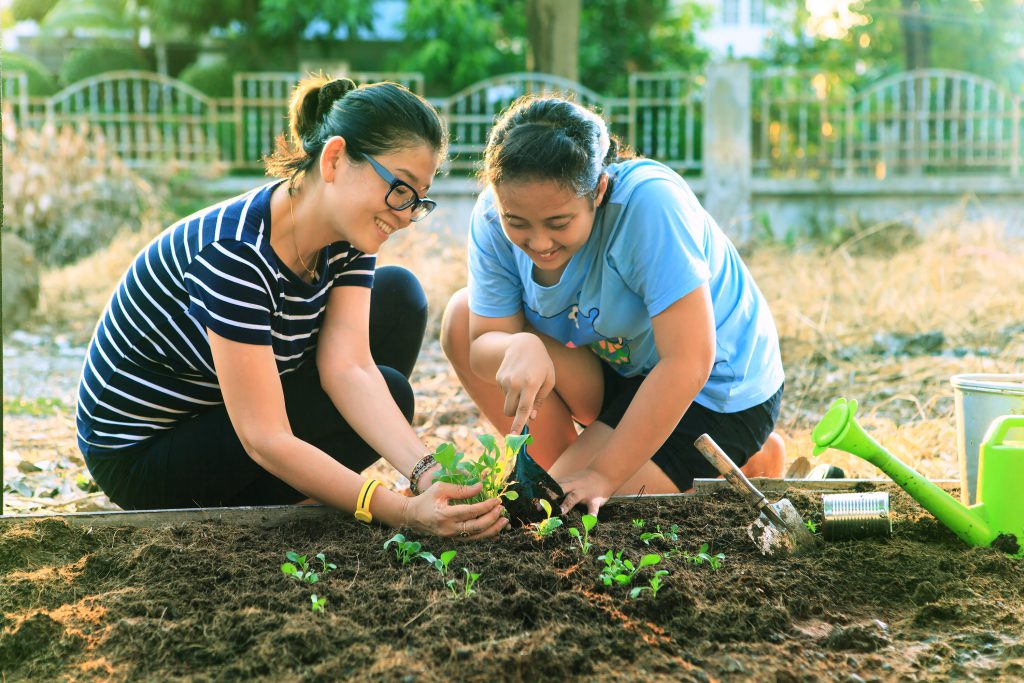
And as if we were in synchrony, at the same time Celebrate Urban Birds was working to develop its Little Green Places poster, the Everts were creating their own great space for birds, Molly writes, " This spring we decided to do something really big, and cleared an area beside our house to plant a bird garden.The boys had some remarks about the bird garden they worked on in Spring 2007,