Distribution, Status, and Habitat
Overview
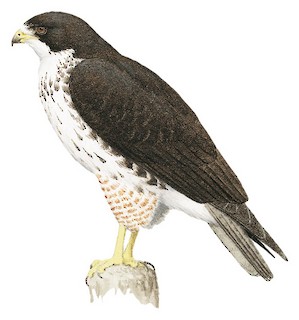
The Orange-breasted Falcon is a raptor of the Neotropics whose range historically stretched from southern Mexico through northern Argentina. It is now found only locally throughout its expansive range, with most current observations coming from well-known nesting locations. Never considered common anywhere, the Orange-breasted Falcon’s current abundance and distribution are clouded by confusion with the similarly-plumaged Bat Falcon. Many purported records of Orange-breasted Falcons outside their known localities may pertain to that species (see the Peregrine Fund's Global Raptor Information Network at www.globalraptors.org for even more detailed information).
Habitat
Areas of remote tropical rainforest and semi-deciduous tropical forest with suitable cliffs for nesting. The best known nesting sites in Belize, Guatemala, and Ecuador are in contiguous tropical evergreen and semi-deciduous forests such as the Tikal archeological site in the Department of Petén, Guatemala. Orange-breasted Falcons are almost entirely dependent on forests, whether forest moasic or uninterrupted mature forest. They live and hunt above the canopy, often within rolling limestone hills as pictured here in Western Belize.
Central America
In Central America, the Orange-breasted Falcon once ranged from southeastern Mexico through Panama, but its range may have retracted primarily to Belize and Guatemala, now thought to be the center of a disjunct northern population. This population may be separated from the closest known nesting falcons 900 miles to the south in the Darien Province of Panama. The species is still relatively easy to see at Tikal, Guatemala, and Mountain Pine Ridge Forest Preserve, Belize, where several nesting pairs are known. For quality accommodations in the heart of the Mountain Pine Ridge, contact the Hidden Valley Inn at www.hiddenvalleyinn.com. Hidden Valley Inn graciously supports the Peregrine Fund's Orange-breasted Falcon field work and experimental releases in the Preserve
Elsewhere in Central America, the status of Orange-breasted Falcon is unclear where no breeding records exist. The species has been documented by few verifiable sightings and even fewer museum specimens. Beyond the Maya Mountains of Belize and the northern Peten in Guatemala, where six (6) museum specimens have been collected (all in Guatemala), 10 museum specimens have been identified in Mexico and Central America: Mexico (2), Honduras (1), Nicaragua (2), Costa Rica (5), and Panama ((2), all but the 1962 specimen collected in Nicaragua dating prior to 1947. The most recent of the five specimens as collected in Costa Rica in 1934. Orange-breasted Falcon breeding had not been confirmed outside of Belize and Guatemala until 2000 and 2001 when the Peregrine Fund located four active breeding pairs of falcons in Panama (see below). No historical records exits for El Salvador and little forest habitat remains. The reasons for the apparent decline of the birds in these areas are unclear, but the species is known to be sensitive to deforestation and habitat alteration (Ecuador; road construction and logging), predation by burgeoning Black Vulture populations (Belize and Guatemala), dramatic shifts in the abundance of prey, or direct mortality caused by stochastic events such as Hurricane Mitch in 1998, which may have devastated prime Orange-breasted Falcon habitat in Honduras (R. Berry, personal observation.).
Mexico
Status uncertain; possibly extirpated. Historically, the Orange-breasted Falcon occupied tropical southeastern Mexico’s Atlantic slope from Veracruz south through Chiapas. The species is confirmed by only two museum specimens, one (undated) collected at Tecolutla, Veracruz (Friedman, 1950) and another collected in 1947 at Palma Real, Ocosingo, Chiapas. It has never been documented with photographs in Mexico since the early 1970s (Howell and Webb 1995; Steve Howell, personal communication). Most recent records were from Palenque in the 1970s and in Sierra de los Tuxtlas in March of 1985, with a sighting in the Yaxchilan National Monument Lacandona Forest in eastern Chiapas on 7 February 1998 (F. Olivares et al (2002). Another recent record of a lone female hunting in southern Chiapas along the Usumacinta River was recorded on September 21, 1991 (Eduardo Iñigo-Elias, pers. com.), but confusion with many of these sighting with the more common Bat Falcon is likely.
Belize
Currently hosts the largest known nesting population in Central America, with up to 13 known nest sites, not all of which are occupied each year. Orange-breasted Falcons are regularly seen by tour groups birding the Mountain Pine Ridge Forest Preserve in the Maya Mountains. The Peregrine Fund has been monitoring this population in Belize (and Guatemalan) since 1992 and most of what is know about the species is based upon these continuing studies. The population appears to be stable, but may be directly threatened by Black Vultures that utilize their nest sites and/or consume their eggs and young. Local communities encourage the presence of Black Vultures for control of human refuse.
Guatemala
The population in Guatemala, which is probably fewer than a dozen pairs, is thought to be contiguous with the larger population in Western Belize. Tikal is a popular place to see Orange-breasted Falcons throughout the year, and many birders and tour companies continue to find them there. Two youngsters were fledged in the Park in 2006, the first successful nesting since 1980. Park biologists monitor the birds year-round. As in Belize, Black Vultures pose a threat to the falcons and Park biologists are trapping and relocating them whenever possible.
El Salvador, Nicaragua, and Honduras
Little data are available from El Salvador, where no historical records exist and little forest remains. In Nicaragua and Honduras, the Orange-breasted Falcon was historically considered rare (Howell and Webb 1995). The species has been confirmed by two specimens in Nicaragua, one in 1962 (Howell, 1972), the second at Matagalpa at 4000 feet elevation in 1891(British Museum). In Honduras, a specimen was collected at El Hatillo in 1932. In Honduras, considerable excellent remote forest and cliff site habitat exists in the Los Mosquitia region, especially along the Rio Patuca River (R. Berry, personal communication)
Costa Rica
Extremely rare or extripated. Formerly resident on the Caribbean slope in foothills to 4,300 ft, but has since been extirpated (Stiles and Skutch 1994). Four museum specimens have been identified, the latest in 1934 at La Hondoura. There have been no reliable confirmed records in the last twenty- five years (Stiles 1985).Panama
Panama is the brightest spot in an otherwise discouraging history of Orange-breasted Falcon declines in Central America. Prior to 2000, the species was known only known from two nineteenth-century specimens from Chiriqui and three records of birds seen only in flight from 1957–1981 that may have been Bat Falcons (Ridgely and Gwynne 1989). Nonetheless, extensive helicopter and ground reconnaissance conducted by the Peregrine Fund throughout Central American in 2000 and 2001 revealed four nesting pairs of Orange-breasted Falcons in very remote pristine forest environments in the Darien Province close to the Colombian border.
South America
In South America, the Orange-breasted Falcon is widespread but local east of the Andes, south to northern Argentina. The Peregrine Fund has conducted limited and largely unproductive surveys of the species in Argentina and Peru. Records away from known nesting pairs are few, and the speces' true status on the continent needs clarification. More information is needed about Orange-breasted Falcons in South America—and your observations can help!
Brazil
Rare, but thought to occur throughout Brazill in local areas of suitable habitat, but especially along the eastern slope of the Andes. Until recently, the species had not been recorded in the Amazon Basin and some authors felt the species was entirely absent from this enormous area. Between 1988 and 1995, eight credible sightings occured in central Amazonian, most along the Rio Nigro, Amazonas (Whittaker 1994). Whittaker also reported a sighting along the Rio Guapora in Rondonia in 2000. There are thirteen specimens recorded as having been collected in Brazil from the following locations; Nova Petropolis, Rio Grande do Sul (1882), Canutama, Rio Plurus, Amazonas (1935 and 1935), Labrea, Amazonas (1935), Rio Tapajoz, Para, Fordiandia (1938), Cuiaba (or Cuyaba), Mata Grosso (undated), Buriti (or Burity) near Parnagua, Piauhy (1903), Bahia (undated and undated), IIha Sao Francisco, Santa Catarina (undated), Lagoa dos Patos, Rio Grande do Sul (undated), Santarem (undated), and Brazil (no location or date).
Colombia
Status uncertain. Márquez et al. (2005) listed specimens from Cauca, Putumayo, and Tolima in Colombian collections. The species may persist in the northeastern tropical forest, but has not been found recently at historic locations in the northwest. It is known from few a localities primarily on the Andean east slope, and is considered very rare (Hilty and Brown 1986). There are four recent records (1988–1998), two each from Huila and Cauca states (Instituto Alexander von Humboldt).
Venezuela
Very rare resident with most records from foothills and mountains with suitable cliffs for nesting areas. Most known nest sites are in remote locations (Hilty 2003). At least one known nest site visited by tour groups in the Tepuis of southeastern Venezuela (W. Paulson, per.com.), which may harbor a sizable population. Three specimens are in museums, two taken near Merida in 1904 and 1911, and another at Caicara, Rio Orinoco in 1907. Two other undated specimens exist, one taken in San Esteban, near Puerto Cabello, the other at Kabanayen, Bolivar. There are also recent records at several locations from Merida to Bolivar.
Guyana
Status uncertain. In the last decade, a pair of Orange-breasted Falcons has nested at Turtle Mountain, Iwokrama Reserve (the pair has since disappeared) and on the escarpment next to Kaieteur Falls on the Potaro River. A single specimen exists from Cayenne dated 1860.
Ecuador
Known from a few locations; the total population is thought to be less than a few dozen pairs. Peter Jenny of the Peregrine Fund discovered three pairs in 1979, 1980 and 1981 nesting in emergent ceiba and mahogany trees along the road from Baeza to Lago Agrio, but the trees were harvested shortly thereafter and these pairs vacated their prior nesting sites. R. Ridgely reports Orange-breasted Falcons nesting on a cliff in the Roi Hollin valley along the Loredo Road in eastern Ecuador sporadically from 1987 through 2005, and in 2000 a tree nesting pair in an emergent Ceiba tree 1000 or more meters from the forest, also along this highway. He also reports a territorial pair which attempted to nest in an emergent Ceiba in the Yasuni National Park in 2006 (Ridegely, pers.com.). Three study skins are extant from Ecuador, one from the Loredo Road from Narupa to Loredo, 10 km WSW of Loredo, Napo Province in 1991, the other two taken in 1923 and 1916 at Perico, Rio Chinchipe and Near Perico, respectively.
Peru
Rare in humid lowland forest east of the Andes. Several pairs currently known from at least four locations on the Andean east slope and subtropics. Several Orange-breasted Falcons have shown up with the parot trade in the local bird market in Lima in the last several decades and respected Peruvian falconers report having located at least one eyrie in 2006. The species is also known by five museum specimens collected in Chelpes, Junin, Rio Pachitea, Montelegre, Chaupe, Pomara, Lower Rio Maranon and Valle de Chauchanyo, Junin, from between 2000 and 7300 feet elevation, between 1921 through 1942. This extensive area may contain a large but little known population and is in need of much further study and exploration.
Bolivia
Status uncertain and in need of confirmation; probably at least a few resident pairs. Amboro National Park has several recent records. The species is confirmed by three specimens, one collected in 1944 at Buena Vist. Dpto. Santa Cruz, the second in 1986 at Cerro San Micera, Provinica Chiquitos, Dpto. Santa Cruz and the third in sub-tropical forest of the eastern Andean slopes at 1100 meters in Chapare, Depto. Cochabamba in 1982.
Paraguay
Status uncertain. Rare breeding resident in the Chaco and Oriente regions. Three specimens exist, one collected from Harqueta in 1934, another from Orloff, Chaco in 1938, with the third from Puerto Bertoni, Alta Parana, undated. Few recent records.
Surinam
Possibly a widespread resident both in the interior and costal regions. Haverschmidt (1963, 1968) lists four specimens taken in the country, two at Liberte on the Surinam River (1961), one near Paramaribo on the coast ( 1962), and the forth in Rama (1961). There are no breeding records for the species in Surinam.
Trinidad and Tobago
Thought to be a rare visitor. Two specimens exist without supporting information. A few 20th Century sightings. Status is unclear.