Skip to content. Skip to navigation

Cornell Lab of Ornithology

Sections

Identification Summary

The red, green, and blue adult male Painted Bunting is almost unmistakable. The duller, green females and immature can be more confusing. In the United States and in northern Mexico, Painted Buntings are the only all-green birds with a sparrow-like (conical) bill. In southwestern Mexico, however, female Painted Buntings might be confused with female Orange-breasted Bunting (Passerina leclancherii).

PaBu adult male PaBu female
   
 Adult male
 Female


Vocalizations

The song is a short, rich warble, lasting about 2 seconds and containing an average of 10 syllables. The song of Painted Bunting is superficially similar to the songs of Indigo and Lazuli buntings, but typically includes fewer phrases with notes that are doubled or tripled.

Representative song of Painted Bunting, eastern (Charleston Co., South Carolina; recorded by Geoffrey A. Keller; MLNS 105417)

Representative song of Painted Bunting, western

(Edwards Co., Texas; recorded by Geoffrey A. Keller; MLNS 105245)

Males sing as soon as they arrive on breeding territories. Males typically sing from an exposed, elevated perch (1-10 m [3.3-33'] above the ground); but the song also may be given from a perch more concealed among vegetation, especially by males on territory before the arrival of females, and by non-territorial males. Males begin singing immediately upon arrival. The rate of singing may be as great as 10 songs per minute, during interactions between adjacent males during territorial establishment. The rate of singing declines markedly following the arrival of females, and shows yet another significant decline after pairs are established.

Singing by males on the wintering grounds has not been reported.

The most common call is a single-note tchip or plik.

Call of Painted Bunting (Val Verde Co., Texas; recorded by Theodore A. Parker III; MLNS 45007)

Similar species

It would be difficult to confuse the adult male Painted Bunting with any other species. The drabber, green females and immature can be more confusing. Throughout most of its range, however, Painted Bunting is the only all-green bunting. The nonbreeding distribution of Painted Bunting overlaps, however, with resident Orange-breasted Buntings in western Mexico. Orange-breasted Buntings occur from extreme southern Nayarit south along the coast to extreme western Chiapas, and inland in the Río Balsas drainage to western Puebla. Female and immature Orange-breasted Bunting are green above, and yellow below, and so have a superficial resemblance to Painted Bunting. In distinguishing the two species, note in particular the color of the lores, and of the underparts. Female and immature Orange-breasted Buntings have yellow lores that contrast with the green forecrown and sides of  the face, and yellow, or more strongly yellowish-green underparts; the lores of Painted Buntings are not noticeablely pale or contrasting, and the underparts are dull green or yellowish-green.

In Mexico and Central America, also take care not to confuse female Painted Bunting with female euphonias (Euphonia species). Euphonias are smaller than buntings, with much shorter tails; are less uniformly green; and typically range higher in the forest canopy, not relatively low near the ground.


We acknowledge the support of the U.S. Fish & Wildlife Service in the creation of this site, which is part of the Focal Species Strategy for Migratory Birds (Focal Species PDF)

Wolf Creek Charitable Foundation


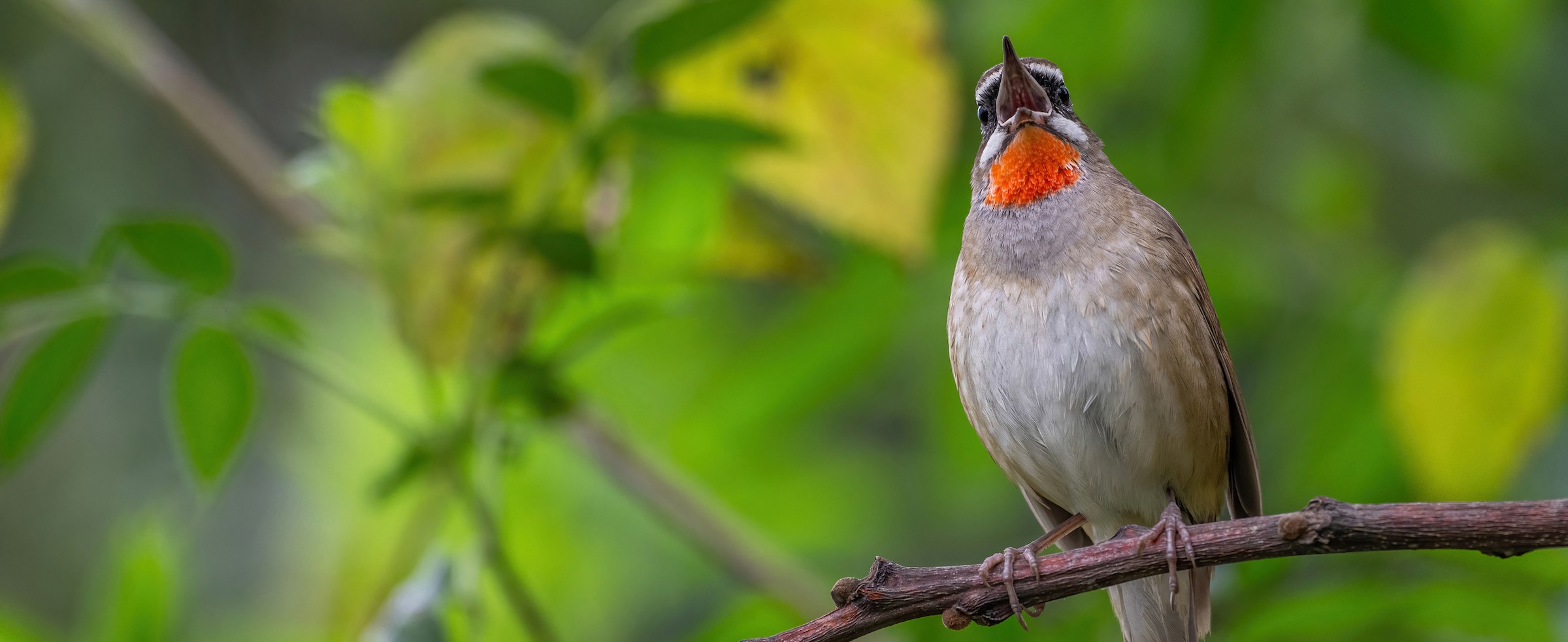
Banner photo credits

Linda Alley - male Painted Bunting

Greg Lavaty - female Painted Bunting