Great Questions about Pigeons
What is a Pigeon?
Common name: Rock Pigeons
Scientific name: Columba livia ("columba" is
Latin for dove or pigeon; "livia" means blue or blue-gray color)
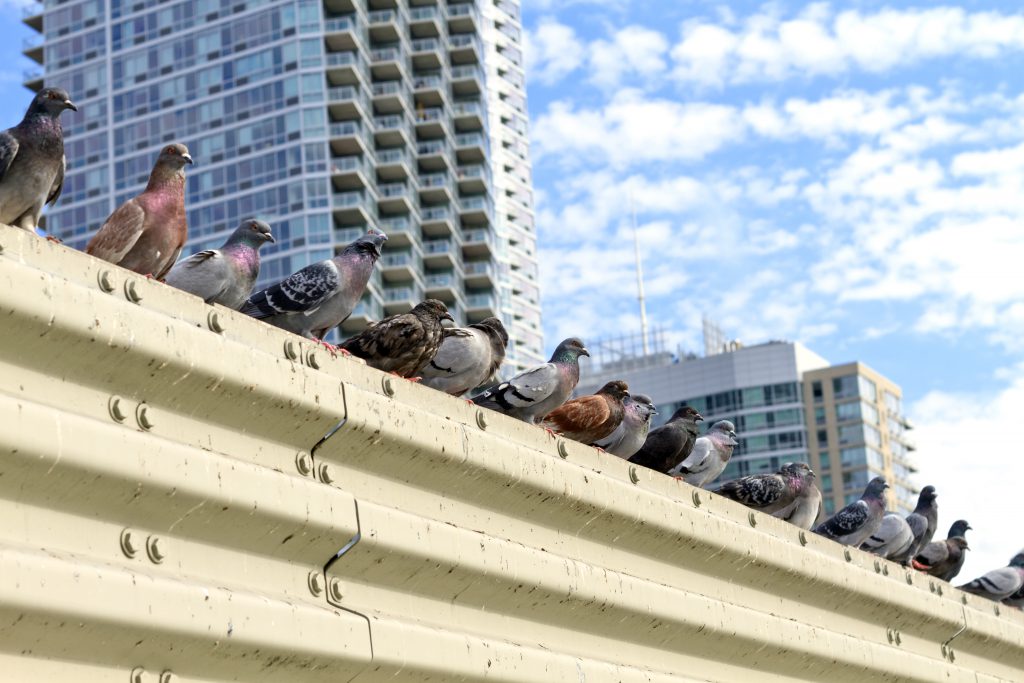
Rock Pigeons originated in Africa, Asia, Europe, and the Middle East. Some of these pigeons were eventually domesticated by humans. They arrived in North America with Northern Europeans who settled in Nova Scotia, Canada, in the early 1600s. Some of these Rock Pigeons established populations in cities and towns. Escaped racing and homing pigeons also may contribute to these pigeon flocks. Because Rock Pigeons in North America (and many other continents) are from populations established by escaped domestic pigeons, we refer to them as feral pigeons. The term "wild" is reserved for pigeon populations that were never domesticated and still live in their native habitats.
What’s the difference between a pigeon and a dove?
Not much. 'Pigeon' is from French, pijon, and 'dove' is an
English word. When some people hear the word "pigeon," they think of a
pest, a "winged rat." When they hear the word "dove," they may think of
a symbol of peace and love. But white doves of peace are simply white
pigeons. Remember, until recently, feral pigeons were also called Rock
Doves. Doves sometimes are considered smaller than pigeons, but this is
not always the case. Pigeons and doves are all members of the family
Columbidae, which includes 303 species worldwide. Forty-seven
living species, plus one extinct species, are listed for North and
Central America. The Passenger Pigeon, Ectopistes migratorius,
is extinct.
Do other species of pigeons or doves, besides Rock Pigeons, live near me?
Probably! Check out All About Birds to see what species of pigeons and doves are present throughout the continent.
Some species that can be seen in North America are:
Mourning DoveFound throughout most of North America.
Eurasian Collared DoveIntroduced into the Bahamas in the mid-1970s, it is now found throughout the southeastern United States and has been seen across the continent.
Inca DoveA common resident of urban areas of the Southwest
Ringed Turtle-DoveA domesticated dove. It frequently escapes from captivity, and feral populations have become established in some cities in the southern United States.
White-winged DoveFound in the Southwest United States and tropics. An introduced population has become established in Florida.
Common Ground-DoveThe smallest dove in the United States, the Common Ground-Dove is a bird of the southern United States and tropical America. Aptly named, it feeds and nests on the ground.
White-crowned PigeonFound in islands and coastlines in the Caribbean and can be seen in southern Florida.
Band-tailed PigeonThis large pigeon looks a lot like the introduced Rock Pigeon but it's a native. The Band-tailed Pigeon is found in the American West as well as throughout Central and South America.
What species of North American pigeon is extinct?
Passenger Pigeons (scientific name Ectopistes
migratorius) once flew in flocks of thousands. About two to three
billion Passenger Pigeons ranged across eastern North America;
they may have been the most numerous bird species in history. But they
were hunted to extinction for meat, sport, and by farmers who were
protecting their crops from the huge ravenous flocks. The last
Passenger Pigeon died at the Cincinnati Zoological Garden in September,
1914.
How long do pigeons live?
Pigeons can live about five years in the wild. They sometimes live for more than 15 years when raised by people.
What good are feral pigeons?
Think about what cities would be like without the help of feral pigeons. These birds are flying street cleaners. They gobble up tons of bread, popcorn, and other human leftovers each year. And pigeons have become part of the urban landscape around the world. They provide many city dwellers with beauty and companionship.
Are feral pigeons dirty? Do they carry diseases?
Pigeons have a bad reputation in cities. Some people think they’re
dirty and harbor diseases. But city birds know how to keep clean. You
can often see them taking baths. Pigeon droppings can create problems
on buildings or statues if allowed to accumulate in large amounts. The
droppings also can harbor diseases unless they are regularly washed
away. Cleanliness is key. If you handle pigeons, be sure to wash your
hands afterwards, just as you would after handling any wild
animal.
In response to questions about the effects of pigeons on human health,
in 1986 the Association of Pigeon Veterinarians issued a statement that
concludes, "…to our knowledge, the raising, keeping, and the exercising
of pigeons and doves represents no more of a health hazard than the
keeping of other communal or domestic pets." A spokesman for the
American Pigeon Fanciers Council says this statement applies to feral
pigeon flocks, too. He says the homing and racing pigeons that people
raise stay healthy even though they often come into contact with feral
pigeons.
How can you tell males from females?
You can’t always do it. Pigeon males and females look almost exactly
the same. In general, males are more colorful, with more
iridescence. Some female pigeons may be duller in coloring
or smaller than their mates.
Interesting Note:
Odd-colored birds of a species get picked-off more easily by
predators. In general, if a predator spots a bird that stands out from
the rest, they will try to catch it more often than the birds that
blend in.
What do pigeons eat?
Seeds, berries, fruit, insects, grain, garbage, etc..
Why don't I ever see any baby pigeons?
You may already have seen newly fledged young pigeons but didn't recognize them. They look much like adults, but younger nestling pigeons are more difficult to see. Adult pigeons build nests in hard-to-reach places, such as covered crevices along building ledges, in the nooks and crannies of building beams and rafters, or in hidden-away places under bridges. You can find these birds nesting just about anywhere in the urban environment that resembles the caves and sea cliffs of their natural environment in Europe, the Middle East, and northern Africa.
During their first week of life, the well-hidden baby pigeons are fed a high-fat, high-protein diet of crop milk produced by both parents. They grow very fast. They walk well at about 18 days of age and start exercising their wings about a week later. But because they have been regularly fed by the adults and haven't done much exercising, the birds are often bigger than their parents by the time they start to fly, which is on average 30 to 32 days after hatching.
Some young pigeons, or squabs, might venture away from the nest site before fledging, but most stay close to home. So we humans aren't likely to lay eyes on a juvenile pigeon until it is full-grown. maybe even temporarily a little plumper than its parents, and has taken flight and begun to scrabble for food with other city pigeons.
Watch pigeons up close this spring! Distinguish the young from the adults:
* Look at their ceres. The heart-shaped growth at the top of the pigeon's beak, the cere, is dull and grayish in young birds and white in adults.
* Look at their eyes. The eyes of a young bird are brown. The eyes of an adult bird are orange to orange-red in color.
Why don't pigeons perch on trees like other birds? Why do they like buildings?
Pigeons will perch on trees, but they are better adapted to the man-made surfaces in urban areas. That's because human-made structures are good substitutes for the cliffs and ledges of the birds' natural habitat.
What's going on when a pigeon puffs up and struts around?
The puffed-up, strutting bird is a male pigeon courting and showing off for a female. Males fluff their iridescent neck feathers, reflecting shimmering green, bronze, and purple; they spread their tail feathers; they parade or dance in a circle around the female; they coo loudly. This courtship behavior may lead to mating or it might serve to strengthen the lifelong bonds of an already-mated pair.
Although you can see pigeon courtship all year long, it peaks in springtime in urban areas around the globe.
Where do pigeons nest?
Pigeons nest in all kinds of places! Nooks and crannies in buildings, bridges, and other places that mimic their natural 'cliffside' habitat. Pigeons might lay their eggs on an air conditioning unit on the window of a city building or on the floor of a balcony. Their nests are skimpy -- sometimes they might lay their eggs on bare floor or in a pot.
Book recommendation: A great book about where birds nest is: Urban Roosts: Where Birds Nest in the City by Barbara Bash (Author), Sierra Club Books (Author)
How long does it take for pigeons to leave the nest?
Pigeons incubate their eggs for approximately 18 days. It takes approximately 30 days after hatching for the young to leave the nest.What are pigeons' predators?
Humans, cats, Peregrine Falcons, Merlins, Red-tailed and Cooper's Hawks.