Staff
| Spring Field Ornithology is taught
by Steve
Kress, Vice President of Bird Conservation for the National
Audubon Society, as well as guest lecturers from the Lab of Ornithology
and a dozen highly-experienced field trip
leaders. Erica Marx is the
Course Coordinator and Sandy
Podulka is the field trip organizer. Many Lab staff devote guidance, support, and time to Spring Field Ornithology Class. Cornell staff members that have or currently contribute to the course include Rick Bonney, Director of Program Development and Evaluation; Dr. Kimberly Bostwick, Curator of Ornithology & Mammalogy at the Cornell Vertebrate Collections; Dr. John Fitzpatrick, Director of the Lab of Ornithology; Dr. Ken Rosenberg, Director of Conservation Science; Chris Wood, Project Leader of eBird; and Dr. David Winkler, Professor in the Department of Ecology & Evolutionary Biology at Cornell.
Stephen W. Kress is
Vice President for Bird
Conservation for the
National Audubon Society and Director of the Society's Maine Coast Seabird
Sanctuaries. He is a Visiting
Fellow at the Cornell Lab of Ornithology. He is also the
author of
many popular birding
books, including The Audubon
Guide to Attracting Birds, The National Audubon Society's Birder's
Handbook, The Bird Garden, Project Puffin: How We Brought Puffins Back
to Egg Rock, Saving Birds, Golden Guide to Bird Life, and
others.
Erica is in charge of day-to-day course operations including registrations, publicity, organizing and updating materials for lectures and field trips, planning the overnight field trips, and developing web content. Erica also works closely with several volunteers to improve the course. She was a student in Spring Field Ornithology in 1996. Erica holds a master's degree in Interdisciplinary Ecology from the
University of Florida and a bachelors degree in Natural
Resources from Cornell University. She is a lecturer in the
Biology Department at Ithaca College and coordinates birding programs
at the Audubon Camp in Maine on Hog Island for the
National Audubon Society. Prior to taking this position she
managed a reforestation project in the Ecuadorian Amazon.
Sandy coordinates the field trips
sections of the course. She chooses field trip leaders and organizes
leaders and participants into groups. She received a B.S. in Wildlife
Biology from Cornell University and an M.S. in Zoology (Animal
Behavior) from the University of Maryland, where she studied the
function of song repertoires in Song Sparrows. Sandy is also one of the
editors of the Lab's Home Study Course in
Bird Biology, 2nd
Edition. SFO Field Trip LeadersSpring Field Ornithology's field trip leaders vary from year to year, but each and every one of them plays an important role in the success of the course's field trips section. They are chosen because they are among the most knowledgeable, experienced birders in the Cayuga Lake Basin.
Bill Baker is an
enthusiastic local birder. He has taken SFO in the past, and
shortly after obtaining course alumni status, was asked to join the
staff. Nine out of ten students agree - Bill is a top-notch staff
member!
Jeff originally hails from northern Indiana where he became interested in birds and birding at the age of 9. He received a B.S. in Wildlife Management from Purdue University and has spent most of his time since working in the computer industry and watching birds. In early 2001, he and his family moved from the Texas heat to Ithaca where he is a programmer with the Information Science group at the Lab of Ornithology.
Meena, a former officer for the Cayuga Bird Club, has worked as a Research Associate within the Bird Population Studies group at the Cornell Lab of Ornithology. Meena especially impresses us with her ability to locate and imitate birds in the field. In addition to her birding expertise, she also enjoys sharing her knowledge about other subjects (such as butterflies and astronomy) with the Spring Field Ornithology field trip participants.
After graduating from Cornell, Tom has enjoyed road trips around North America as well as southern South America learning about bird distribution and identification. His interest in birds stems from a love of migration, and he is involved in research projects attempting to understand the peculiarities of migration in the Northern Saw-whet Owl and the Lesser Black-backed Gull. Tom grew up birding in Pennsylvania and is currently a member of the Pennsylvania Ornithological Records Committee and the New York State Avian Records Committee.
Stephen W. Kress is Vice President for Bird Conservation for the National Audubon Society and Manager of the Society's Maine Coast Seabird Sanctuaries. He is a Visiting Fellow at the Cornell Lab of Ornithology.
Kevin is a co-editor of the 2nd New
York State Breeding Bird Atlas, based at the Cornell Lab of
Ornithology. He was a
creator of the Lab's All About
Birds website. Kevin has been interested in birding
since he was a child. He has traveled throughout North America, as well
as to Europe, Central America, South America, and Africa, watching and
studying birds. He has led birding field trips for groups of all skill
levels in Ohio, New York, New Jersey, Florida, Hawaii, Costa Rica, and
Peru. He is a past president of the Cayuga Bird
Club, a past president and
former webmaster for the New York State
Ornithological Association,
and a former member of the New York State Avian
Records Committee (NYSARC). Kevin was formerly a member of the
Lab of Ornithology birding
team, The Sapsuckers, who compete in the World Series of Birding in New Jersey each May.
Bob McGuire is an avid birder and longtime SFO student. After years of Bob participating in the SFO field trips as an advanced-level birder, we finally persuaded him to lead a few field trips in 2005. Recently retired from Rock Stream Studios (his company made audiokinetic sculptures - ball machines), he spends much of his time recording bird vocalizations.
Ann signed up for the Lab's Spring Field Ornithology course in 1998 and immediately became hooked on birds. After taking the SFO field trip sections for a couple years, she joined the Cayuga Bird Club where she is an active member. Ann has been a volunteer for Project Puffin and the Breeding Bird Atlas. She starts each year by participating in the Christmas Bird Count. Most weekends she can be found somewhere around the Cayuga Lake basin with her binoculars in hand. Each fall, time permitting, Ann enjoys visiting the Cape May, NJ area.
In a Lorenzian ethology experiment gone awry, Dave Nutter imprinted on birds as a child. For years he has led trips for this course as part of his ongoing rehabilitation into human society. Growing up in suburban Maryland, he attributed his sanity to the amount of time spent in Rock Creek Park a few blocks from home. Dave began birding by taking a course for kids (that was very similar to Spring Field Ornithology) through the Smithsonian Associates in Washington, DC. This was back when Peterson Guides had black-and-white plates interspersed among text. The course was run by John Trott, an educator who believed that kids learn best from their peers. Dave was next a student and teacher at the George Whittel Field Ecology Center of the Audubon Naturalist Society of the Central Atlantic States under one of Trott's disciples, Holly Wagner, with whom he later helped teach the same Smithsonian Associates course. For Dave, this course is not simply a way to learn about birds, it is a glimpse at the incredible variety of life with which we share this planet. Indeed, finding the birds again every spring is reassurance that we do still share the planet.
In addition to being a field trip leader, Sandy is also the coordinator of field trip leaders for the course. She received a B.S. in Wildlife Biology from Cornell University and an M.S. in Zoology (Animal Behavior) from the University of Maryland, where she studied the function of song repertoires in Song Sparrows. Sandy is also one of the editors of the Lab's Home Study Course in Bird Biology, 2nd Edition.
Bruce has been an SFO field trip leader since 1994. Although his professional interests are not affiliated with ornithology—he’s an associate professor of management at Cornell’s Hotel School—he spends a great deal of time running around the Cayuga Lake area and elsewhere chasing whatever is coming through.
Michael Andersen led trips as a student in Cornell University's Department of Natural Resources. He started watching birds on Cape Cod, Massachusetts at the age of twelve. His passion and excitement for birding is as varied as the birds themselves. He has always found enjoyment in photography, traveling, and studies of bird identification. More recent endeavors have seen him dabbling in butterfly and dragonfly watching. As always, Michael loves to share his enthusiasm for birds and nature with others and is excited to come back for repeated seasons as a SFO field trip leader.
Jai is an avid birder and spends most
of his spare time watching birds. In the Summer of 2001, he spent a few
weeks on an island off the coast of Maine, working with Steve Kress as
a research intern for the Seabird Restoration
Program with
the National Audubon Society. In 2001 he was the winner of the McIlroy (birding competition)
Award, held in Ithaca,
NY.
Gladys was introduced to birding
while in college. She loved what she was seeing, and found it was a
wonderful way to relax. Shortly
after taking Spring Field Ornithology, she joined the Cayuga Bird Club. She enjoys participating in the local bird
counts, such as the Christmas Bird
Count; the Ithaca June Count;
and the Great Backyard Bird
Count. Gladys says "I love
traveling and birding in new areas and habitats. Learning birds by
sight and sound really opens up the world in ways I hadn't realized
before I avidly birded. And, there is so much other wildlife that you
encounter while birding." Gladys is currently participating in the
second Breeding Bird
Atlas, a project of
the Federation of NYS Bird Clubs and the NYS DEC. By day she works at Cornell's Dairy Cattle Research
Facility. She enjoys leading
trips, because she knows how thrilling it can be to see a new birds for
the first time.
Mark Chao has been one of Ithaca's
more active birders since moving here in 2001. Though he birds
everywhere, Mark has a special fondness for Sapsucker
Woods, where he has seen more
than 170 species. Past SFO participants have widely noted Mark's
enthusiasm and his uncanny knack for remembering people's names. Mark's
profession is promoting energy efficiency; he serves as the senior
staffer for the Institute for Market
Transformation, a nonprofit
environmental organization that he helped to found in 1996. He and his
wife Miyoko Chu (Science Editor at the Lab of Ornithology) have two
young children.
Ben is employed with the Cornell Lab of Ornithology's Macaulay Library Visual Media Collections as a Video Archivist, editing and archiving video footage of birds. He began birding at the age of twelve, in the foothills of the Berkshires in northwestern Connecticut. He is an active birder in the Cayuga Lake Basin.
Laura Erickson is the Science Editor at the Lab. She’s been an avid birder since she used two field guides and a recording to identify her first Black-capped Chickadee on March 2nd, 1975. She’s birded over much of the United States and also in Costa Rica, Ecuador, Guatemala, Mexico, and Trinidad and Tobago, but spring migration is still her favorite birding experience of each year. She writes regularly for Birder’s World and is author of 101 Ways to Help Birds, For the Birds: An Uncommon Guide, and Sharing the Wonder of Birds with Kids. She once was a winner in the American Ornithologists' Union's bird-calling contest in the repertoire category for her owl calls.
Bob Fogg is a local birder who
volunteered his time in order to lead some field trips for the 2002
Spring Field Ornithology Course.
Dan is a Research Climatologist
at Cornell's Northeast Regional Climate
Center with an avocation in
birding that spans nearly 15 years. As an undergraduate he assisted a
professor in field study of vireos and has participated in Citizen Science programs of the Cornell Lab of
Ornithology. He has led
several bird walks in various venues. From having grown up in
the Southern Appalachian Mountains, his favorite group of birds is the wood
warblers.
Dr. John Greenly is a physicist and
musician at Cornell University. He has loved birding for more than 30 years,
across North America, in Europe, Central America and Asia. He has been
leading SFO field trips for more than 10 years, and looks forward to
every new SFO year as a wonderful springtime ritual, seeing again the
tremendous rivers of birds flowing back into our part of the world for
another breeding season. He also treasures the pleasure of helping to
introduce new people to the amazing life of birds.
Scott Haber has served
as Vice President of
the Cornell Student Birding Club. He has been an avid birder for many years, and
has particularly enjoyed leading field trips locally for both SFO and
the Cayuga Bird Club, as well as participating in Ithaca birding
traditions such at the David
Cup. Scott also volunteers as
a curatorial associate at the Cornell Museum of Vertebrates, which has led to a broad interest in birds
of the new world tropics. He has spent a good deal of time birding all
over the United States, as well as in Argentina, Costa Rica, Ecuador,
and England.
Stefan Hames is a Research Associate
in the Conservation
Science department at the Lab
of Ornithology, where he
studies the effects of habitat loss and fragmentation, as well as the
effects of pollution, on forest birds. Stefan got his start in
ornithology as a volunteer hawk counter, trapper, and bander at
the Golden Gate Raptor Observatory
for six migration seasons and studied
forest-nesting hawks in Tompkins County as a part of his doctoral
dissertation. He is interested in ALL birds, but really likes
hawks.
Wes is a Research Associate and Data
Analyst with the Lab's Bird
Population Studies program. Despite his busy writing schedule, he
sometimes has time to lead a trip or two for SFO.
Pete was a student in
the Natural
Resources department at
Cornell. He has been birding since he was in middle school. Pete has
been involved with several ornithology projects as an undergrad,
including Tree Swallow biology in Ithaca with Dr. David Winkler, and
Snow Goose habitat degradation in the Canadian Arctic. His academic
interests include neotropical ornithology, conservation, and movements
of seabirds. Pete is planning to pursue a Ph.D and become a
professor.
In addition to leading field trips,
Steve is also the main Course Instructor for Spring Field
Ornithology.
Lynn has been birding since her early
30s—some 30 years, though she says that she often still feels like a
beginner around the likes of the Cornell Sapsuckers birding team! She says "It's fun going
out with new-to-birding folks, because it helps me remember the
excitement I felt when first begin spotting and identifying species on
my own. That first loon or merganser or Ferruginous Hawk was a great
experience. Birding keeps me alert to what's happening around me. It's
shocking to see how poorly connected most people are to their natural
world—how much they miss. As long as my eyesight and hearing are still
pretty sharp, I'll always be happy to lead some field trips for
SFO!"
Jay McGowan has been an active birder in our area for some time. He is a past recipient of the Lillian Stoner Award (which he won in 2004, in honor of his leadership among bird enthusiasts and his accomplishments as a birder and digiscoping pioneer) and along with his father Kevin, was previously a member of the Digiscoping Hawks, a fledgling World Series of Birding team that came in 7th place in 2006 (their first year) for digitally photographing the highest number of species (124 in 24 hours) through a spotting scope. For 2007, Jay opted to join the Lab's student birding team, The Redheads.
Harold was formerly a computer programmer in the Bioacoustics Research Program at the Cornell Lab of Ornithology. Since joining the Lab Staff in 1994, he developed a strong interest in birds, both recreational and scientific. He enjoys sharing this interest with others, and especially beginning birders.
Jason has worked in the Natural
History museum at the University of Kansas, studied the behavior of loons in Michigan's
Upper Peninsula, and worked
with a diversity of bird species in Panama, Colombia, Venezuela, and
Brazil. He came to Cornell from the University of California,
Berkeley, where he earned his
Ph.D. studying the evolutionary history of tyrant flycatchers. Jason
was previously employed with the Lab as a Home Study
Course Instructor and
Research Associate. He also served as Interim Director for the
Lab's Education Program. In addition, he leads field trips for SFO.
His expertise and enthusiasm for sharing knowledge about birds make him
a perfect fit as a field trip leader for any student wanting to know
more about birds.
Mike is a Wildlife Ecologist who is
the leader for Audubon's grassland bird project. He has an office at
the Lab of Ornithology. Mike earned his Bachelor's degree in Fisheries
and Wildlife from Utah State University in Logan, UT, and then attended
SUNY Brockport while earning his Master's degree.
Tom has
led several birding trips for Spring Field Ornithology over the past
few years.
Bill Ostrander is vice-president of
the Chemung Valley Audubon
Society, the Finger Lakes
Region editor for The Kingbird
(journal of the Federation of New York State Bird
Clubs), and a FNYSBC board
member. Bill received a B.S. in Wildlife Science
from Cornell University,
worked for 14 years as a naturalist at Tanglewood Community Nature Center
in Elmira, and is currently a GIS
Technician for Weiler Mapping,
Inc.
Mike is a notable local birder who
works at the Lab of Ornithology. He has led several field trips for Spring
Field Ornithology.
Alan is a Research Associate at the Lab of Ornithology, where
he edits the Birds of North America (BNA), an 18
volume series documenting the life histories of our continent's
breeding birds. Before BNA, Alan worked on Atlantic coastal birds,
particularly terns and Ospreys, and wrote a
life history of Ospreys for Cambridge University Press. His
interests lie in life history aspects of birds, and he likes to
encourage students to think about where a particular species has been,
where it might be going to, as well as what it eats, where it nests,
and how it raises its young. Alan signed on as a Field Trip Leader for
SFO in 2004.
Mike works in the Conservation Science department at the Cornell Lab of
Ornithology on projects using
acoustic monitoring, including searching for the Ivory-billed
Woodpecker and studying
flight calls given by nocturnal migrants. He has enjoyed studying birds
in many different areas and habitats over the years, but his current
passion is birding closer to home with his daughter, Reina (who, like
all three-year olds, is a budding naturalist).
Bard's professional career was in
visual arts education, however he has watched, drawn, studied and
otherwise enjoyed the natural world as long as he can remember. As an
active member (and club president for 2 terms) of the Cayuga Bird Club since 1991, Bard has regularly lead club field
trips, initiated the construction and installation of the Osprey nest
platform at Dryden Lake, compiled and presented the "Cayuga Birdline"
for 2-3 years, and has also coordinated the Dryden portion of
the CBC Christmas and
June bird counts. During the spring in 1998 and 1999, he scouted
portions of New Jersey for the (Cornell) "Sapsuckers" birding team. Bard is also a Regional
Coordinator for Region 3 of the 2000 NYS Breeding Bird Atlas
Project, and serves on the
Atlas Steering Committee, chairing its Illustration
sub-committee.
Ron is the Acting Director of the Conservation Science program at the
Lab of Ornithology. Ivory-billed Woodpecker Research
Project. Ron holds B.S. and M.S. degrees in Wildlife Biology
from Penn State University, and much of his research has been focused
on the breeding biology of American Kestrels, grassland ecology, and
using citizen science to study and monitor bird populations. In
addition, Ron is also one of the main editors of the Lab's Home Study Course in Bird Biology.
In his "spare time" he sometimes leads field trips for Spring Field
Ornithology.
Ken is the Director of Conservation
Science at the Lab of Ornithology, where he oversees
several Citizen
Science projects focused on bird conservation issues, as
well as the search for the Ivory-billed Woodpecker. Ken is an active
leader in Partners in Flight and other national and international
bird-conservation initiatives. In addition to being an excellent field
trip leader and former member of the Cornell Lab's famous Sapsuckers birding team. Ken has also been
a longtime guest speaker for Spring Field Ornithology's annual songbird
conservation lecture.
Dave has been birdwatching for over
25 years. During this time he has traveled to every county of New York
State looking at birds, and boasts a New York list of over 300 species.
Currently he is the Statistician for the Chemung Valley Audubon Society, and keeps records of all bird sightings in
the Chemung Valley, as well as organizes all field trips, bird counts,
and other special events. Dave also maintains the club's web site and
listserv. In his "spare" time, he is also a Region 3 Co-Coordinator of
the current NY Breeding Bird Atlas
Project. Duties include
assigning blocks to volunteers, compiling data, editing reports, and
recruiting more volunteers.
Marty Schlabach is the former
Director of the Cayuga Bird Club,
former Spring Field
Ornithology student, and a
great SFO field trip leader!
Laura's not only the proud owner of a
yard that is a fantastic habitat for Barred Owls, she is also a great
field trip leader for Spring Field Ornithology. To find out more about
Laura, visit her Evoluntionary Biology
Program info page.
Brian Sullivan was formerly the
project leader for eBird, an online database developed by the Lab of
Ornithology and the
National Audubon Society.
An avid birder in
the Cayuga Lake basin area for some time now, Ben Taft has also led
field trips for Spring Field Ornithology on occasion.
Chris is a favorite among field trip leaders and has been leading trips for some time. He took some time off in 2002 in order to spend some time with his daughter Aleta and his wife (The Lab's Graphic Designer) Diane, but we are hoping he will return to lead additional trips in future years. Chris also works with the Bioacoustics Research Program of the Lab of Ornithology.
Mark is one of SFO's newer field trip
leaders. A Zoology major, he received his Bachelor's Degree from
Colorado State University, his Master's Degree from Texas A & M, and his PhD from Cornell
University. He has taught
biology, and much of this research has dealt with studying the
nutritional ecology of fruit-eating birds (basically, understanding why
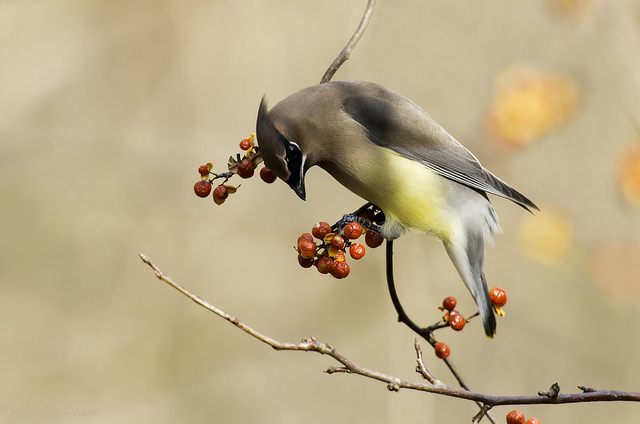
birds, especially Cedar Waxwings, eat particular fruits). Mark enjoys
watching birds in his spare time - when he is not busy fishing, maple
sugaring, golfing, or gardening!
Rachel works in the Evolutionary Biology Program at the Lab of
Ornithology where she uses genetic
tools to examine conservation problems facing birds. Her primary
research interests lie in the fields on behavioural ecology and
conservation genetics. She is currently conducting research on the
genetics of avian hybridization, and has a particular interest in
Golden-winged and Blue-winged Warblers. She has taught bird capture and
banding workshops for many years, and has instructed an undergraduate
field course entitled "Behavioural Ecology and Conservation Biology of
Birds". She has been a keen birder since her early undergraduate days
in Canada and has welcomed the opportunity to bird the Cayuga Lake Basin in recent years.
Matt is an avid birder in the Central
New York area who has led several field trips for Spring Field
Ornithology since 1998. He has a Master's Degree in Ornithology, and
has taught his own field ornithology class (as well as other nature
classes) at Lime Hollow Center for
Environment & Culture where is also acting president of their bird
club. Matt won back to back David Cups
(Cayuga Lake Basin Birding competition) and nominated Summerhill,
Bear Swamp, and Great Swamp Conservancy (which was his masters research
site) as Audubon Important Bird
Areas. He has also worked
with at-risk teens at George Jr. Republic as a program director in addition to trying to
implement an outdoor education/wilderness therapy program. He is also
noted as the founder of 2 Finger Lakes Land Trust Preserves, 1 Cornell
Natural Area Preserve and is land steward for Dorothy McIlroy Bird
Preserve. Matt is currently employed with the Cornell Lab
of Ornithology's Macaulay
Library. |