
Updates and Corrections—October 2025 (Page 3)
Changes to Groups
New groups in Elegant Crested-Tinamou Eudromia elegans
Summary: (0→2 groups)
Details: Clements v2025 taxa 49–61
Two new groups are formed for Elegant Crested-Tinamou Eudromia elegans:
- Elegant Crested-Tinamou (Northern) Eudromia elegans [intermedia Group]
- subspecies intermedia, magnistriata, and riojana
- Elegant Crested-Tinamou (Southern) Eudromia elegans [elegans Group]
- subspecies albida, wetmorei, devia, numida, multiguttata, elegans, and patagonica
Graphical abstract:

New groups in Andean Tinamou Nothoprocta pentlandii
Summary: (0→2 groups)
Details: Clements v2025 taxa 92–102
Two new groups are formed for Andean Tinamou Nothoprocta pentlandii:
- Andean Tinamou (Northern) Nothoprocta pentlandii [oustaleti Group]
- subspecies ambigua, oustaleti, and niethammeri
- Andean Tinamou (Southern) Nothoprocta pentlandii [pentlandii Group]
- subspecies fulvescens, pentlandii, patriciae, doeringi, and mendozae
Graphical abstract:

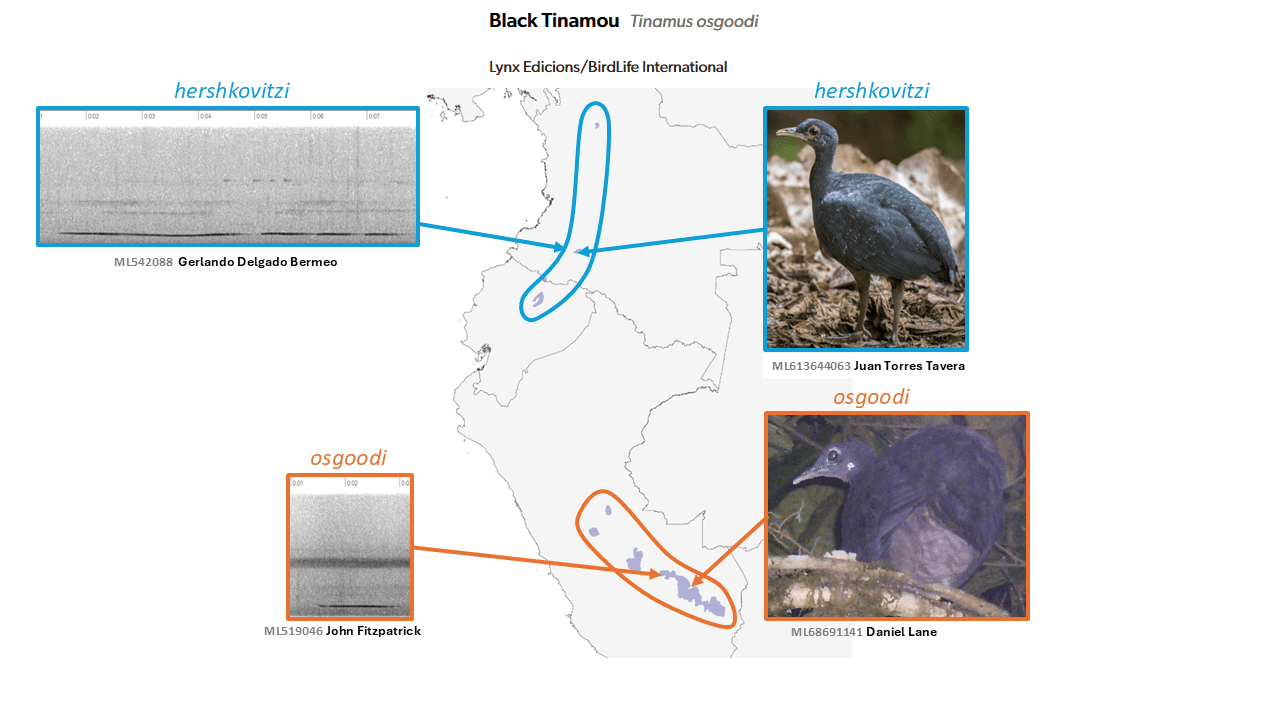
New groups in Black Tinamou Tinamus osgoodi
Summary: (0→2 groups)
Details: Clements v2025 taxa 146–148
Two new groups are formed for Black Tinamou Tinamus osgoodi:
- Black Tinamou (Colombian) Tinamus osgoodi hershkovitzi (monotypic)
- Black Tinamou (Peruvian) Tinamus osgoodi osgoodi (monotypic)
Graphical abstract:
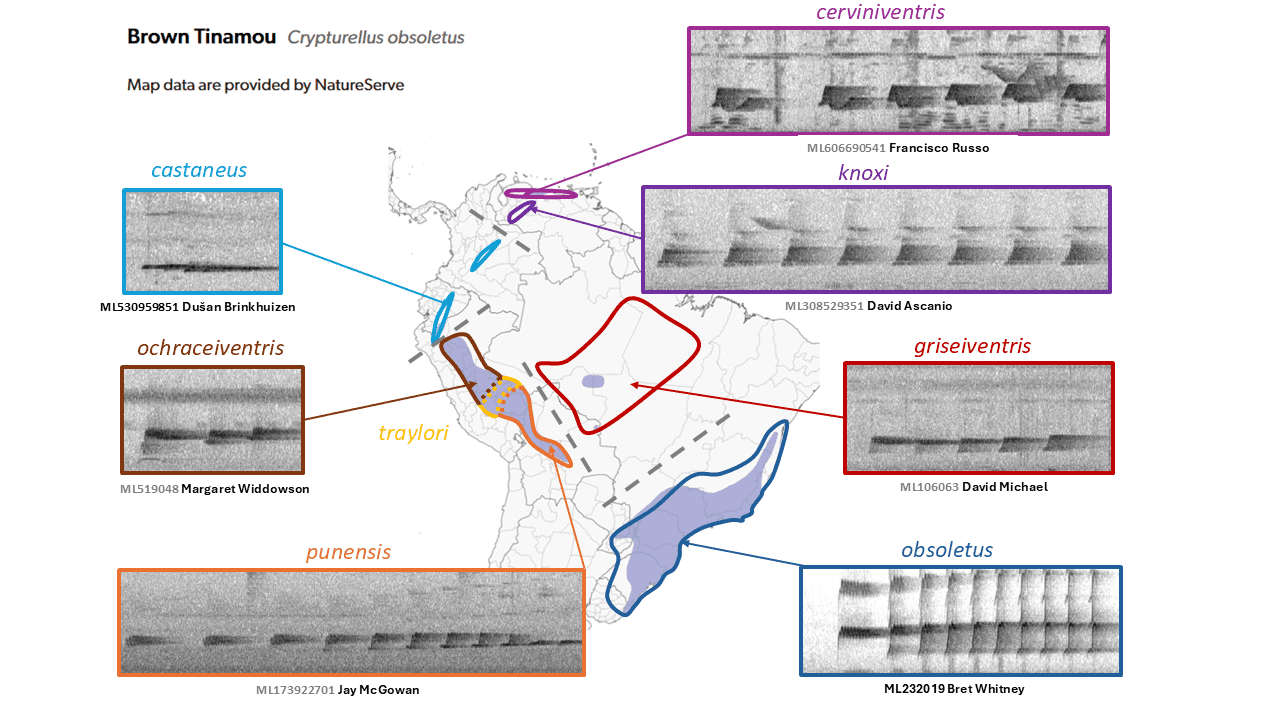
New and redefined groups in Brown Tinamou Crypturellus obsoletus
Summary: (2→5 groups)
Details: Clements v2025 taxa 159–169
Three new groups are formed and one group redefined for Brown Tinamou Crypturellus obsoletus:
- Brown Tinamou (Venezuelan) Crypturellus obsoletus cerviniventris/knoxi
- subspecies cerviniventris and knoxi
- Brown Tinamou (Ecuadorian) Crypturellus obsoletus castaneus
- Brown Tinamou (Andean) Crypturellus obsoletus [punensis Group]
- subspecies ochraceiventris, traylori, and punensis
- Brown Tinamou (Amazonian) Crypturellus obsoletus griseiventris (monotypic)
- Brown Tinamou (Atlantic) Crypturellus obsoletus obsoletus (monotypic)
Graphical abstract:

New groups in Taiga Bean-Goose Anser fabalis
Summary: (0→2 groups)
Details: Clements v2025 taxa 301–305
Two new groups are formed for Taiga Bean-Goose Anser fabalis:
- Taiga Bean-Goose (Western) Anser fabalis fabalis/johanseni
- subspecies fabalis and johanseni
- Taiga Bean-Goose (Eastern) Anser fabalis middendorffii (monotypic)
Graphical abstract:

New groups in Torrent Duck Merganetta armata
Summary: (0→4 groups)
Details: Clements v2025 taxa 468–476
Four new groups are formed for Torrent Duck Merganetta armata:
- Torrent Duck (Colombian) Merganetta armata leucogenis/colombiana
- subspecies leucogenis and colombiana
- Torrent Duck (Black-bellied) Merganetta armata turneri (monotypic)
- Torrent Duck (Bolivian) Merganetta armata garleppi/berlepschi
- subspecies garleppi and berlepschi)
- Torrent Duck (Patagonian) Merganetta armata armata (monotypic)
Graphical abstract:
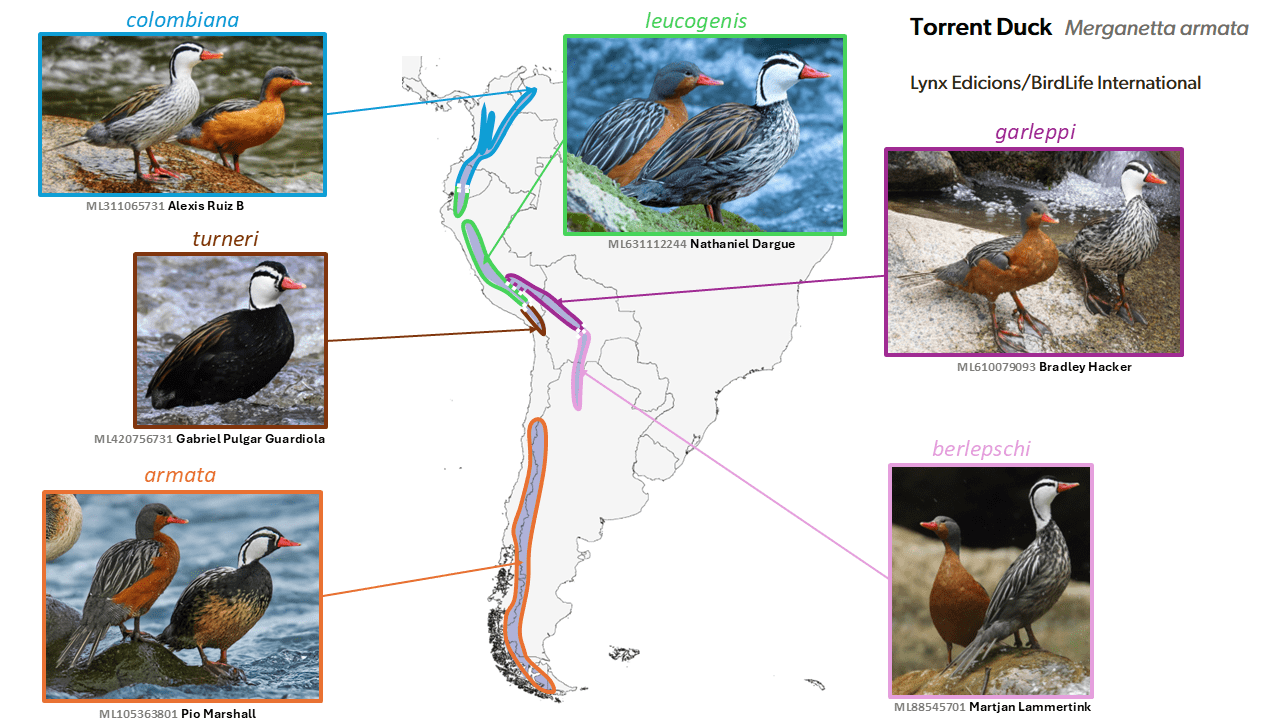
Notes: The northern colombiana has been considered a separate species from southern armata, with the remaining taxa considered a single species, leucogenis (Hellmayr and Conover 1948; see SACC Anseriformes note 8b), and molecular analysis showed deep divergences between the same three groups, suggesting that three species may be involved (Gutiérrez-Pinto et al. 2019), and that at least an adjustment to these groups is needed. However, it appears that the distinctive turneri of southern Peru and far northern Chile was not sampled in Gutiérrez-Pinto et al. (2019).
New groups in Sickle-winged Guan Chamaepetes goudotii
Summary: (0→4 groups)
Details: Clements v2025 taxa 855–861
Four new groups are added for Sickle-winged Guan Chamaepetes goudotii:
- Sickle-winged Guan (Santa Marta) Chamaepetes goudotii sanctaemarthae (monotypic)
- Sickle-winged Guan (West Andean) Chamaepetes goudotii goudotii/fagani
- subspecies goudotii and fagani
- Sickle-winged Guan (East Andean) Chamaepetes goudotii tschudii (monotypic)
- Sickle-winged Guan (South Andean) Chamaepetes goudotii rufiventris (monotypic)
Graphical abstract:

New groups in Band-tailed Guan Penelope argyrotis
Summary: (0→2 groups)
Details: Clements v2025 taxa 873–877
Two new groups are formed for Band-tailed Guan Penelope argyrotis:
- Band-tailed Guan (Santa Marta) Penelope argyrotis colombiana (monotypic)
- Band-tailed Guan (Band-tailed) Penelope argyrotis argyrotis/albicauda
- subspecies argyrotis and albicauda
Graphical abstract:

New groups in Andean Guan Penelope montagnii
Summary: (0→2 groups)
Details: Clements v2025 taxa 900–907
Two new groups are formed for Andean Guan Penelope montagnii:
- Andean Guan (Northern) Penelope montagnii [montagnii Group]
- subspecies montagnii, atrogularis, and brooki
- Andean Guan (Southern) Penelope montagnii sclateri/plumosa
- subspecies sclateri and plumosa
Graphical abstract:

New groups in Spot-bellied Bobwhite Colinus leucopogon
Summary: (0→3 groups)
Details: Clements v2025 taxa 1057–1065
Three new groups are formed for Spot-bellied Bobwhite Colinus leucopogon:
- Spot-bellied Bobwhite (White-breasted) Colinus leucopogon hypoleucus/incanus
- subspecies hypoleucus and incanus
- Spot-bellied Bobwhite (White-faced) Colinus leucopogon leucopogon (monotypic)
- Spot-bellied Bobwhite (Dark-chinned) Colinus leucopogon [sclateri Group]
- subspecies leylandi, sclateri, and dickeyi
Graphical abstract:

Note: Based on male plumage and biogeography, leylandi and leucopogon should form one group, rather than leylandi being part of the sclateri group. However, the phylogeny of Salter et al. (2021) conflicts with plumage-based groups, and further research is needed.
New groups in Crested Bobwhite Colinus cristatus
Summary: (0→2 groups)
Details: Clements v2025 taxa 1066–1081
Two new groups are formed for Crested Bobwhite Colinus cristatus:
- Crested Bobwhite (Colombian) Colinus cristatus [cristatus Group]
- subspecies mariae, panamensis, decoratus, cristatus, littoralis, badius, leucotis, and bogotensis)
- Crested Bobwhite (Venezuelan) Colinus cristatus [parvicristatus Group]
- subspecies parvicristatus, horvathi, barnesi, mocquerysi, and sonnini
Graphical abstract:

Note: Further study is needed on group definition; the taxa of the eastern parvicristatus group [which should be the sonnini group based on priority] typically have shorter crests and plainer, browner breasts than the western cristatus group, although cristatus of the Guajira to Paraguana peninsulas and the adjacent mainland appears the most distinct in plumage in its group, with the black facial stripes of males. Salter et al. (2021), however, found horvathi to belong to the cristatus group.
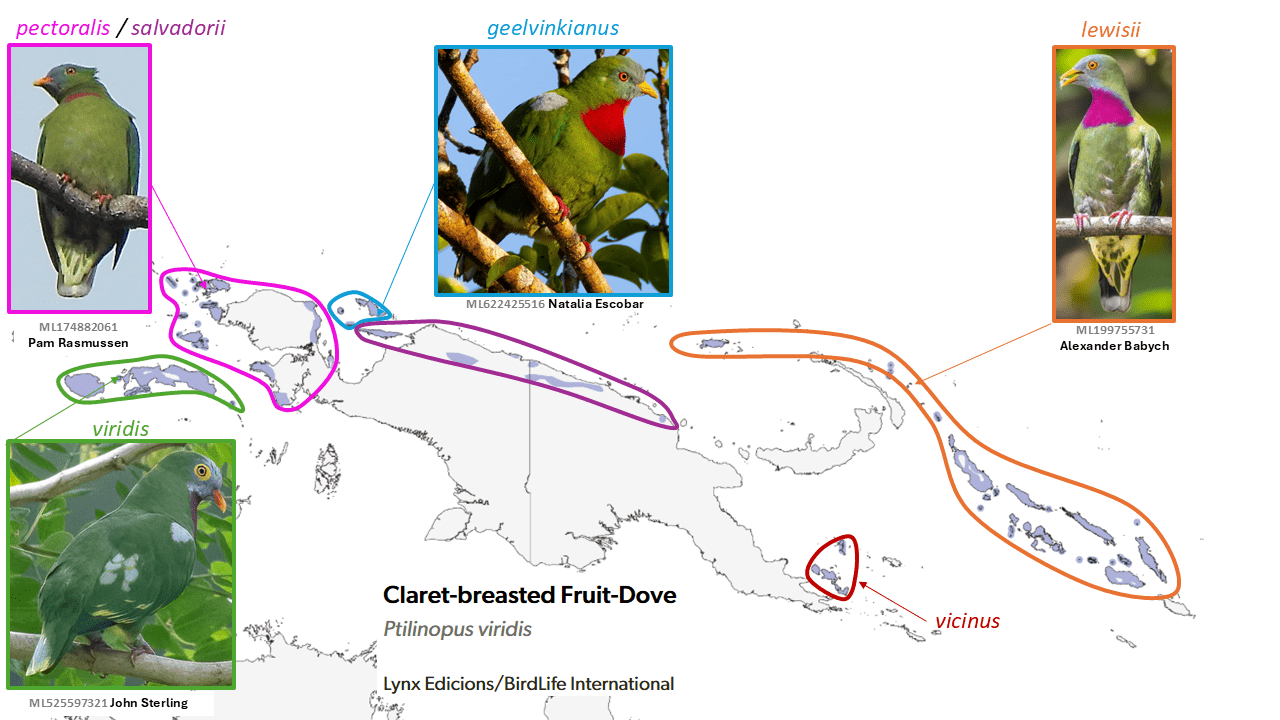
New groups in Claret-breasted Fruit-Dove Ptilinopus viridis
Summary: (0→5 groups)
Details: Clements v2025 taxa 2674–2681
Five new groups are formed for Claret-breasted Fruit-Dove Ptilinopus viridis:
- Claret-breasted Fruit-Dove (Moluccan) Ptilinopus viridis viridis (monotypic)
- Claret-breasted Fruit-Dove (Northern) Ptilinopus viridis pectoralis/salvadorii
- subspecies pectoralis and salvadorii
- Claret-breasted Fruit-Dove (Geelvink) Ptilinopus viridis geelvinkianus (monotypic)
- Claret-breasted Fruit-Dove (D’Entrecasteaux) Ptilinopus viridis vicinus (monotypic)
- Claret-breasted Fruit-Dove (Solomons) Ptilinopus viridis lewisii (monotypic)
Graphical abstract:
New groups in Rufous-vented Ground-Cuckoo Neomorphus geoffroyi
Summary: (0→3 groups)
Details: Clements v2025 taxa 3040–3048
Three new groups are formed for Rufous-vented Ground-Cuckoo Neomorphus geoffroyi:
- Rufous-vented Ground-Cuckoo (Western) Neomorphus geoffroyi [salvini Group]
- subspecies salvini, aequatorialis, and australis
- Rufous-vented Ground-Cuckoo (Amazonian) Neomorphus geoffroyi geoffroyi/amazonicus
- subspecies geoffroyi and amazonicus
- Rufous-vented Ground-Cuckoo (Atlantic) Neomorphus geoffroyi dulcis (monotypic)
Graphical abstract:

Notes: Western and eastern taxa appear to be more broadly allopatric than generally realized, but ranges remain poorly known.
The dulcis group could perhaps be combined into the geoffroyi group, and rufous-crowned salvini may be best treated as its own group. Species limits in Neomorphus geoffroyi clearly require reevaluation; note especially iris color difference between western and eastern taxa. In addition, there appear to be habitat differences between some taxa. The range of the even less well-known Scaled Ground Cuckoo Neomorphus squamiger Todd, 1925, formerly considered conspecific with geoffroyi, partly separates the eastern and western groups of N. geoffroyi (see Firme et al. 2014).
New and renamed groups in Amazilia Hummingbird Amazilis amazilia
Summary: (3→6 groups)
Details: Clements v2025 taxa 5123–5129
Four new groups are formed for Amazilia Hummingbird Amazilis amazilia by reconstitution of the former Amazilia Hummingbird (White-throated) Amazilis amazilia [dumerilii Group]:
- Amazilia Hummingbird (Green-tailed) Amazilis amazilia dumerilii (monotypic)
- Amazilia Hummingbird (Azuay) Amazilis amazilia azuay (monotypic)
- Amazilia Hummingbird (Montane) Amazilis amazilia alticola
- Amazilia Hummingbird (North Peruvian) Amazilis amazilia leucophoea (monotypic)
The existing group Amazilia Hummingbird (Blue-throated) Amazilis amazilia caeruleigularis is unchanged, and the monotypic composition of Amazilis amazilia amazilia is unchanged but the English name changes from Amazilia Hummingbird (Green-throated) to Amazilia Hummingbird (Amazilia).
Graphical abstract:
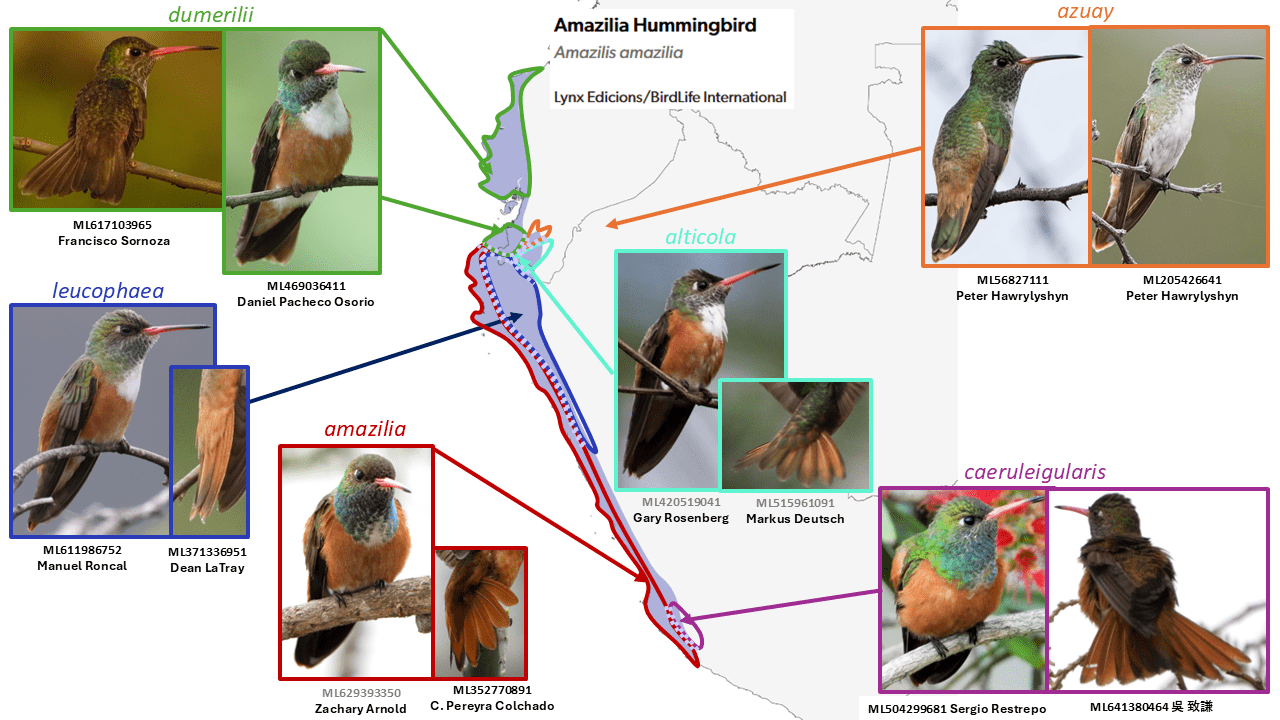
Note: The amazilia and caeruleigularis groups might be best combined into a single group, and the alticola and leucophaea groups could perhaps be combined into one. Species status was proposed for alticola (Weller 2000), but the evidence was not deemed sufficient for acceptance by SACC. Intergrades between alticola and dumerilii are known (Krabbe and Ridgely 2010). The recently described azuay (Krabbe & Ridgely, 2010) is especially distinctive, and has an unusual distribution, in the semiarid valley of the Río Jubones of southern Ecuador, and although it was described as a subspecies, its status would seem to need investigation.
New groups in Sooty Oystercatcher Haematopus fuliginosus
Summary: (0→2 groups)
Details: Clements v2025 taxa 5796–5798
Two new groups are formed for Sooty Oystercatcher Haematopus fuliginosus:
- Sooty Oystercatcher (Yellow-spectacled) Haematopus fuliginosus opthalmicus (monotypic)
- Sooty Oystercatcher (Orange-spectacled) Haematopus fuliginosus fuliginosus (monotypic)
Graphical abstract:

New groups in Hadada Ibis Bostrychia hagedash
Summary: (0→3 groups)
Details: Clements v2025 taxa 7516–7521
Three new groups are formed for Hadada Ibis Bostrychia hagedash:
- Hadada Ibis (Western) Bostrychia hagedash brevirostris (monotypic)
- Hadada Ibis (Eastern) Bostrychia hagedash erlangeri/nilotica
- subspecies erlangeri and nilotica
- Hadada Ibis (Southern) Bostrychia hagedash hagedash (monotypic)
Graphical abstract:

Notes: Previously considered three subspecies, with nilotica (Neumann, 1909), type locality near Addis Ababa, intervening between western and eastern populations of brevirostris. The realization based on ML media that West African brevirostris (Reichenow, 1907), type locality Equatorial Guinea, have dark red irides, indicates that pale-eyed erlangeri (Neumann, 1909), type locality southern Somalia, cannot be maintained within that subspecies, and should be in the same group, if not united with nilotica, in which case a first reviser action may be needed. Furthermore, photos from northern Namibia, northern Botswana, and Zambia show these to be pale-eyed birds as well, and these are here assumed to be erlangeri. Contact zones are very approximate and further study is needed, but a seemingly sharp discontinuity between southern dark-eyed, pale gray hagedash and pale-eyed, darker erlangeri merits further study. Whether brevirostris or any form occurs in much of central Africa also warrants study.
New and redefined groups in Little Heron Butorides atricapilla
Summary: (1→6 groups)
Details: Clements v2025 taxa 7673–7703
The preexisting Striated Heron (Old World) Butorides striata [atricapilla Group] is redefined into six new groups for Little Heron Butorides atricapilla sensu stricto:
- Little Heron (African) Butorides atricapilla [atricapilla Group]
- with subspecies atricapilla, rhizophorae, and rutenbergi
- Little Heron (Seychelles) Butorides atricapilla crawfordi/degens
- subspecies crawfordi and degens
- Little Heron (Red Sea) Butorides atricapilla brevipes (monotypic)
- Little Heron (Asian) Butorides atricapilla [javanica Group]
- subspecies albolimbata, didii, albidula, javanica, spodiogaster, actophila, carcinophila, and amurensis
- Little Heron (Australasian) Butorides atricapilla [stagnatilis Group]
- subspecies moluccarum, steini, papuensis, idenburgi, flyensis, rogersi, cinerea, littleri, stagnatilis, macrorhyncha, and solomonensis)
- Little Heron (Tahiti) Butorides atricapilla patruelis (monotypic)
Graphical abstract:

Redefined groups in Megascops watsonii
Summary: (2→2 groups)
Details: Clements v2024 taxa 8880–8884
Was:
- Tawny-bellied Screech-Owl (Tawny-bellied) Megascops watsonii watsonii (monotypic)
- Tawny-bellied Screech-Owl (Austral) Megascops watsonii usta (monotypic)
Now:
- Tawny-bellied Screech-Owl (Northern) Megascops watsonii watsonii (monotypic)
- Tawny-bellied Screech-Owl (Southern) Megascops watsonii [usta Group]
- subspecies stangiae, ater, and usta
Graphical Abstract:

New groups in Great Horned Owl Bubo virginianus
Summary: (0→3 groups)
Details: Clements v2025 taxa 8910–8927
Three new groups are formed for Great Horned Owl Bubo virginianus:
- Great Horned Owl (Northern) Bubo virginianus [virginianus Group]
- subspecies algistus, lagophonus, saturatus, pacificus, elachistus, subarcticus, pallescens, pinorum, heterocnemis, virginianus, mayensis, and mesembrinus
- Great Horned Owl (North Andean) Bubo virginianus nigrescens (monotypic)
- Great Horned Owl (Tropical) Bubo virginianus nacurutu/deserti
- subspecies nacurutu and deserti
Graphical abstract:


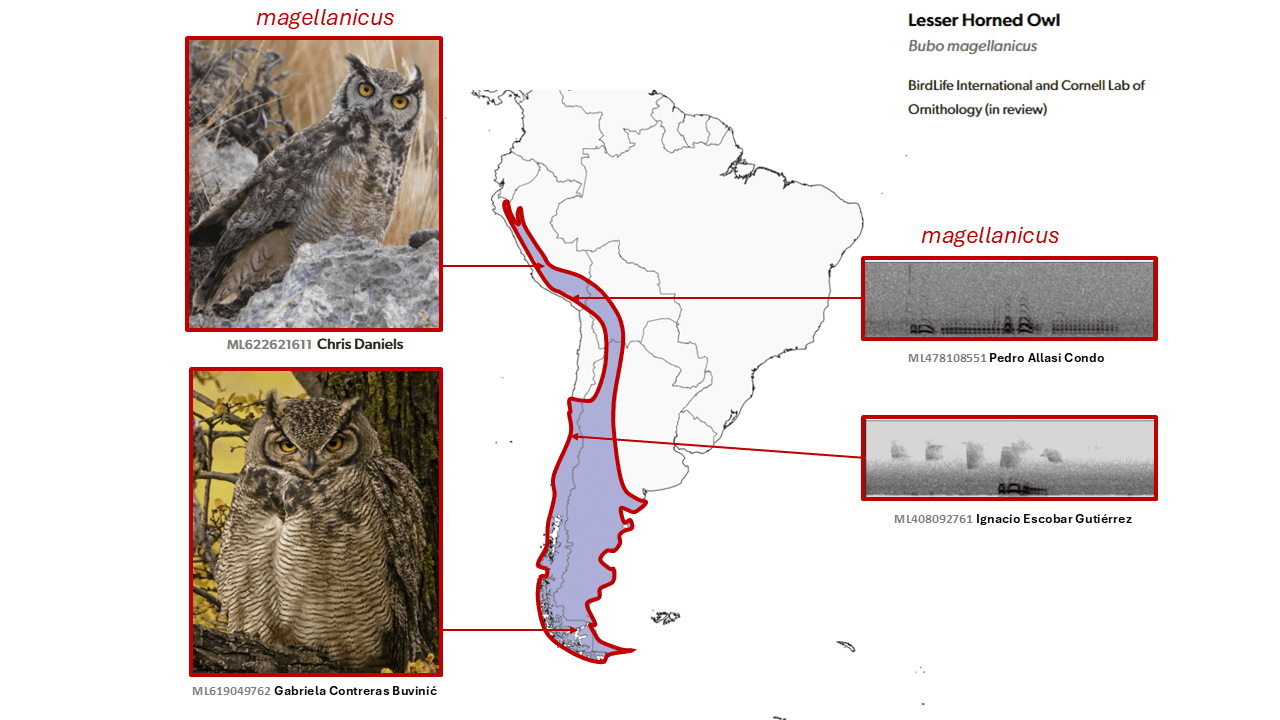
Note: Species limits of Bubo virginianus are under consideration by SACC, which (unlike Clements) still considers magellanicus a subspecies of B. virginianus, and a four-species treatment along the lines of the groups outlined above has passed, but English names are still under discussion. A graphic of Bubo magellanicus is included here for comparative purposes:
New groups in Blue-black Kingfisher Todiramphus nigrocyaneus
Summary: (0→3 groups)
Details: Clements v2025 taxa 10111–10114
Three new groups are formed for Blue-black Kingfisher Todiramphus nigrocyaneus:
- Blue-black Kingfisher (Western) Todiramphus nigrocyaneus nigrocyaneus (monotypic)
- Blue-black Kingfisher (Northern) Todiramphus nigrocyaneus quadricolor (monotypic)
- Blue-black Kingfisher (Southern) Todiramphus nigrocyaneus stictolaemus (monotypic)
Graphical abstract:

New and redefined groups in Common Paradise-Kingfisher Tanysiptera galatea
Summary: (2→6 groups)
Details: Clements v2025 taxa 10262–10281
Four new groups are formed for Common Paradise-Kingfisher Tanysiptera galatea:
- Common Paradise-Kingfisher (Morotai) Tanysiptera galatea doris/emiliae
- subspecies doris and emiliae
- Common Paradise-Kingfisher (Halmahera) Tanysiptera galatea [margarethae Group]
- subspecies browningi, brunhildae, sabrina, and margarethae
- Common Paradise-Kingfisher (Obi) Tanysiptera galatea obiensis (monotypic)
- Common Paradise-Kingfisher (Amboyna) Tanysiptera galatea [nais Group]
- subspecies acis, boanensis, and nais
One group is redefined:
- from the former Common Paradise-Kingfisher (Common) Tanysiptera galatea [galatea Group] with 14 subspecies
- to Common Paradise-Kingfisher (Papuan) Tanysiptera galatea [galatea Group]
- subspecies galatea, meyeri, minor, and vulcani
Graphical abstract:

New groups in Brown Jacamar Brachygalba lugubris
Summary: (0→2 groups)
Details: Clements v2025 taxa 10483–10491
Two new groups are formed for Brown Jacamar Brachygalba lugubris:
- Brown Jacamar (Black-billed) Brachygalba lugubris [lugubris Group]
- subspecies fulviventris, caquetae, lugubris, obscuriceps, naumburgae, and phaeonota
- Brown Jacamar (Pale-billed) Brachygalba lugubris melanosterna (monotypic)
Graphical abstract:

New groups in Yellow-throated Woodpecker Piculus flavigula
Summary: (0→3 groups)
Details: Clements v2025 taxa 11839–11842
Three new groups are formed for Yellow-throated Woodpecker Piculus flavigula:
- Yellow-throated Woodpecker (Red-moustached) Piculus flavigula flavigula (monotypic)
- Yellow-throated Woodpecker (Yellow-faced) Piculus flavigula magnus (monotypic)
- Yellow-throated Woodpecker (Red-throated) Piculus flavigula erythropis (monotypic)
Graphical abstract:

New groups in Black-capped Lory Lorius lory
Summary: (0→5 groups)
Details: Clements v2025 taxa 12619–12627
Five new groups are formed for Black-capped Lory Lorius lory:
- Black-capped Lory (Vogelkop) Lorius lory lory (monotypic)
- Black-capped Lory (Biak) Lorius lory cyanauchen (monotypic)
- Black-capped Lory (Northern) Lorius lory [jobiensis Group]
- subspecies jobiensis, viridicrissalis, and salvadorii
- Black-capped Lory (Southern) Lorius lory erythrothorax (monotypic)
- Black-capped Lory (Fly River) Lorius lory somu (monotypic)
Graphical abstract:
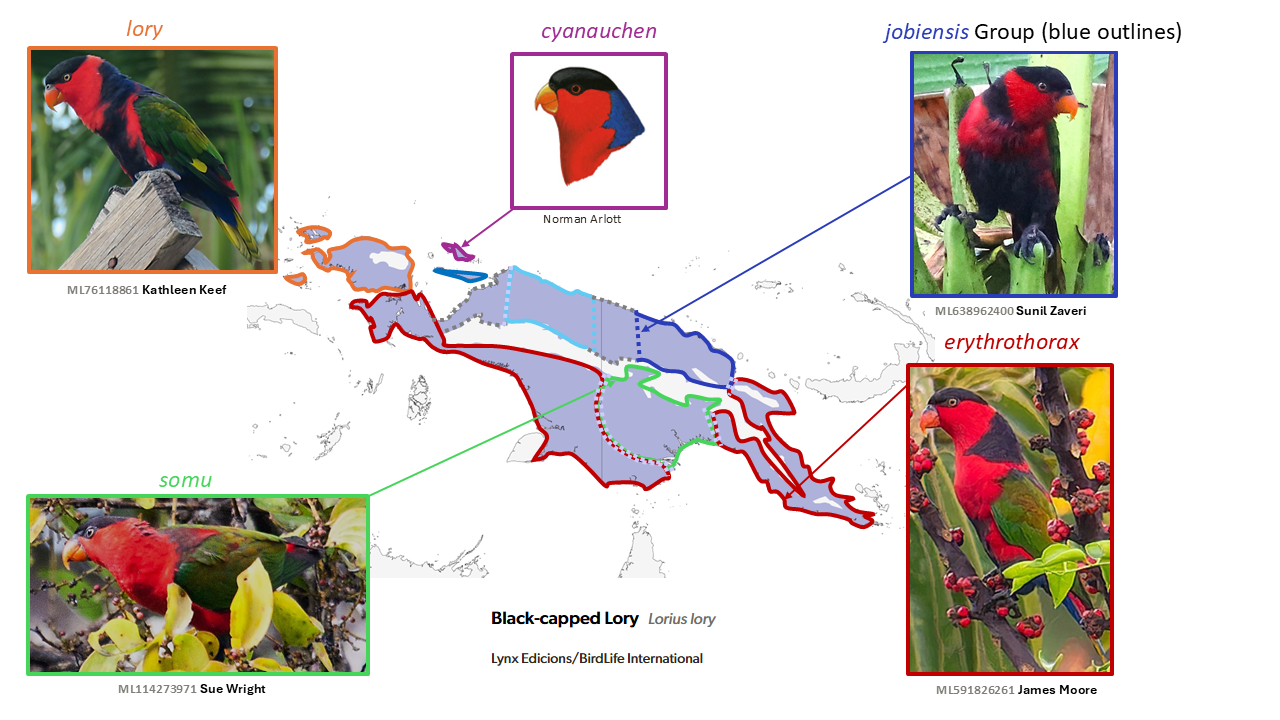
Notes: The occurrence of erythrothorax on both western and eastern sides of the range of somu seems implausible, and is considered unusual but not unprecedented by Beehler and Pratt (2016). These authors state that somu is perhaps a foothills and uplands form, while erythrothorax is a lowland form. This situation warrants further investigation.
New and redefined groups in Red-lored Amazon Amazona autumnalis
Summary: (1→2 groups, taking into account split of two group-level taxa)
Details: Clements v2025 taxa 12909–12911
Two new groups are formed for Red-lored Amazon Amazona autumnalis (sensu stricto):
- Red-lored Amazon (Red-lored) Amazona autumnalis autumnalis (monotypic)
- Red-lored Amazon (Salvin’s) Amazona autumnalis salvini (monotypic)
Graphical abstract: See Splits section.
Redefined groups in Brown-throated Parakeet Eupsittula pertinax
Summary: (2→5 groups)
Details: Clements v2025 taxa 13102–13120
One existing group, Brown-throated Parakeet (Brown-throated) Eupsittula pertinax [pertinax Group], is redefined into four new groups for Brown-throated Parakeet Eupsittula pertinax:
- Brown-throated Parakeet (Colombian) Eupsittula pertinax [aeruginosa Group]
- subspecies aeruginosa, griseipecta, and lehmanni)
- Brown-throated Parakeet (Gold-faced) Eupsittula pertinax pertinax/xanthogenia
- subspecies pertinax and xanthogenia
- Brown-throated Parakeet (Venezuelan) Eupsittula pertinax [chrysophrys Group]
- subspecies arubensis, tortugensis, margaritensis, venezuelae, surinama, and chrysophrys
- Brown-throated Parakeet (Amazonian) Eupsittula pertinax chrysogenys/paraensis
- subspecies chrysogenys and paraensis)
Graphical abstract:

Notes: The Middle American ocularis group was suggested to be a distinct species, “Veraguas Parakeet” Eupsittula pertinax by Dyer and Howell (2023), citing differences in plumage, bare parts, and voice. However, it is quite similar in at least the first two aspects to taxa of the venezuelae Group, and species limits require study. The pertinax complex is very closely related to the Cactus Parakeet Eupsittula cactorum (Collar 1992, Padilla-Jacobo et al. 2025).
New and redefined groups in Ornate Stipplethroat Epinecrophylla ornata
Summary: (2→3 groups)
Details: Clements v2025 taxa 13704–13710
One existing group is redefined into one new group for Ornate Stipplethroat Epinecrophylla ornata:
- Ornate Stipplethroat (Plain-backed) Epinecrophylla ornata meridionalis (monotypic)
- subspecies ornata, saturata, and atrogularis
Graphical abstract:

Notes: Males of the two mainly southern Peruvian taxa, atrogularis and meridionalis, usually have solid gray backs, but individuals such as that shown for atrogularis do occur rarely, and are considered to be atrogularis but further study is needed. The Brazilian subspecies hoffmannsi has been considered a separate species (del Hoyo and Collar 2016), as it is vocally somewhat different (Boesman 2016: 45) and differs in size and structure, and in female plumage (mainly the lack of the checkered throat patch of other taxa in the complex). However, based on UCE analyses (Johnson et al. 2021), hoffmannsi is embedded within a clade containing meridionalis and atrogularis, the latter two being virtually indistinguishable in male plumage, and with very similar vocalizations. In a future update, atrogularis will likely be treated as its own group.
New and redefined groups in White-flanked Antwren Myrmotherula axillaris
Summary: (2→3 groups)
Details: Clements v2025 taxa 13731–13739
One existing group, White-flanked Antwren (White-flanked) Myrmotherula axillaris [axillaris Group], is redefined into a new group for White-flanked Antwren Myrmotherula axillaris:
- White-flanked Antwren (Black-backed) Myrmotherula axillaris melaena/albigula
- subspecies axillaris, heterozyga, and fresnayana
Graphical abstract:
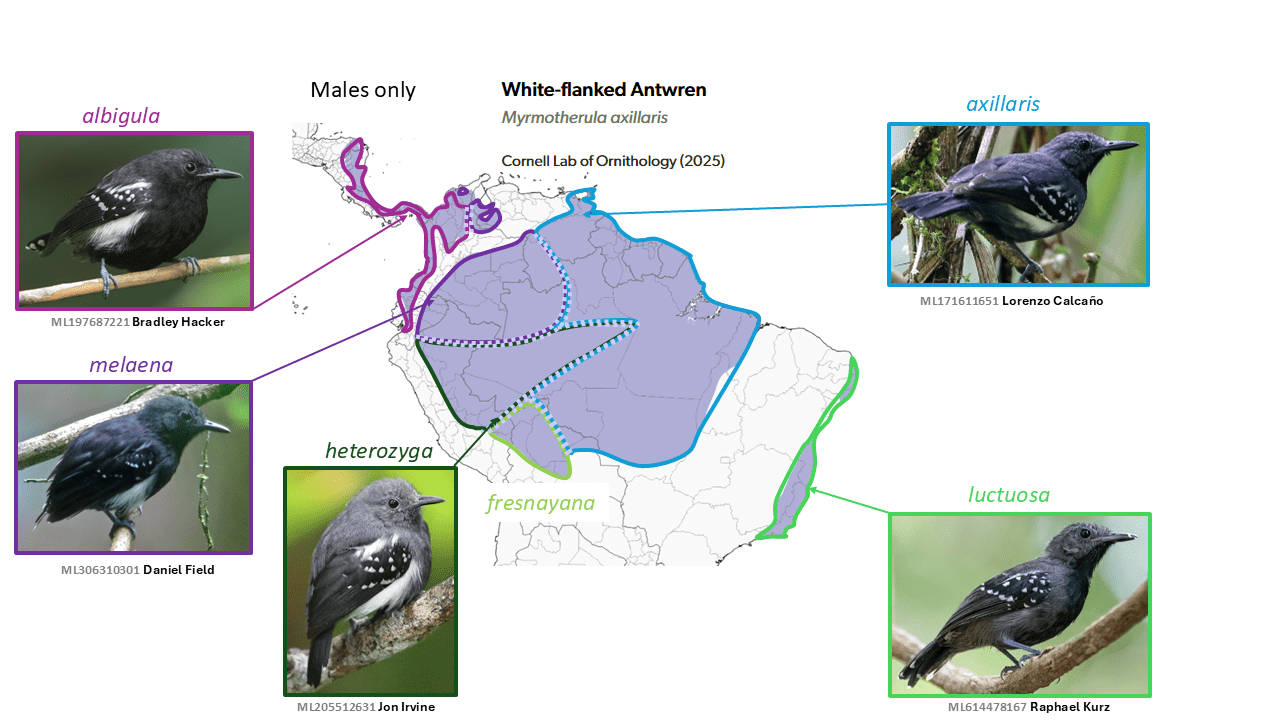
Notes: While Atlantic forest luctuosa is evidently vocally and morphologically the most distinct lineage and has been proposed for a split (del Hoyo and Collar 2016), genetically it is less divergent than western Amazonian heterozyga/lafresnaya is from the remaining taxa, with the next most divergent clade being Central American, trans-Andean, and northwestern Amazonian albigula/melaena (Harvey et al. 2020), considered a separate species by Dyer and Howell (2023) on the basis of plumage and vocalizations. Likely a fourth group, the axillaris group, should be recognized, and there may be multiple species in the group: the two northwestern taxa, the two southwestern ones, and the eastern taxa as one or two further species.
New groups in Slaty Antwren Myrmotherula schisticolor
Summary: (0→2 groups)
Details: Clements v2025 taxa 13740–13744
Two new groups are formed for Slaty Antwren Myrmotherula schisticolor:
- Slaty Antwren (Western) Myrmotherula schisticolor schisticolor (monotypic)
- Slaty Antwren (Eastern) Myrmotherula schisticolor sanctaemartae/interior
- subspecies sanctaemartae and interior
Graphical abstract:

New groups in Long-winged Antwren Myrmotherula longipennis
Summary: (0→3 groups)
Details: Clements v2025 taxa 13749–13757
Three new groups are formed for Long-winged Antwren Myrmotherula longipennis:
- Long-winged Antwren (Northern) Myrmotherula longipennis longipennis (monotypic)
- Long-winged Antwren (Western) Myrmotherula longipennis garbei/zimmeri
- subspecies garbei and zimmeri
- Long-winged Antwren (Southern) Myrmotherula longipennis [paraensis Group]
- subspecies ochrogyna, paraensis, and transitiva
Note: Taxonomy of this complex will be modified extensively in a comprehensive forthcoming review by Isler and Chesser (in press).
New groups in Plain-winged Antwren Myrmotherula behni
Summary: (0→2 groups)
Details: Clements v2025 taxa 13767–13772
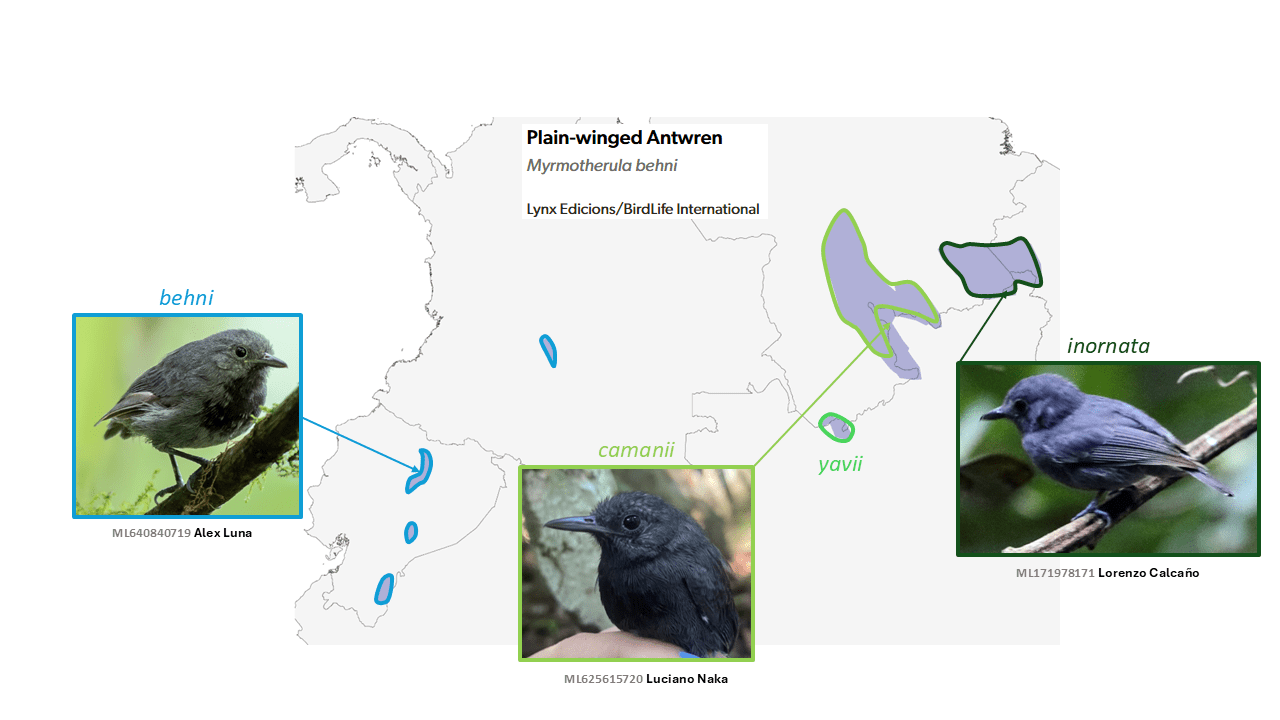
Two new groups are formed for Plain-winged Antwren Myrmotherula behni:
- Plain-winged Antwren (Tepui) Myrmotherula behni [inornata Group]
- subspecies yavii, camanii, and inornata
- Plain-winged Antwren (Ecuadorian) Myrmotherula behni behni (monotypic)
Graphical abstract:
New groups in Gray Antwren Myrmotherula menetriesii
Summary: (0→3 groups)
Details: Clements v2025 taxa 13773–13780
Three new groups are formed for Gray Antwren Myrmotherula menetriesii:
- Gray Antwren (North Amazonian) Myrmotherula menetriesii cinereiventris/pallida
- subspecies cinereiventris and pallida
- Gray Antwren (West Amazonian) Myrmotherula menetriesii menetriesii/berlepschi
- subspecies menetriesii and berlepschi
- Gray Antwren (Northeastern) Myrmotherula menetriesii omissa (monotypic)
Note: Taxonomy of this complex will be modified extensively in a comprehensive forthcoming review by Isler and Chesser (in press).
New groups in Striated Antbird Drymophila devillei
Summary: (0→2 groups)
Details: Clements v2025 taxa 13868–13870
Three new groups are formed for Striated Antbird Drymophila devillei:
- Striated Antbird (Western) Drymophila devillei devillei (monotypic)
Striated Antbird (Eastern) Drymophila devillei subochracea (monotypic)
New groups in Blackish Antbird Cercomacroides nigrescens
Summary: (0→3 groups)
Details: Clements v2025 taxa 13914–13921
Three new groups are formed for Blackish Antbird Cercomacroides nigrescens:
- Blackish Antbird (Guianan) Cercomacroides nigrescens nigrescens (monotypic)
- Blackish Antbird (Andean) Cercomacroides nigrescens notata/aequatorialis
- subspecies notata and aequatorialis
- Blackish Antbird (Amazonian) Cercomacroides nigrescens approximans/ochrogyna
- subspecies approximans and ochrogyna
Graphical abstract:

New groups in Gray Antbird Cercomacra cinerascens
Summary: (0→2 groups)
Details: Clements v2025 taxa 13926–13932
Two new groups are formed for Gray Antbird Cercomacra cinerascens:
- Gray Antbird (Northern) Cercomacra cinerascens cinerascens/immaculata
- subspecies cinerascens and immaculata
- Gray Antbird (Southern) Cercomacra cinerascens sclateri/iterata
- subspecies sclateri and iterata
Graphical abstract:

Note: Photos of some individuals on ML and Wikiaves from the northern group (if identified correctly) appear either to have more extensive white wing covert spotting than those depicted here. There may be more than one species in this complex (Zimmer and Isler 2003, SACC Thamnophilidae note 39d).
New groups in Silvered Antbird Sclateria naevia
Summary: (0→2 groups)
Details: Clements v2025 taxa 13984–13989
Two new groups are formed for Silvered Antbird Sclateria naevia:
- Silvered Antbird (Eastern) Sclateria naevia [naevia Group]
- subspecies naevia, diaphora, and toddi
- Silvered Antbird (Western) Sclateria naevia argentata (monotypic)
Graphical abstract:

Notes: The form diaphora of southeastern Venezuela is described as having a few dark streaks on the breast, and may represent clinal variation or a hybrid zone. It appears likely that argentata occurs in northwestern Bolivia, and toddi in northeastern Bolivia. Two males of toddi are shown, demonstrating variation in underparts color and pattern, and the apparent occurrence of toddi in northeastern Bolivia.
New groups in Hairy-crested Antbird Rhegmatorhina melanosticta
Summary: (0→2 groups)
Details: Clements v2025 taxa 14099–14103
Two new groups are formed for Hairy-crested Antbird Rhegmatorhina melanosticta:
- Hairy-crested Antbird (Gray-crested) Rhegmatorhina melanosticta melanosticta (monotypic)
- Hairy-crested Antbird (Rufous-crested) Rhegmatorhina melanosticta purusiana/brunneiceps
- subspecies purusiana/brunneiceps
Graphical abstract:

Note: The crest color of purusiana is more like that of melanosticta than it is to that of brunneiceps. However, Ribas et al. (2018) found a deep divergence between purusiana and a clade comprised of nominate melanosticta and brunneiceps. Thus a three-group solution seems likely to prove more satisfactory.
New groups in Giant Antpitta Grallaria gigantea
Summary: (0→2 groups)
Details: Clements v2025 taxa 14193–14197
Two new groups are formed for Giant Antpitta Grallaria gigantea:
- Giant Antpitta (Western) Grallaria gigantea hylodroma (monotypic)
- Giant Antpitta (Eastern) Grallaria gigantea gigantea/lehmanni
- subspecies gigantea and lehmanni
Graphical abstract:

New groups in Variegated Antpitta Grallaria varia
Summary: (0→2 groups)
Details: Clements v2025 taxa 14201–14208
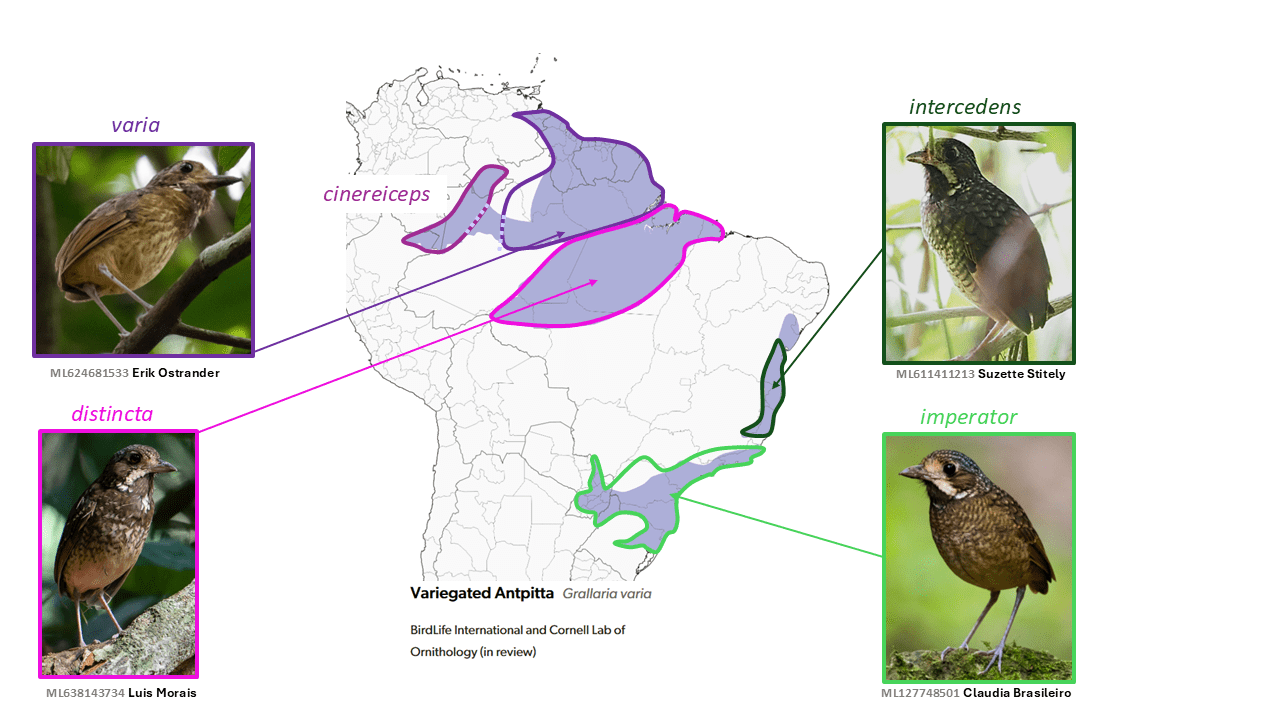
Two new groups are formed for Variegated Antpitta Grallaria varia:
- Variegated Antpitta (Amazonian) Grallaria varia [varia Group]
- subspecies cinereiceps, varia, and distincta
- Variegated Antpitta (Atlantic) Grallaria varia imperator/intercedens
- subspecies imperator and intercedens
Graphical abstract:
New groups in Rufous-capped Antthrush Formicarius colma
Summary: (0→2 groups)
Details: Clements v2025 taxa 14467–14472
Two new groups are formed for Rufous-capped Antthrush Formicarius colma:
- Rufous-capped Antthrush (Rufous-capped) Formicarius colma [colma Group]
- subspecies colma, nigrifrons, and amazonicus
- Rufous-capped Antthrush (Rufous-fronted) Formicarius colma ruficeps (monotypic)
Graphical abstract:

Note: In the past (e.g. Cory and Hellmayr 1924), amazonicus (from south of the Amazon and east of the Madeira) and ruficeps (of the Atlantic forest) were treated together as a separate species from colma, but were later lumped by Peters (1951). Based on plumage and apparent differences in song (shorter, more distinctly upturned, and higher-pitched in amazonicus and ruficeps than in colma and nigrifrons), this seems likely to require reevaluation. An adjustment to the groups will likely be made in the 2026 update.
New groups in Rufous-breasted Antthrush Formicarius rufipectus
Summary: (0→2 groups)
Details: Clements v2025 taxa 14494–14499
Two new groups are formed for Rufous-breasted Antthrush Formicarius rufipectus:
- Rufous-breasted Antthrush (Rufous-breasted) Formicarius rufipectus [rufipectus Group]
- subspecies rufipectus, lasallei, and carrikeri
- Rufous-breasted Antthrush (Southern) Formicarius rufipectus thoracicus (monotypic)
Graphical abstract:

New groups in Short-tailed Antthrush Chamaeza campanisona
Summary: (0→4 groups)
Details: Clements v2025 taxa 14501–14517
Four new groups are formed for Short-tailed Antthrush Chamaeza campanisona:
- Short-tailed Antthrush (Tepui) Chamaeza campanisona [fulvescens Group]
- subspecies yavii, huachamacarii, obscura, and fulvescens
- Short-tailed Antthrush (North Andean) Chamaeza campanisona [columbiana Group]
- subspecies venezuelana, columbiana, and punctigula
- Short-tailed Antthrush (South Andean) Chamaeza campanisona [olivacea Group]
- subspecies olivacea, berlepschi, and boliviana
- Short-tailed Antthrush (Atlantic) Chamaeza campanisona campanisona/tshororo
- subspecies campanisona and tshororo
Graphical abstract:

New groups in Striated Antthrush Chamaeza nobilis
Summary: (0→2 groups)
Details: Clements v2025 taxa 14518–14522
Two new groups are formed for Striated Antthrush Chamaeza nobilis:
- Striated Antthrush (Striated) Chamaeza nobilis nobilis/rubida
- subspecies nobilis and rubida
- Striated Antthrush (Ochre-breasted) Chamaeza nobilis fulvipectus (monotypic)
Graphical abstract:

New groups in Barred Antthrush Chamaeza mollissima
Summary: (0→2 groups)
Details: Clements v2025 taxa 14528–14530
Two new groups are formed for Barred Antthrush Chamaeza mollissima:
- Barred Antthrush (Barred) Chamaeza mollissima mollissima (monotypic)
- Barred Antthrush (Yungas) Chamaeza mollissima yungae (monotypic)
Graphical abstract:

New and redefined groups in Black-banded Woodcreeper Dendrocolaptes picumnus
Summary: (3→8 groups)
Details: Clements v2025 taxa 14723–14735
Five new groups are formed for Black-banded Woodcreeper Dendrocolaptes picumnus:
- Black-banded Woodcreeper (Costa Rican) Dendrocolaptes picumnus costaricensis (monotypic)
- Black-banded Woodcreeper (Caribbean) Dendrocolaptes picumnus seilerni (monotypic)
- Black-banded Woodcreeper (Andean) Dendrocolaptes picumnus multistrigatus (monotypic)
- Black-banded Woodcreeper (Tapajos) Dendrocolaptes picumnus transfasciatus (monotypic)
- Black-banded Woodcreeper (Bolivian) Dendrocolaptes picumnus olivaceus (monotypic)
Graphical abstract:

Notes: Based on the phylogeny in Santana et al. (2021), Chaco pallescens and montane olivaceus should be a group. Furthermore, the two southern taxa casaresi and pallescens are dissimilar in plumage, and thus casaresi (unsampled in Santana et al. (2021) may be best treated as a monotypic group.
The Brazilian Ornithological Records Committee (Pacheco et al. 2021) considers transfasciatus to be a separate species, Santarem Woodcreeper Dendrocolaptes transfasciatus. This treatment resolves the paraphyly evident in the phylogeny of Santana et al. (2021).
The Santana et al. (2021) phylogeny furthermore recovered the western Amazonian taxon validus and the northern Amazonian taxon picumnus as separate clades, so their inclusion in the same group seems unwarranted, though they look similar and share at least a broadly similar habitat.
Of the taxa sampled in Santana et al. (2021), the next most divergent taxon (after transfasciatus) in the phylogeny is costaricensis (puncticollis, the more northerly Mesoamerican taxon, was not included).
New groups in Red-billed Scythebill Campylorhamphus trochilirostris
Summary: (0→3 groups)
Details: Clements v2025 taxa 14887–14902
Three new groups are formed for Red-billed Scythebill Campylorhamphus trochilirostris:
- Red-billed Scythebill (Northern) Campylorhamphus trochilirostris venezuelensis/brevipennis
- subspecies venezuelensis and brevipennis
- Red-billed Scythebill (Trans-Andean) Campylorhamphus trochilirostris thoracicus/zarumillanus
- subspecies thoracicus and zarumillanus
- Red-billed Scythebill (Amazonian) Campylorhamphus trochilirostris [trochilirostris Group]
subspecies napensis, notabilis, snethlageae, devius, lafresnayanus, hellmayri, major, and trochilirostris
Graphical abstract:

Redefined groups in Brown-winged Schiffornis Schiffornis turdina
Summary: (2→4 groups)
Details: Clements v2025 taxa 15994–16000
One existing group Brown-winged Schiffornis (Amazonian) Schiffornis turdina amazonum is renamed, as:
- Brown-winged Schiffornis (West Amazonian)
One existing group, Brown-winged Schiffornis (Brown-winged) Schiffornis turdina [turdina Group] (with subspecies wallacii, steinbachi, intermedia, and turdina) is redefined as three groups:
- Brown-winged Schiffornis (East Amazonian) Schiffornis turdina wallacii (monotypic)
- Brown-winged Schiffornis (Peruvian) Schiffornis turdina steinbachi (monotypic)
- Brown-winged Schiffornis (Atlantic) Schiffornis turdina turdina/intermedia
- subspecies intermedia and turdina
Graphical abstract:

Notes: Groups largely follow those of Lima et al. (2024; SACC Prop 1031). Multiple newly recognized species, including one species new to science, may result from the study summarized in this proposal. Two taxa shown here (intercedens and cracrafti, the latter being newly described) are not recognized in Clements et al. (2025).
New groups in White-bellied Tody-Tyrant Hemitriccus griseipectus
Summary: (0→2 groups)
Details: Clements v2025 taxa 16347–16349
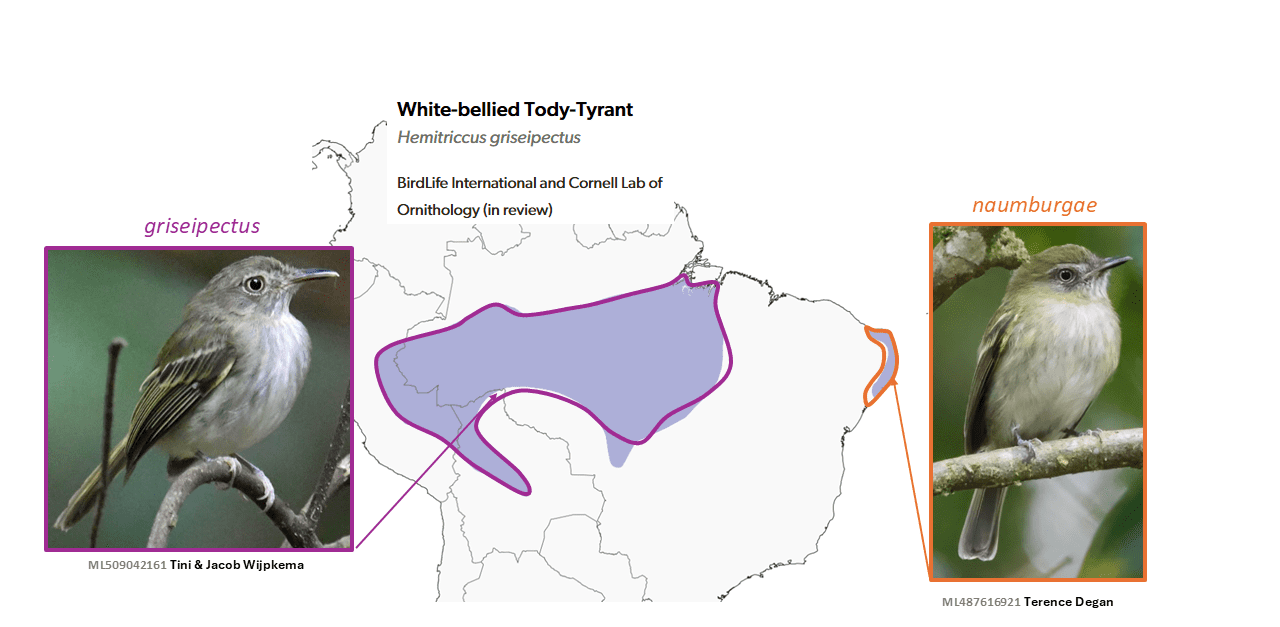
Two new groups are formed for White-bellied Tody-Tyrant Hemitriccus griseipectus:
- White-bellied Tody-Tyrant (White-bellied) Hemitriccus griseipectus griseipectus (monotypic)
- White-bellied Tody-Tyrant (Pernambuco) Hemitriccus griseipectus naumburgae (monotypic)
Graphical abstract:
New groups in Northern Beardless-Tyrannulet Camptostoma imberbe
Summary: (0→2 groups)
Details: Clements v2025 taxa 16551–16553
Two new groups are formed for Northern Beardless-Tyrannulet Camptostoma imberbe:
- Northern Beardless-Tyrannulet (Northern) Camptostoma imberbe imberbe (monotypic)
- Northern Beardless-Tyrannulet (Yucatan) Camptostoma imberbe thyellophilum (monotypic)
Graphical abstract:

New groups in Southern Beardless-Tyrannulet Camptostoma obsoletum
Summary: (2→6 groups)
Details: Clements v2025 taxa 16554–16571
Four new groups are formed for Southern Beardless-Tyrannulet Camptostoma obsoletum, with the realignment of Southern Beardless-Tyrannulet (Northern) Camptostoma obsoletum [pusillum Group] into:
- Southern Beardless-Tyrannulet (Central American) Camptostoma obsoletum [flaviventre Group]
- subspecies flaviventre, orphnum, and majus
- Southern Beardless-Tyrannulet (Colombian) Camptostoma obsoletum caucae (monotypic)
- Southern Beardless-Tyrannulet (Caribbean) Camptostoma obsoletum pusillum (monotypic)
- Southern Beardless-Tyrannulet (Amazonian) Camptostoma obsoletum napaeum/olivaceum
- subspecies napaeum and olivaceum
and the realignment of Southern Beardless-Tyrannulet (Southern) Camptostoma obsoletum [obsoletum Group] into:
- Southern Beardless-Tyrannulet (Peruvian) Camptostoma obsoletum [sclateri Group]
- subspecies sclateri, maranonicum, and griseum, and
- Southern Beardless-Tyrannulet (Southern) Camptostoma obsoletum [obsoletum Group]
- subspecies bolivianum, cinerascens, and obsoletum
Graphical abstract:

New and redefined groups in Riverside Tyrant Knipolegus orenocensis
Summary: (2→3 groups)
Details: Clements v2025 taxa 17049–17052
Two new groups are formed for Riverside Tyrant Knipolegus orenocensis by redefinition of the existing Riverside Tyrant (Riverside) Knipolegus orenocensis orenocensis/xinguensis:
- Riverside Tyrant (Xingu) Knipolegus orenocensis xinguensis (monotypic)
- Riverside Tyrant (Orinoco) Knipolegus orenocensis orenocensis (monotypic)
Graphical abstract:

Notes: The two widely separated taxa nominate orenocensis (of the Orinoco drainage) and xinguensis (of the Rio Xingu to Rio Tocantins of east-central Brazil) clearly should not be maintained in the same subspecies group to the exclusion of Amazonian sclateri. Both sexes of orenocensis are essentially unstreaked dark gray, females somewhat paler, while sclateri is highly sexually dimorphic, with glossy black males and much more streaked, paler-bellied females; xinguensis is somewhat intermediate in female plumage but is geographically separated from orenocensis by sclateri. According to Remsen et al. (2025), “Fitzpatrick (2004) noted that differences in degree of sexual dimorphism suggest that Amazonian subspecies could be considered separate species from nominate Knipolegus orenocensis.”
New groups in Yellow-breasted Bowerbird Chlamydera lauterbachi
Summary: (0→2 groups)
Details: Clements v2025 taxa 17565–17567
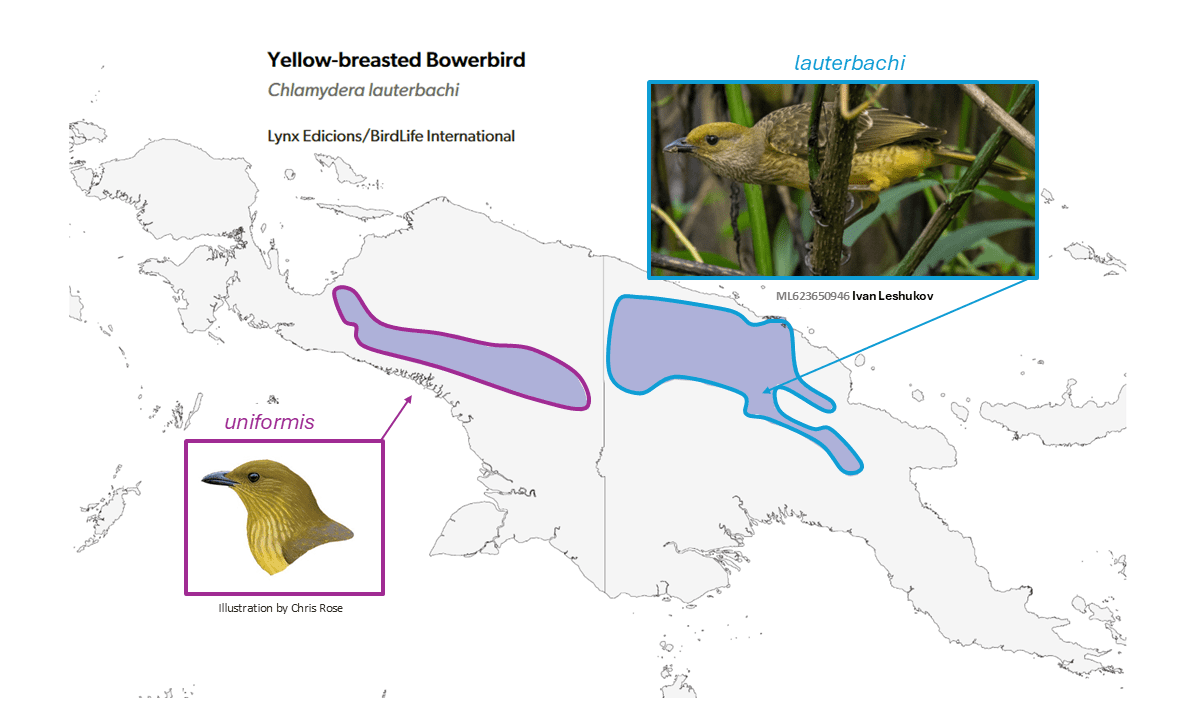
Two new groups are formed for Yellow-breasted Bowerbird Chlamydera lauterbachi:
- Yellow-breasted Bowerbird (Eastern) Chlamydera lauterbachi lauterbachi (monotypic)
- Yellow-breasted Bowerbird (Central) Chlamydera lauterbachi uniformis (monotypic)
Graphical abstract:
New groups in Brown Treecreeper Climacteris picumnus
Summary: (0→2 groups)
Details: Clements v2025 taxa 17586–17590
Two new groups are formed for Brown Treecreeper Climacteris picumnus:
- Brown Treecreeper (Cape York) Climacteris picumnus melanotus (monotypic
- Brown Treecreeper (Southern) Climacteris picumnus picumnus/victoriae
- subspecies picumnus and victoriae
Graphical abstract:

New groups in Black-tailed Treecreeper Climacteris melanurus
Summary: (0→2 groups)
Details: Clements v2025 taxa 17591–17593
Two new groups are formed for Black-tailed Treecreeper Climacteris melanurus:
- Black-tailed Treecreeper (Black-tailed) Climacteris melanurus melanurus (monotypic)
- Black-tailed Treecreeper (Pilbara) Climacteris melanurus wellsi (monotypic)
Graphical abstract:

New groups in White-shouldered Fairywren Malurus alboscapulatus
Summary: (0→3 groups)
Details: Clements v2025 taxa 17687–17695
Three new groups are formed for White-shouldered Fairywren Malurus alboscapulatus:
- White-shouldered Fairywren (Southern) Malurus alboscapulatus lorentzi (monotypic)
- White-shouldered Fairywren (Pied) Malurus alboscapulatus alboscapulatus/naimii
- subspecies alboscapulatus and naimii
- White-shouldered Fairywren (Black) Malurus alboscapulatus [moretoni Group]
- subspecies aida, kutubu, and moretoni
Graphical abstract:

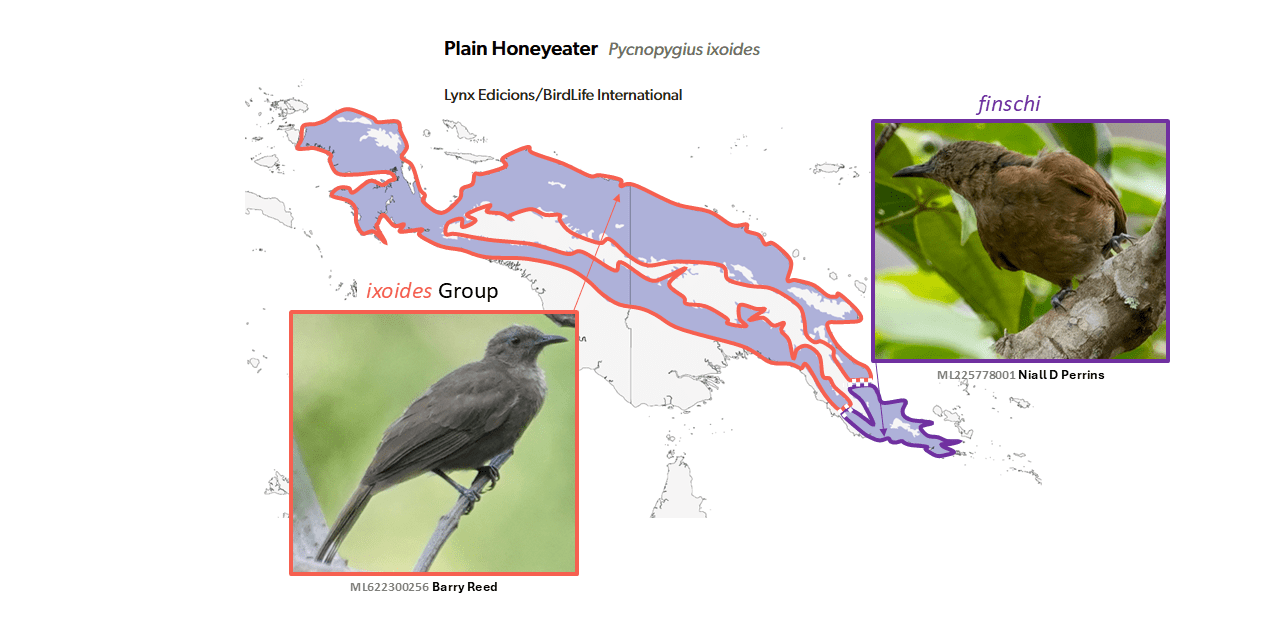
New groups in Plain Honeyeater Pycnopygius ixoides
Summary: (0→2 groups)
Details: Clements v2025 taxa 17713–17720
Two new groups are formed for Plain Honeyeater Pycnopygius ixoides:
- Plain Honeyeater (Plain) Pycnopygius ixoides [ixoides Group]
- subspecies ixoides, simplex, proximus, unicus, and cinereifrons)
- Plain Honeyeater (Rusty) Pycnopygius ixoides finschi
Graphical abstract:
New groups in Marbled Honeyeater Pycnopygius cinereus
Summary: (0→2 groups)
Details: Clements v2025 taxa 17721–17725
Two new groups are formed for Marbled Honeyeater Pycnopygius cinereus:
- Marbled Honeyeater (Western) Pycnopygius cinereus cinereus/dorsalis
- subspecies cinereus and dorsalis
- Marbled Honeyeater (Eastern) Pycnopygius cinereus marmoratus (monotypic)
Graphical abstract:

New groups in Yellow-gaped Honeyeater Meliphaga flavirictus
Summary: (0→2 groups)
Details: Clements v2025 taxa 17762–17764
Two groups are formed for Yellow-gaped Honeyeater Meliphaga flavirictus:
- Yellow-gaped Honeyeater (Northern) Meliphaga flavirictus crockettorum (monotypic)
- Yellow-gaped Honeyeater (Southeastern) Meliphaga flavirictus flavirictus (monotypic)
Graphical abstract:

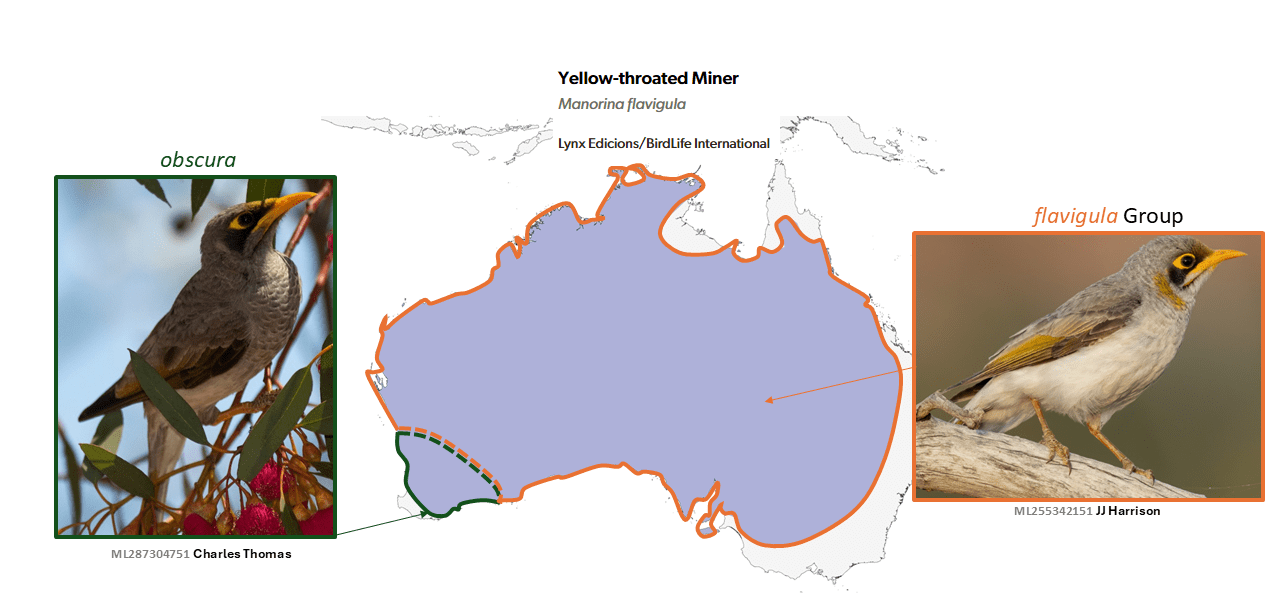
New groups in Yellow-throated Miner Manorina flavigula
Summary: (0→2 groups)
Details: Clements v2025 taxa 17813–17819
Two new groups formed for Yellow-throated Miner Manorina flavigula:
- Yellow-throated Miner (Pale-rumped) Manorina flavigula [flavigula Group]
- subspecies melvillensis, lutea, wayensis, and flavigula
- Yellow-throated Miner (Dark-rumped) Manorina flavigula obscura (monotypic)
Graphical abstract:
New groups in Ornate Melidectes Melidectes torquatus
Summary: (0→2 groups)
Details: Clements v2025 taxa 17828–17835
Two new groups are formed for Ornate Melidectes Melidectes torquatus:
- Ornate Melidectes (Ornate) Melidectes torquatus [torquatus Group]
- subspecies torquatus, nuchalis, mixtus, cahni, and polyphonus)
- Ornate Melidectes (Large-wattled) Melidectes torquatus emilii (monotypic)
Graphical abstract:

New groups in Belford’s Melidectes Melidectes belfordi
Summary: (0→3 groups)
Details: Clements v2025 taxa 17842–17849
Three new groups are formed for Belford’s Melidectes Melidectes belfordi:
- Belford’s Melidectes (Eastern) Melidectes belfordi belfordi/brassi
- subspecies belfordi and brassi
- Belford’s Melidectes (Western) Melidectes belfordi joiceyi/kinneari
- subspecies joiceyi and kinneari
- Belford’s Melidectes (Schrader Mts.) Melidectes belfordi schraderensis (monotypic)
Graphical abstract:

New groups in Varied Honeyeater Gavicalis versicolor
Summary: (0→2 groups)
Details: Clements v2025 taxa 17873–17875
Two new groups are formed for Varied Honeyeater Gavicalis versicolor:
- Varied Honeyeater (Northern) Gavicalis versicolor sonoroides (monotypic)
- Varied Honeyeater (Southern) Gavicalis versicolor versicolor (monotypic)
Graphical abstract:

New groups in Smoky Honeyeater Melipotes fumigatus
Summary: (0→2 groups)
Details: Clements v2025 taxa 17917–17919
Two new groups are formed for Smoky Honeyeater Melipotes fumigatus:
- Smoky Honeyeater (Kumawa) Melipotes fumigatus kumawa (monotypic)
- Smoky Honeyeater (Smoky) Melipotes fumigatus fumigatus/goliathi
- subspecies fumigatus and goliathi
Graphical abstract:

New groups in Papuan Black Myzomela Myzomela nigrita
Summary: (0→3 groups)
Details: Clements v2025 taxa 17971–17978
Three new groups are formed for Papuan Black Myzomela Myzomela nigrita:
- Papuan Black Myzomela (Waigeo) Myzomela nigrita steini (monotypic)
- Papuan Black Myzomela (Black) Myzomela nigrita [nigrita Group]
- subspecies nigrita, meyeri, pluto, and louisiadensis
- Papuan Black Myzomela (D’Entrecasteaux) Myzomela nigrita forbesi (monotypic)
Graphical abstract:

New groups in Red-headed Myzomela Myzomela erythrocephala
Summary: (0→2 groups)
Details: Clements v2025 taxa 17982–17984
Two new groups are formed for Red-headed Myzomela Myzomela erythrocephala:
- Red-headed Myzomela (Papuan) Myzomela erythrocephala infuscata (monotypic)
- Red-headed Myzomela (Western) Myzomela erythrocephala erythrocephala (monotypic)
Graphical abstract:

New groups in Rufous-sided Honeyeater Ptiloprora erythropleura
Summary: (0→2 groups)
Details: Clements v2025 taxa 18065–18067
Two new groups are formed for Rufous-sided Honeyeater Ptiloprora erythropleura:
- Rufous-sided Honeyeater (Red-eyed) Ptiloprora erythropleura erythropleura (monotypic)
- Rufous-sided Honeyeater (White-eyed) Ptiloprora erythropleura dammermani (monotypic)
Graphical abstract:

New groups in White-cheeked Honeyeater Phylidonyris niger
Summary: (0→2 groups)
Details: Clements v2025 taxa 18108–18110
Two new groups are formed for White-cheeked Honeyeater Phylidonyris niger:
- White-cheeked Honeyeater (White-cheeked) Phylidonyris niger niger (monotypic)
- White-cheeked Honeyeater (Gould’s) Phylidonyris niger gouldii (monotypic)
Graphical abstract:

New groups in Tawny-breasted Honeyeater Xanthotis flaviventer
Summary: (0→4 groups)
Details: Clements v2025 taxa 18153–18169
Four new groups are formed for Tawny-breasted Honeyeater Xanthotis flaviventer:
- Tawny-breasted Honeyeater (Western) Xanthotis flaviventer [flaviventer Group]
- subspecies fusciventris, flaviventer, and rubiensis
- Tawny-breasted Honeyeater (Northern) Xanthotis flaviventer meyerii/philemon
- subspecies meyerii and philemon
- Tawny-breasted Honeyeater (Southern) Xanthotis flaviventer [filiger Group]
- subspecies saturatior, tararae, giulianettii, visi, kumusii, madaraszi, and filiger
- Tawny-breasted Honeyeater (D’Entrecasteaux) Xanthotis flaviventer spilogaster (monotypic)
Graphical abstract:

New groups in Weebill Smicrornis brevirostris
Summary: (0→2 groups)
Details: Clements v2025 taxa 18281–18286
Two new groups are formed for Weebill Smicrornis brevirostris:
- Weebill (Yellow) Smicrornis brevirostris flavescens (monotypic)
- Weebill (Brown) Smicrornis brevirostris [brevirostris Group]
- subspecies brevirostris, occidentalis, and ochrogaster
Graphical abstract:

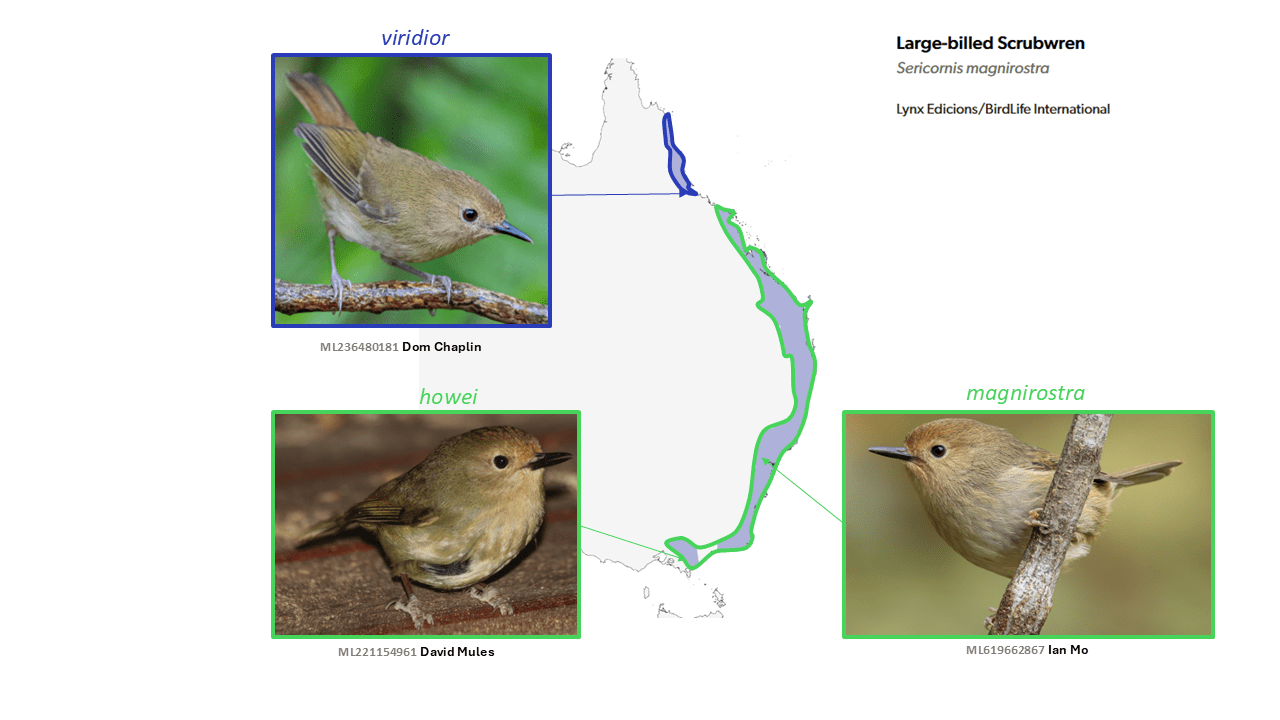
New groups in Large-billed Scrubwren Sericornis magnirostra
Summary: (0→2 groups)
Details: Clements v2025 taxa 18331–18335
Two new groups are formed for Large-billed Scrubwren Sericornis magnirostra:
- Large-billed Scrubwren (Straight-billed) Sericornis magnirostra viridior (monotypic)
- Large-billed Scrubwren (Recurve-billed) Sericornis magnirostra magnirostra/howei
- subspecies magnirostra and howei
Graphical abstract:
New groups in Southern Whiteface Aphelocephala leucopsis
Summary: (0→2 groups)
Details: Clements v2025 taxa 18372–18374
Two new groups are formed for Southern Whiteface Aphelocephala leucopsis:
- Southern Whiteface (Gray-flanked) Aphelocephala leucopsis leucopsis (monotypic)
- Southern Whiteface (Rufous-flanked) Aphelocephala leucopsis castaneiventris (monotypic)
Graphical abstract:

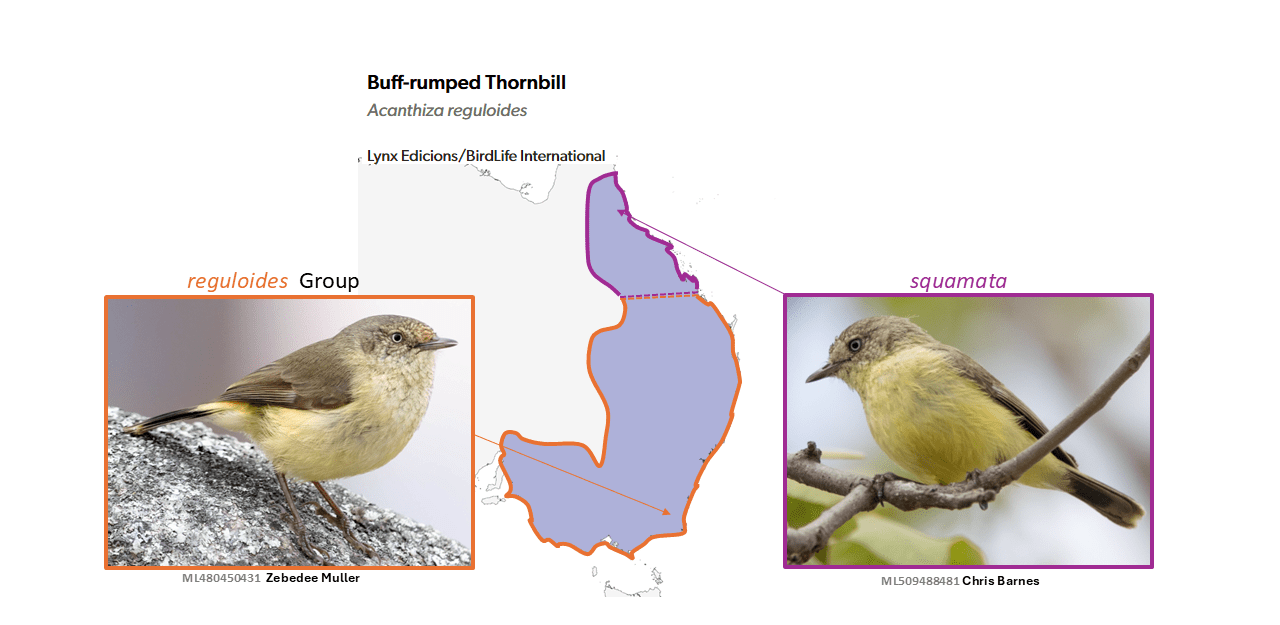
New groups in Buff-rumped Thornbill Acanthiza reguloides
Summary: (0→2 groups)
Details: Clements v2025 taxa 18417–18422
Two new groups are formed for Buff-rumped Thornbill Acanthiza reguloides:
- Buff-rumped Thornbill (Yellowish) Acanthiza reguloides squamata (monotypic)
- Buff-rumped Thornbill (Buff-rumped) Acanthiza reguloides [reguloides Group]
- subspecies nesa, reguloides, and australis
Graphical abstract:
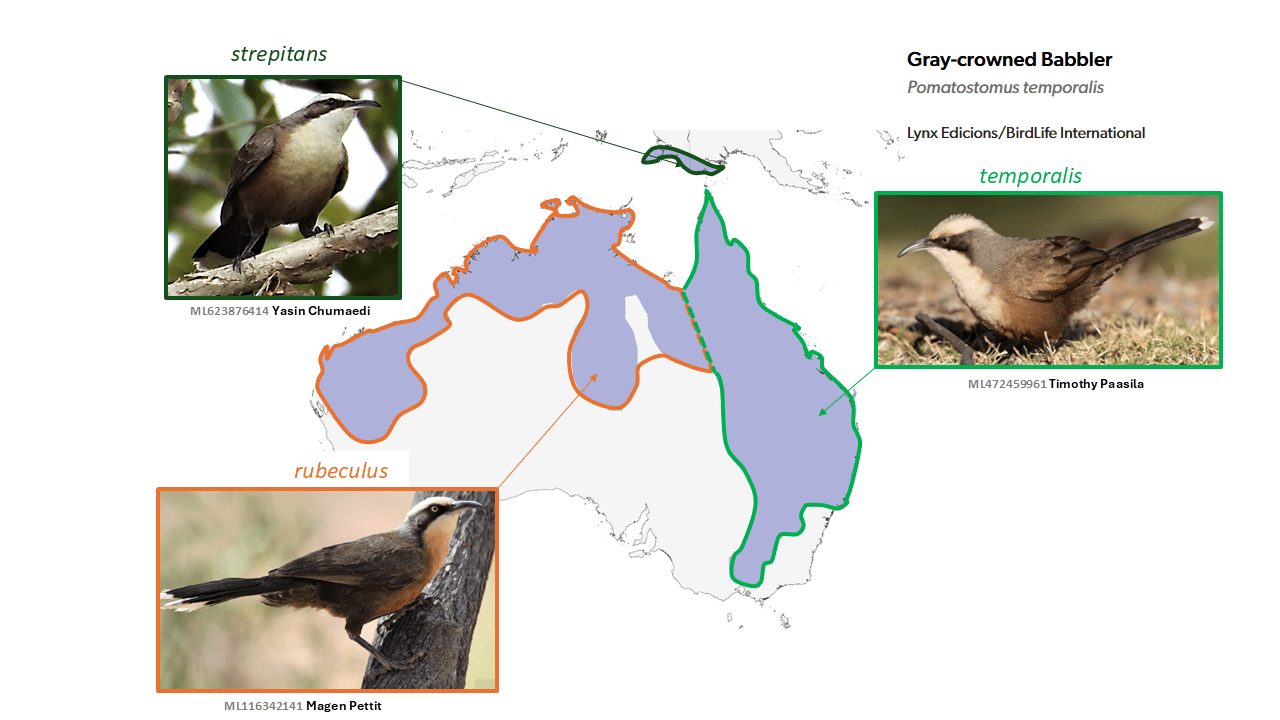
New groups in Gray-crowned Babbler Pomatostomus temporalis
Summary: (0→2 groups)
Details: Clements v2025 taxa 18504–18508
Two new groups are formed for Gray-crowned Babbler Pomatostomus temporalis:
- Gray-crowned Babbler (Gray-crowned) Pomatostomus temporalis temporalis/strepitans
- subspecies temporalis and strepitans
- Gray-crowned Babbler (Rufous-breasted) Pomatostomus temporalis rubeculus (monotypic)
Graphical abstract:
New groups in Papuan Logrunner Orthonyx novaeguineae
Summary: (0→2 groups)
Details: Clements v2025 taxa 18518–18522
Two new groups are formed for Papuan Logrunner Orthonyx novaeguineae:
- Papuan Logrunner (Arfak) Orthonyx novaeguineae novaeguineae (monotypic)
- Papuan Logrunner (Papuan) Orthonyx novaeguineae victorianus/dorsalis
- subspecies victorianus and dorsalis
Graphical abstract:

New groups in Sahul Cicadabird Edolisoma tenuirostre
Summary: (0→4 groups)
Details: Clements v2025 taxa 18940–18947
Four new groups are formed for Sahul Cicadabird Edolisoma tenuirostre:
- Sahul Cicadabird (Papuan) Edolisoma tenuirostre [muellerii Group]
- subspecies muellerii, nehrkorni, and aruense
- Sahul Cicadabird (Tagula) Edolisoma tenuirostre tagulanum (monotypic)
- Sahul Cicadabird (Rainforest) Edolisoma tenuirostre melvillense (monotypic)
- Sahul Cicadabird (Woodland) Edolisoma tenuirostre tenuirostre (monotypic)
Graphical abstract:
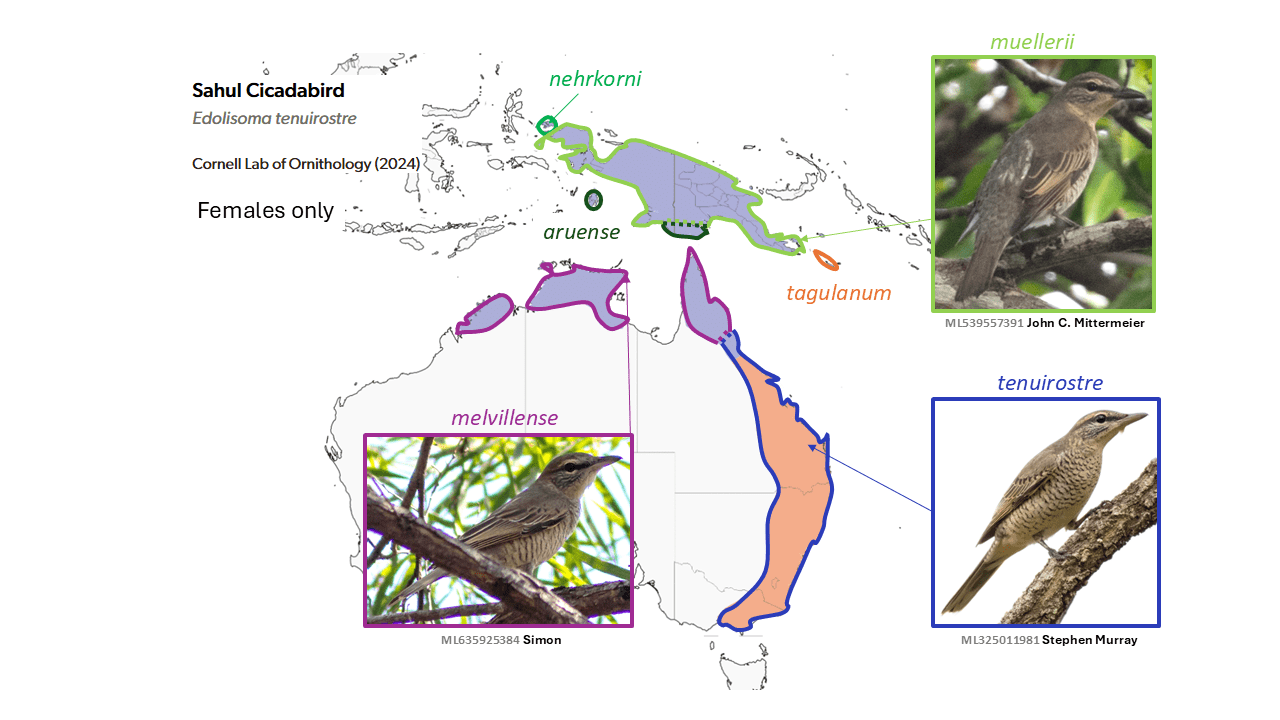
Notes: Widespread New Guinea subspecies muellerii may be better synonymized with nominate (Gregory 2025). Distinctiveness of Waigeo nehrkorni and Tagula/Misima tagulanum requires further study. In eastern Australia, melvillense and tenuirostre largely occupy different habitats and evidently differ in song characteristics, hence their separation into groups (Menkhorst et al. 2017).
New groups in Yucatan Vireo Vireo magister
Summary: (0→2 groups)
Details: Clements v2025 taxa 19302–19304
Two new groups are formed for Yucatan Vireo Vireo magister:
- Yucatan Vireo (Yucatan) Vireo magister magister (monotypic)
- Yucatan Vireo (Cayman) Vireo magister caymanensis (monotypic)
Graphical abstract:

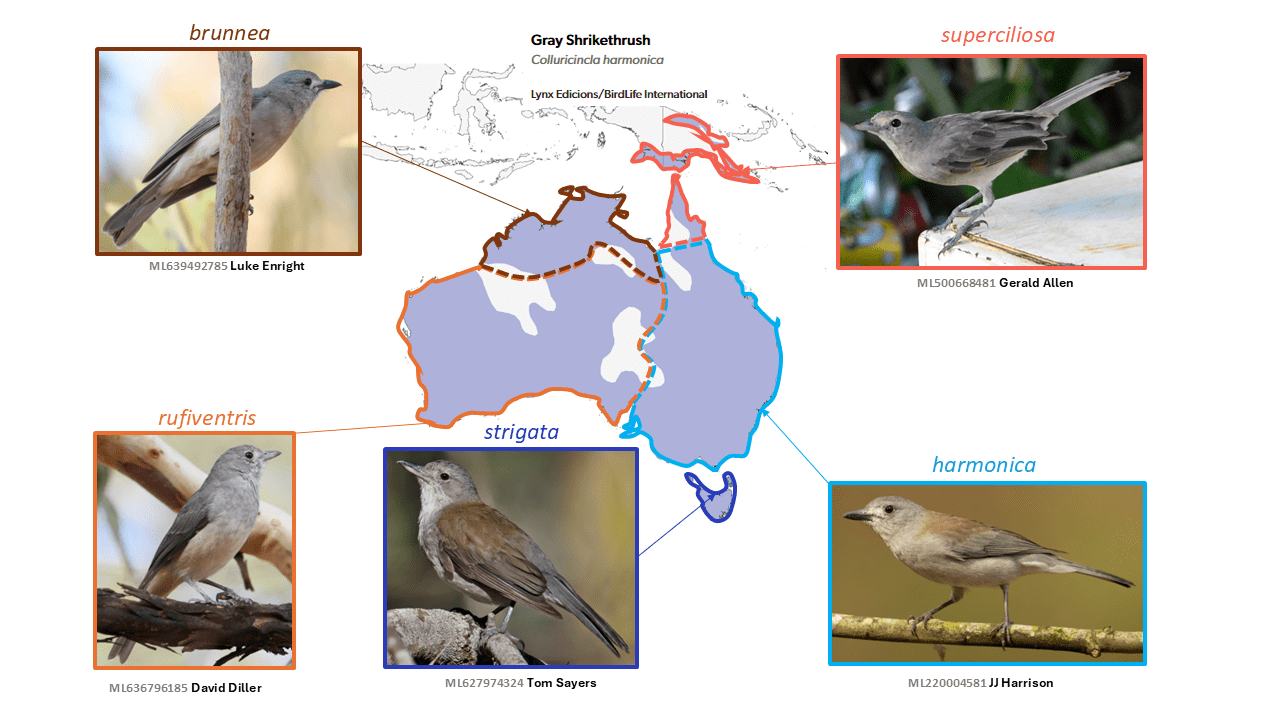
New groups in Gray Shrikethrush Colluricincla harmonica
Summary: (0→2 groups)
Details: Clements v2025 taxa 19318–19325
Two new groups are formed for Gray Shrikethrush Colluricincla harmonica:
- Gray Shrikethrush (Gray) Colluricincla harmonica [brunnea Group]
- subspecies brunnea, superciliosa, and rufiventris
- Gray Shrikethrush (Brown-backed) Colluricincla harmonica harmonica/strigata
- subspecies harmonica and strigata
Graphical abstract:
New groups in Vanuatu Whister Pachycephala chlorura
Summary: (0→2 groups)
Details: Clements v2025 taxa 19394–19399
Two new groups are formed for Vanuatu Whister Pachycephala chlorura:
- Vanuatu Whistler (Vanuatu) Pachycephala chlorura [chlorura Group]
- subspecies intacta, chlorura, and cucullata
- Vanuatu Whistler (Loyalty) Pachycephala chlorura littayei (monotypic)
Graphical abstract:

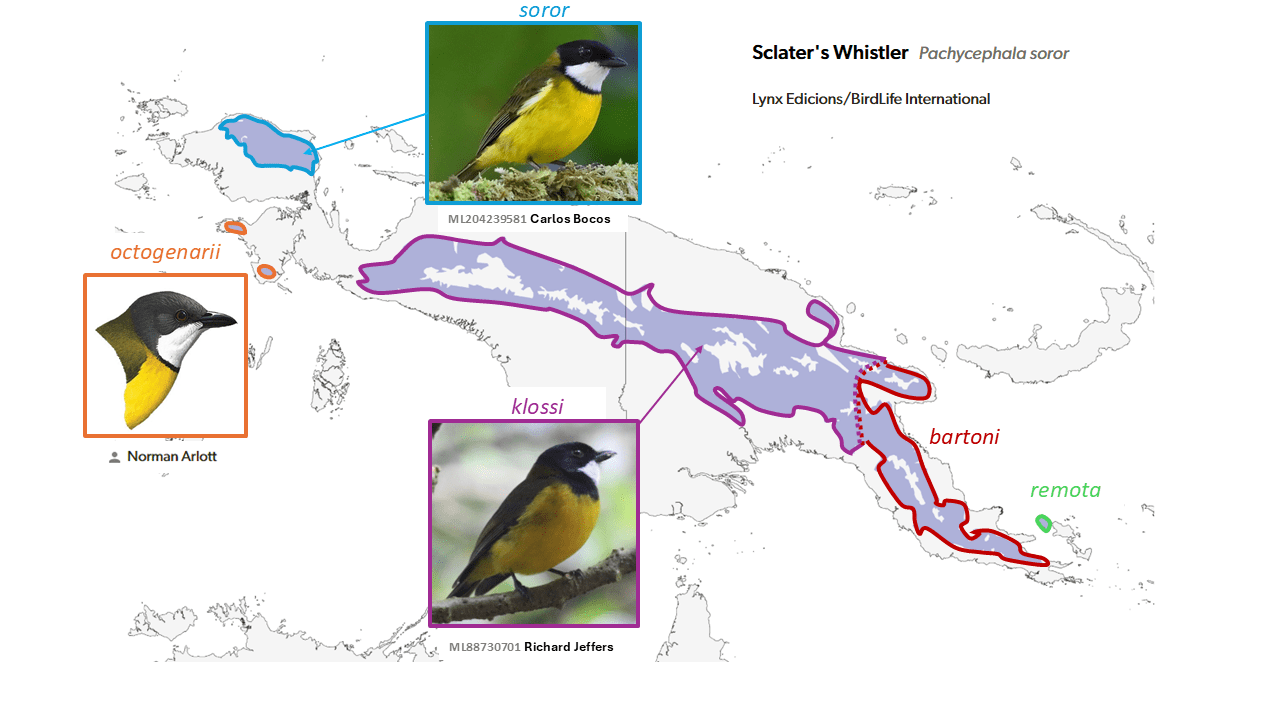
New groups in Sclater’s Whistler Pachycephala soror
Summary: (0→2 groups)
Details: Clements v2025 taxa 19401–19407
Two new groups are formed for Sclater’s Whistler Pachycephala soror:
- Sclater’s Whistler (Sclater’s) Pachycephala soror [soror Group]
- subspecies soror, klossi, bartoni, and remota
- Sclater’s Whistler (Bomberai) Pachycephala soror octogenarii (monotypic)
Graphical abstract:
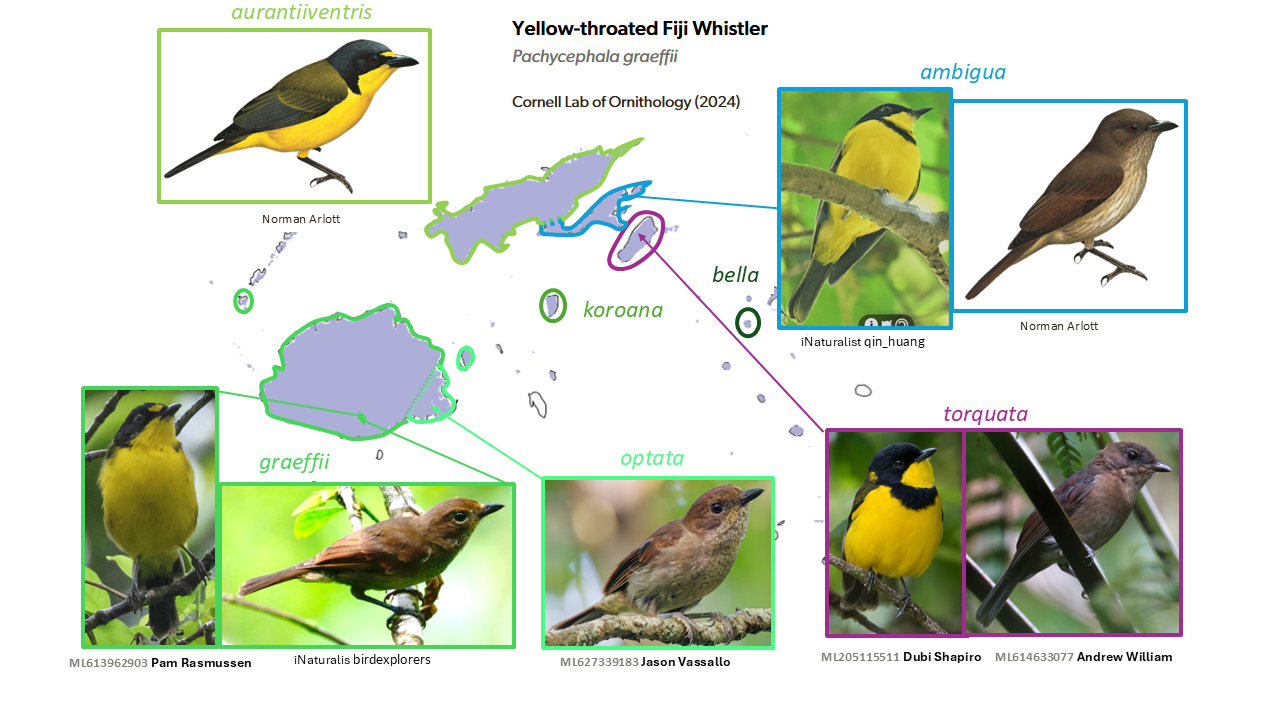
New groups in Yellow-throated Fiji Whistler Pachycephala graeffii
Summary: (0→3 groups)
Details: Clements v2025 taxa 19413–19422
Three new groups are formed for Yellow-throated Fiji Whistler Pachycephala graeffii:
- Yellow-throated Fiji Whistler (Yellow-lored) Pachycephala graeffii graeffii/aurantiiventris
- subspecies graeffii and aurantiiventris
- Yellow-throated Fiji Whistler (Black-banded) Pachycephala graeffii [optata Group]
- subspecies koroana, ambigua, optata, and bella
- Yellow-throated Fiji Whistler (Taveuni) Pachycephala graeffii torquata (monotypic)
Graphical abstract:
New groups in Bismarck Whistler Pachycephala citreogaster
Summary: (0→2 groups)
Details: Clements v2025 taxa 19428–19434
Two new groups are formed for Bismarck Whistler Pachycephala citreogaster:
- Bismarck Whistler (Manus) Pachycephala citreogaster goodsoni (monotypic)
- Bismarck Whistler (Bismarck) Pachycephala citreogaster [citreogaster Group]
- subspecies sexuvaria, citreogaster, tabarensis, and ottomeyeri
Graphical abstract:

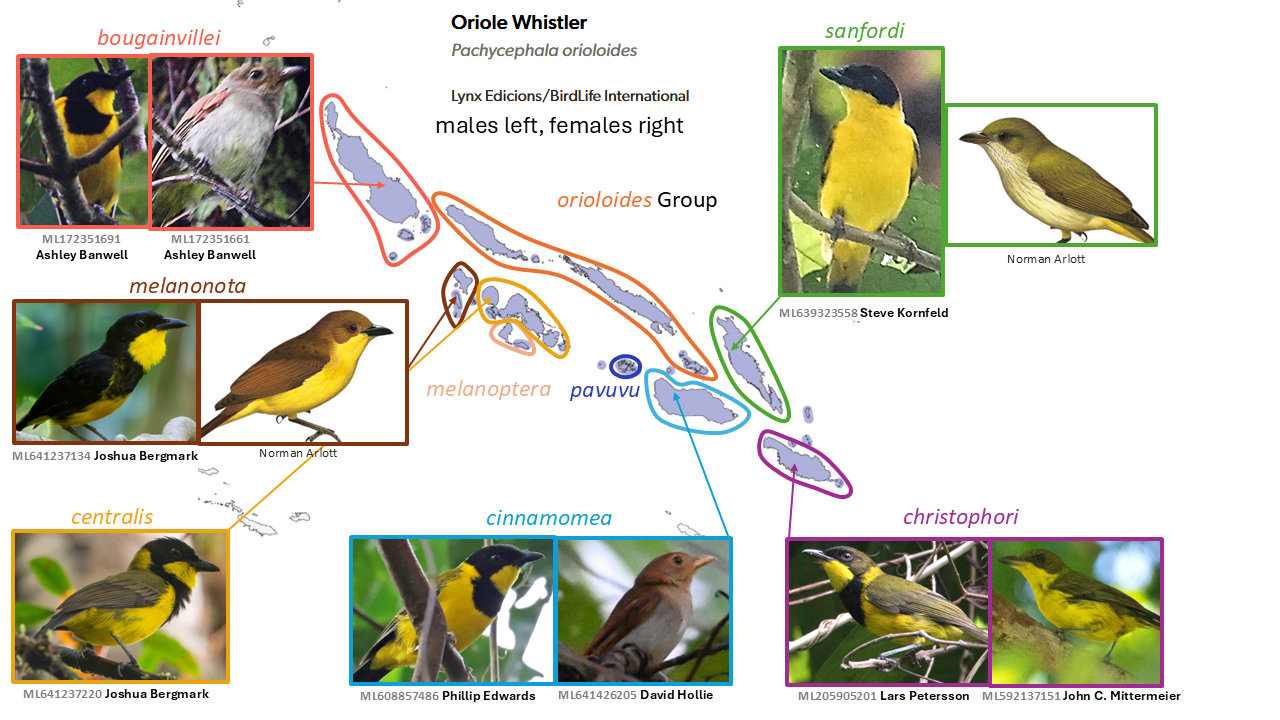
New groups in Oriole Whistler Pachycephala orioloides
Summary: (0→5 groups)
Details: Clements v2025 taxa 19442–19452
Five new groups are formed for Oriole Whistler Pachycephala orioloides:
- Oriole Whistler (North Solomons) Pachycephala orioloides [orioloides Group]
- subspecies bougainvillei, orioloides, pavuvu, centralis, and melanoptera
- Oriole Whistler (Vella Lavella) Pachycephala orioloides melanonota (monotypic)
- Oriole Whistler (Malaita) Pachycephala orioloides sanfordi (monotypic)
- Oriole Whistler (Guadalcanal) Pachycephala orioloides cinnamomea (monotypic)
- Oriole Whistler (Makira) Pachycephala orioloides christophori (monotypic)
Graphical abstract:
New and redefined groups in Tenggara Whistler Pachycephala calliope
Summary: (2→4 groups)
Details: Clements v2025 taxa 19454–19460
The former Tenggara Whistler (Rusty-breasted) Pachycephala calliope [fulvotincta Group] becomes three new groups:
- Tenggara Whistler (Rusty-breasted) Pachycephala calliope fulvotincta/javana
- subspecies fulvotincta and javana
- Tenggara Whistler (Flores Sea) Pachycephala calliope everetti (monotypic)
- Tenggara Whistler (Sumba) Pachycephala calliope fulviventris (monotypic)
Graphical abstract:

New groups in Moluccan Whistler Pachycephala macrorhyncha
Summary: (0→2 groups)
Details: Clements v2025 taxa 19462–19468
Two new groups are formed for Moluccan Whistler Pachycephala macrorhyncha:
- Moluccan Whistler (Moluccan) Pachycephala macrorhyncha [macrorhyncha Group]
- subspecies pelengensis, clio, buruensis, and macrorhyncha
- Moluccan Whistler (Tanimbar) Pachycephala macrorhyncha fuscoflava (monotypic)
Graphical abstract:

New groups in Black-chinned Whistler Pachycephala mentalis
Summary: (0→2 groups)
Details: Clements v2025 taxa 19470–19474
Two new groups are formed for Black-chinned Whistler Pachycephala mentalis:
- Black-chinned Whistler (North Moluccan) Pachycephala mentalis mentalis/tidorensis
- subspecies mentalis and tidorensis
- Black-chinned Whistler (Obi) Pachycephala mentalis obiensis (monotypic)
Graphical abstract:

New and redefined groups in Golden Whistler Pachycephala pectoralis
Summary: (2→3 groups)
Details: Clements v2025 taxa 19476–19485
One new group is formed for Golden Whistler Pachycephala pectoralis:
- Golden Whistler (Norfolk) Pachycephala pectoralis xanthoprocta (monotypic)
- one existing group Golden Whistler (Eastern) Pachycephala pectoralis [pectoralis Group] is redefined
- subspecies pectoralis, youngi, glaucura, and contempta
Graphical abstract:

New and redefined groups in Black-tailed Whistler Pachycephala melanura
Summary: (2→4 groups)
Details: Clements v2025 taxa 19486–19492
Three new groups are formed for Black-tailed Whistler Pachycephala melanura from the former Black-tailed Whistler (Black-tailed) Pachycephala melanura [melanura Group]:
- Black-tailed Whistler (Papuan) Pachycephala melanura spinicaudus/dahli
- subspecies spinicaudus and dahli
- Black-tailed Whistler (Pilbara) Pachycephala melanura melanura (monotypic)
- Black-tailed Whistler (North Australian) Pachycephala melanura robusta (monotypic)
Graphical abstract:


New and redefined groups in Gray Whistler Pachycephala simplex
Summary: (2→4 groups)
Details: Clements v2025 taxa 19529–19539
Two new groups are formed for Gray Whistler Pachycephala simplex:
- Gray Whistler (Kai) Pachycephala simplex rufipennis (monotypic)
- Gray Whistler (Tagula) Pachycephala simplex sudestensis (monotypic)
One existing group is redefined, as:
- Gray Whistler (Gray-headed) Pachycephala simplex [griseiceps Group]
- subspecies miosnomensis, griseiceps, jobiensis, and peninsulae
Graphical abstract:

Notes: The preexisting group Gray Whistler (Brown) Pachycephala simplex simplex/brunnescens is biogeographically implausible as a monophyletic group, as simplex is confined to far north-central Australia, and brunnescens to southeastern New Guinea, the two being separated by part of the range of griseiceps. Further work is needed on this matter, as is also the case for species limits in this complex.
New groups in Wallacean Whistler Pachycephala arctitorquis
Summary: (0→2 groups)
Details: Clements v2025 taxa 19540–19544
Two new groups are formed for Wallacean Whistler Pachycephala arctitorquis:
- Wallacean Whistler (Tayandu) Pachycephala arctitorquis tianduana (monotypic)
- Wallacean Whistler (Wallacean) Pachycephala arctitorquis arctitorquis/kebirensis
- subspecies arctitorquis and kebirensis
Graphical abstract:

New and redefined groups in Drab Whistler Pachycephala griseonota
Summary: (2→6 groups)
Details: Clements v2025 taxa 19545–19551
Five new groups are formed for Drab Whistler Pachycephala griseonota from the former Drab Whistler (Drab) Pachycephala griseonota [griseonota Group]:
- Drab Whistler (Peleng) Pachycephala griseonota lineolata (monotypic)
- Drab Whistler (Halmahera) Pachycephala griseonota cinerascens (monotypic)
- Drab Whistler (Buru) Pachycephala griseonota examinata (monotypic)
- Drab Whistler (Seram) Pachycephala griseonota griseonota (monotypic)
- Drab Whistler (Kai) Pachycephala griseonota kuehni (monotypic)
Graphical abstract:

Notes: mtDNA results in Irestedt et al. (2025) suggest that the griseonota complex may not be monophyletic, with griseonota and examinanda (from Peleng-Sula and Buru, respectively) in one clade and the remaining taxa, including the distinctively plumaged johni of Obi in another. Nuclear DNA results ran counter to this but were poorly supported (Irestedt et al. 2025). The possibility of Pachycephala griseonota comprising more than one species has been previously suggested (Eaton et al. 2021).
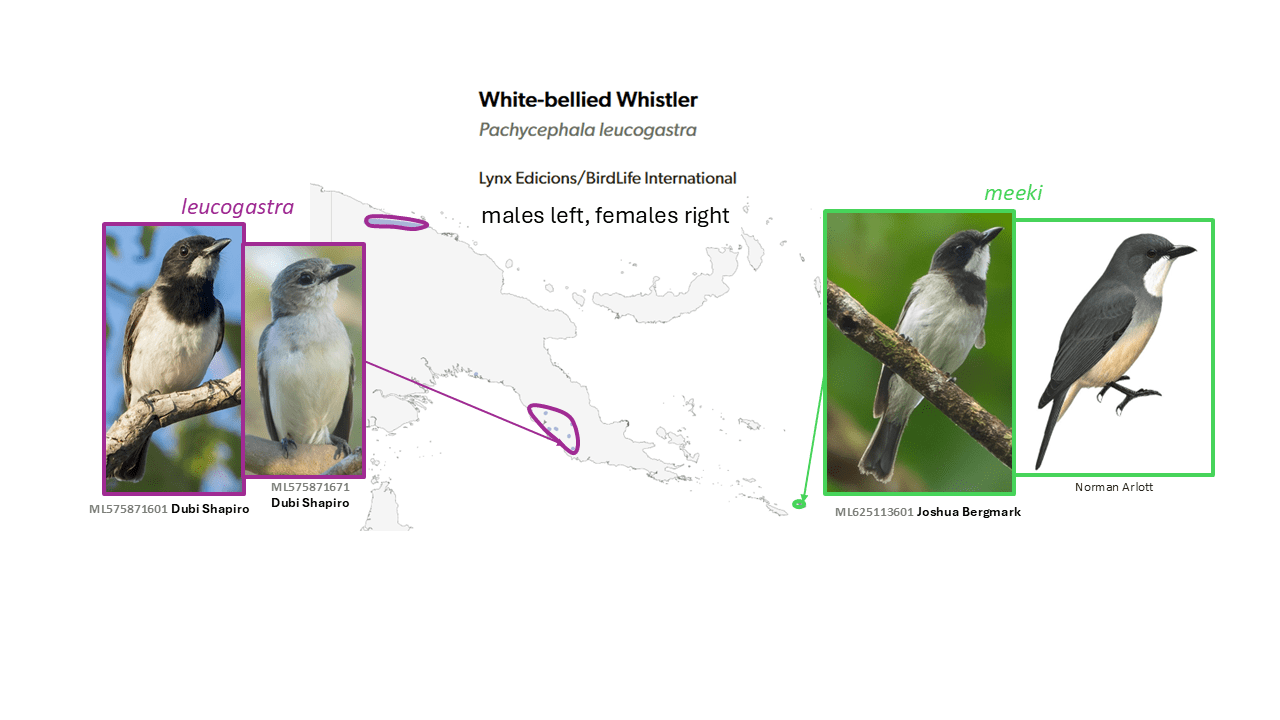
New groups in White-bellied Whistler Pachycephala leucogastra
Summary: (0→2 groups)
Details: Clements v2025 taxa 19552–19554
Two new groups are formed for White-bellied Whistler Pachycephala leucogastra:
- White-bellied Whistler (Papuan) Pachycephala leucogastra leucogastra (monotypic)
- White-bellied Whistler (Rossel) Pachycephala leucogastra meeki (monotypic)
Graphical abstract:
New groups in Rufous Whistler Pachycephala rufiventris
Summary: (0→2 groups)
Details: Clements v2025 taxa 19558–19564
Two new groups are formed for Rufous Whistler Pachycephala rufiventris:
- Rufous Whistler (Australian) Pachycephala rufiventris [rufiventris Group]
- subspecies minor, falcata, pallida, and rufiventris
- Rufous Whistler (Grand Terre) Pachycephala rufiventris xanthetraea (monotypic)
Graphical abstract:

New groups in Northern Variable Pitohui Pitohui kirhocephalus
Summary: (0→6 groups)
Details: Clements v2025 taxa 19577–19588
Six new groups are formed for Northern Variable Pitohui Pitohui kirhocephalus:
- Northern Variable Pitohui (Northwestern) Pitohui kirhocephalus [kirhocephalus Group]
- subspecies kirhocephalus, meyeri, and senex
- Northern Variable Pitohui (Sepik-Ramu) Pitohui kirhocephalus brunneicaudus (monotypic)
- Northern Variable Pitohui (Onin) Pitohui kirhocephalus decipiens (monotypic)
- Northern Variable Pitohui (Wandammen) Pitohui kirhocephalus rubiensis/dohertyi
- subspecies rubiensis and dohertyi
- Northern Variable Pitohui (Yapen) Pitohui kirhocephalus jobiensis (monotypic)
Northern Variable Pitohui (Geelvink) Pitohui kirhocephalus brunneivertex (monotypic)
Graphical abstract:

New groups in Southern Variable Pitohui Pitohui uropygialis
Summary: (0→4 groups)
Details: Clements v2025 taxa 19589–19595
Four new groups are formed for Southern Variable Pitohui Pitohui uropygialis:
- Southern Variable Pitohui (Misool) Pitohui uropygialis uropygialis (monotypic)
- Southern Variable Pitohui (Mimika) Pitohui uropygialis aruensis/nigripectus
- subspecies aruensis and nigripectus
- Southern Variable Pitohui (Brown-headed) Pitohui uropygialis brunneiceps (monotypic)
- Southern Variable Pitohui (Southeastern) Pitohui uropygialis meridionalis (monotypic)
Graphical abstract:

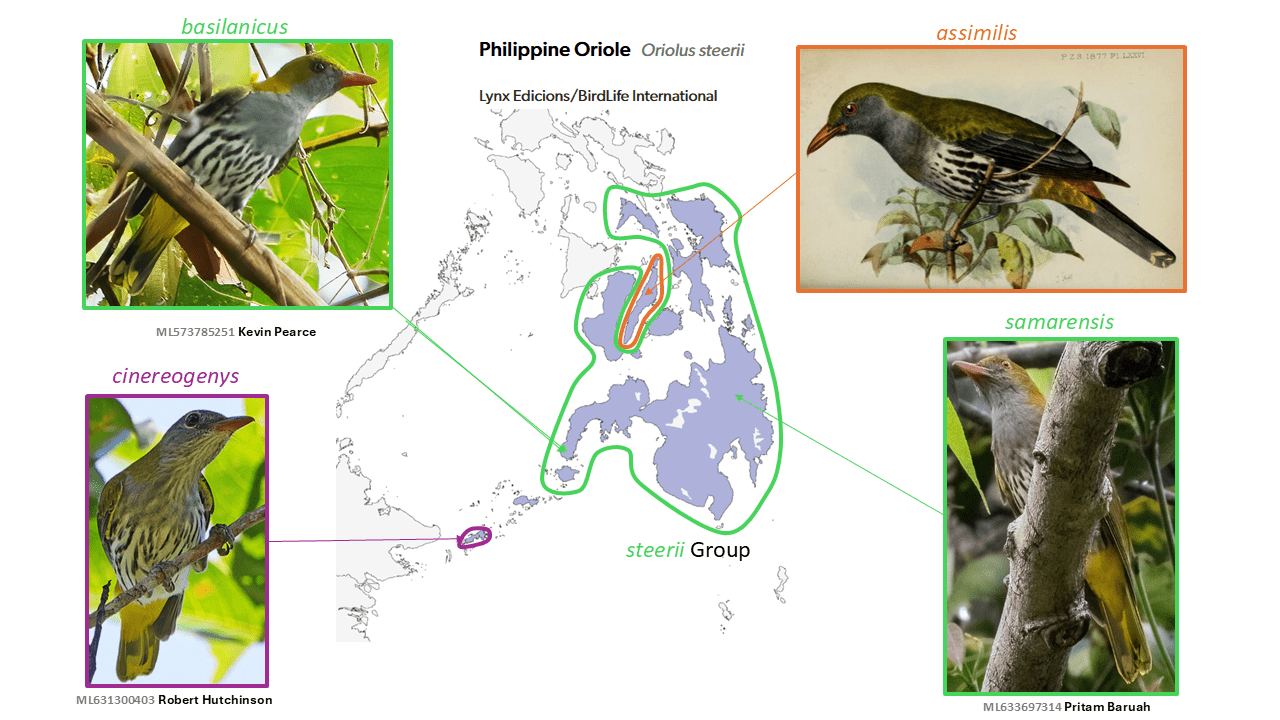
New groups in Philippine Oriole Oriolus steerii
Summary: (0→3 groups)
Details: Clements v2025 taxa 19621–19627
Three new groups are added for Philippine Oriole Oriolus steerii:
- Philippine Oriole (Mindanao) Oriolus steerii [steerii Group]
- subspecies samarensis, basilanicus, and steerii
- Philippine Oriole (Cebu) Oriolus steerii assimilis (monotypic)
- Philippine Oriole (Sulu) Oriolus steerii cinereogenys (monotypic)
Graphical abstract:
New and redefined groups in Australasian Figbird Sphecotheres vieilloti
Summary: (3→4 groups)
Details: Clements v2025 taxa 19708–19714
One new group is formed for Australasian Figbird Sphecotheres vieilloti from redefinition of the former group Australasian Figbird (flaviventris Group) Sphecotheres vieilloti [flaviventris Group] into the following two groups:
- Australasian Figbird (Kai) Sphecotheres vieilloti cucullatus (monotypic)
- Australasian Figbird (Yellow) Sphecotheres vieilloti flaviventris/ashbyi
Graphical abstract:

New groups in Yellow-breasted Boatbill Machaerirhynchus flaviventer
Summary: (0→4 groups)
Details: Clements v2025 taxa 19724–19732
Four new groups are added for Yellow-breasted Boatbill Machaerirhynchus flaviventer:
- Yellow-breasted Boatbill (Waigeo) Machaerirhynchus flaviventer albifrons (monotypic)
- Yellow-breasted Boatbill (White-browed) Machaerirhynchus flaviventer novus/albigula
- subspecies novus and albigula
- Yellow-breasted Boatbill (Yellow-faced) Machaerirhynchus flaviventer xanthogenys (monotypic)
- Yellow-breasted Boatbill (Black-cheeked) Machaerirhynchus flaviventer flaviventer/secundus
- subspecies flaviventer and secundus
Graphical abstract:

New groups in New Zealand Fantail Rhipidura fuliginosa
Summary: (0→2 groups)
Details: Clements v2025 taxa 20397–20402
Two new groups are formed for New Zealand Fantail Rhipidura fuliginosa:
- New Zealand Fantail (Lord Howe) Rhipidura fuliginosa cervina (monotypic)
- New Zealand Fantail (New Zealand) Rhipidura fuliginosa [fuliginosa Group]
- with subspecies fuliginosa, placabilis, and penita
Graphical abstract:

Notes: Chatham Islands penita probably also warrants a separate group. Taxonomy of the extinct Lord Howe cervina may need reevaluation. It was originally described at the species level as Rhipidura cervina Ramsay, 1879.
New groups in Clytorhynchus nigrogularis nigrogularis and Clytorhynchus nigrogularis maximus
Summary: (0→2 groups)
Details: Clements v2024 taxa 20837–20839
Was:
- Black-faced Shrikebill Clytorhynchus nigrogularis (monotypic)
Now:
- Black-faced Shrikebill (Black-faced) Clytorhynchus nigrogularis nigrogularis
- Black-faced Shrikebill (Kadavu) Clytorhynchus nigrogularis maximus
See Subspecies Changes for more details.
New and redefined groups in Southern Fiscal Lanius collaris
Summary: (2→3 groups)
Details: Clements v2025 taxa 21146–21153
One existing group is redefined to form one new group for Southern Fiscal Lanius collaris, with the split of Southern Fiscal (Southern) [collaris Group] into:
- Southern Fiscal (Southern) Lanius collaris collaris/pyrrhostictus
- with subspecies collaris/pyrrhostictus
- Southern Fiscal (Latakoo) Lanius collaris subcoronatus/aridicolus
with subspecies subcoronatus and aridicolus
Graphical abstract:

Notes: This map involves numerous areas of uncertainty, and the colored outlines are based largely on a sample of adults in the 1000 most recently uploaded ML images in which the head pattern is clearly discernible. The purple dashed lines indicate areas in this sample with intermediates between the white-browed subcoronatus/aridicolus group and the black-browed collaris/pyrrhostictus group, and in northern Malawi, between montane Tanzanian marwitzi and (likely) Northern Fiscal Lanius humeralis capelli. In this sample, many individuals in the Western Cape especially have narrow, partial supercilia, while most of the intermediates farther east have only a few white feathers in the supercilia. The widespread presence of intermediates between white- and black-browed individuals is well-documented by specimen material (Dean 2005).
Fuchs et al. (2011) found two main genetic lineages in a study of the phylogeography of the former Common Fiscal (Lanius collaris). In their phylogeny, subcoronatus and aridicolus were not divergent from collaris and pyrrhostictus, while marwitzi appeared as a close sister to the remaining taxa of the southern collaris group, despite the range of marwitzi being embedded within that of the humeralis group, now treated as a separate species based on Fuchs et al. (2011). The species status of the isolated marwitzi should perhaps be reevaluated.
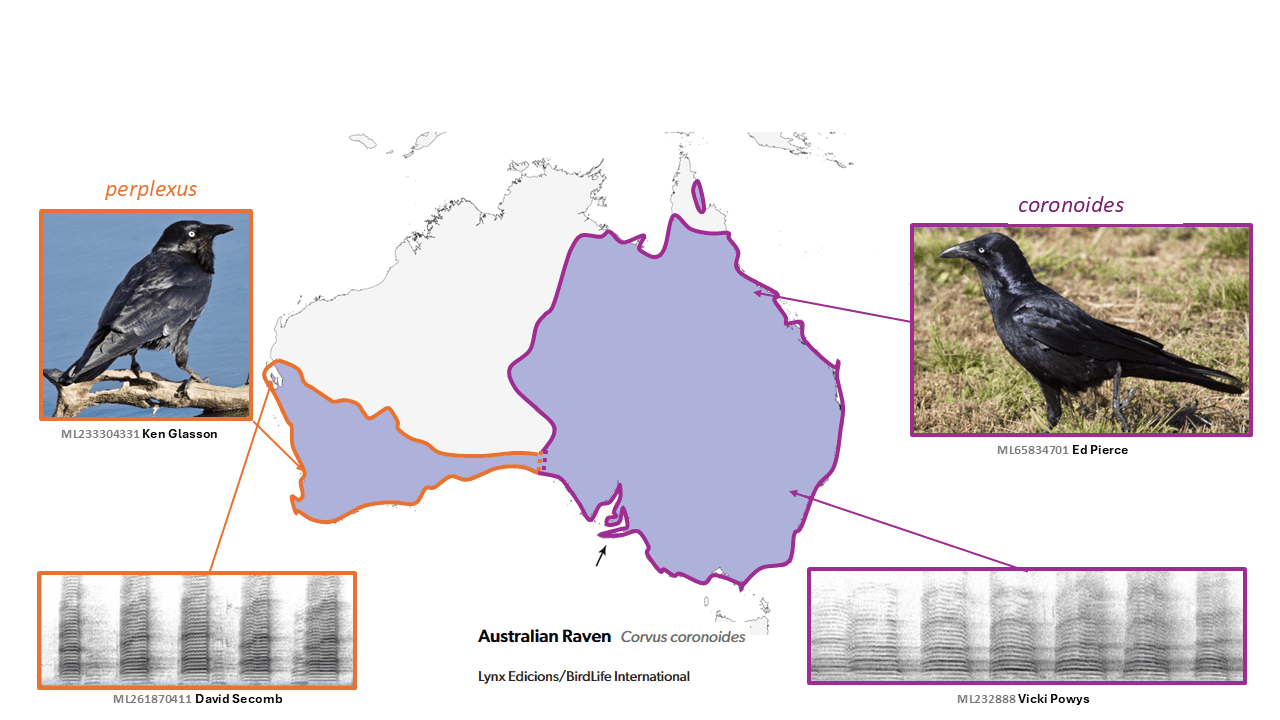
New groups in Australian Raven Corvus coronoides
Summary: (0→2 groups)
Details: Clements v2025 taxa 21608–21610
Two new groups are formed for Australian Raven Corvus coronoides:
- Australian Raven (Eastern) Corvus coronoides coronoides (monotypic)
- Australian Raven (Western) Corvus coronoides perplexus (monotypic)
Graphical abstract:
New groups in Eastern Yellow Robin Eopsaltria australis
Summary: (0→2 groups)
Details: Clements v2025 taxa 21861–21863
Two new groups are formed for Eastern Yellow Robin Eopsaltria australis:
- Eastern Yellow Robin (Wet Tropics) Eopsaltria australis chrysorrhos (monotypic)
- Eastern Yellow Robin (Southeastern) Eopsaltria australis australis (monotypic)
Graphical abstract:

New groups in Western Yellow Robin Eopsaltria griseogularis
Summary: (0→2 groups)
Details: Clements v2025 taxa 21864–21866
Two new groups are formed for Western Yellow Robin Eopsaltria griseogularis:
- Western Yellow Robin (Yellow-rumped) Eopsaltria griseogularis griseogularis (monotypic)
- Western Yellow Robin (Green-rumped) Eopsaltria griseogularis rosinae (monotypic)
Graphical abstract:

New groups in Pale-yellow Robin Eopsaltria capito
Summary: (0→2 groups)
Details: Clements v2025 taxa 21868–21870
Two new groups are formed for Pale-yellow Robin Eopsaltria capito:
- Pale-yellow Robin (Buff-lored) Eopsaltria capito nana (monotypic)
- Pale-yellow Robin (White-lored) Eopsaltria capito capito (monotypic)
Graphical abstract:

New groups in Black-crowned White-eye Zosterops atrifrons
Summary: (0→3 groups)
Details: Clements v2025 taxa 25731–25736
Three new groups are formed for Black-crowned White-eye Zosterops atrifrons:
- Black-crowned White-eye (northern Sulawesi) Zosterops atrifrons atrifrons/surdus
- subspecies atrifrons and surdus
- Black-crowned White-eye (Banggai) Zosterops atrifrons subatrifrons
- Black-crowned White-eye (Sula) Zosterops atrifrons sulaensis
Graphical abstract:

New groups in Silvereye Zosterops lateralis
Summary: (0→10 groups)
Details: Clements v2025 taxa 25769–25788
10 new groups are formed for Silvereye Zosterops lateralis:
- Silvereye (Lord Howe) Zosterops lateralis tephropleurus (monotypic)
- Silvereye (Capricorn) Zosterops lateralis chlorocephalus (monotypic)
- Silvereye (West Australian) Zosterops lateralis chloronotus (monotypic)
- Silvereye (East Australian) Zosterops lateralis [westernensis Group]
- subspecies vegetus, cornwalli, westernensis, pinarochrous, and ochrochrous
- Silvereye (Cinnamon-flanked) Zosterops lateralis lateralis (monotypic)
- Silvereye (Ouvea and Mare) Zosterops lateralis nigrescens (monotypic)
- Silvereye (Lifou) Zosterops lateralis melanops (monotypic)
- Silvereye (New Caledonian) Zosterops lateralis griseonota (monotypic)
- Silvereye (Vanuatu) Zosterops lateralis [vatensis Group]
- subspecies vatensis, valuensis, tropicus, and macmillani
- Silvereye (Fiji) Zosterops lateralis flaviceps (monotypic)
Graphical abstract:

Redefine groups of Troglodytes pacificus
Summary: (2→2 groups)
Details: Clements v2024 taxa 27288–27294
Was:
- Pacific Wren (alascensis Group) Troglodytes pacificus [alascensis Group]
- subspecies alascensis, meligerus, kiskensis, tanagensis, seguamensis, stevensoni, petrophilus, and semidiensis
- Pacific Wren (pacificus Group) Troglodytes pacificus [pacificus Group]
- subspecies helleri, pacificus, muiri, obscurior, and salebrosus
Now:
- Pacific Wren (alascensis Group) Troglodytes pacificus [alascensis Group]
- subspecies alascensis, meligerus, kiskensis, and semidiensis
- Pacific Wren (pacificus Group) Troglodytes pacificus pacificus (monotypic)
Note: See Subspecies Changes section, and Toews et al. (2025) for details.
New groups in Bassian Thrush Zoothera lunulata
Summary: (0→2 groups)
Details: Clements v2025 taxa 28227–28231
Two new groups are formed for Bassian Thrush Zoothera lunulata:
- Bassian Thrush (Northern) Zoothera lunulata cuneata (monotypic)
- Bassian Thrush (Southern) Zoothera lunulata lunulata/halmaturina
- subspecies lunulata and halmaturina
Graphical abstract:

New groups in Slaty-backed Nightingale-Thrush Catharus fuscater
Summary: (2→7 groups)
Details: Clements v2025 taxa 28274–28288
Five new groups are formed for Slaty-backed Nightingale-Thrush Catharus fuscater:
- Slaty-backed Nightingale-Thrush (Pirre) Catharus fuscater mirabilis (monotypic)
- Slaty-backed Nightingale-Thrush (Darien) Catharus fuscater arcanus (monotypic)
- Slaty-backed Nightingale-Thrush (Antioquia) Catharus fuscater opertaneus/tenebris
- subspecies opertaneus and tenebris
- Slaty-backed Nightingale-Thrush (Trans-Andean) Catharus fuscater [berlepschi Group]
- subspecies berlepschi, caniceps, and nebulus
- Slaty-backed Nightingale-Thrush (Bolivian) Catharus fuscater mentalis (monotypic)
One existing group for Slaty-backed Nightingale-Thrush Catharus fuscater is redefined, to:
- Slaty-backed Nightingale-Thrush (Cordilleran) Catharus fuscater fuscater/sanctaemartae
- subspecies fuscater and sanctaemartae
Graphical abstract:

Notes: In an integrative analysis of genomic and mtDNA, vocalization, and phenotypic of all taxa of Catharus fuscater, Halley et al. (2023) found genetics to be broadly congruent with the other types of data. They described one new species and two new subspecies, and proposed recognition of seven species in the C. fuscater complex. Their analysis shows that there are at least three groups that differ in song: the mainly Central American hellmayri group; the northeastern Andes and Santa Marta fuscater/sanctaemartae group; and the main Andean mentalis group; however, there is internal disagreement about the affinities of some taxa.
New and redefined groups in Red-legged Thrush Turdus plumbeus
Summary: (2→3 groups, accounting for split)
Details: Clements v2025 taxa 28619–28625
One new group is formed for Western Red-legged Thrush Turdus plumbeus:
- Western Red-legged Thrush (Cuban Slaty) Turdus plumbeus schistaceus (monotypic)
One existing group is redefined, to:
- Western Red-legged Thrush (Rusty-bellied) Turdus plumbeus [rubripes Group]
- subspecies rubripes, perditus, and coryi
Graphical abstract: See Splits section.
New groups in Great Thrush Turdus fuscater
Summary: (0→4 groups)
Details: Clements v2025 taxa 28677–28685
Four new groups are formed for Great Thrush Turdus fuscater:
- Great Thrush (Santa Marta) Turdus fuscater cacozelus (monotypic)
- Great Thrush (Great) Turdus fuscater [gigas Group]
- subspecies clarus, quindio, gigas, and gigantodes
- Great Thrush (Black) Turdus fuscater ockendeni (monotypic)
Great Thrush (Bolivian) Turdus fuscater fuscater (monotypic)
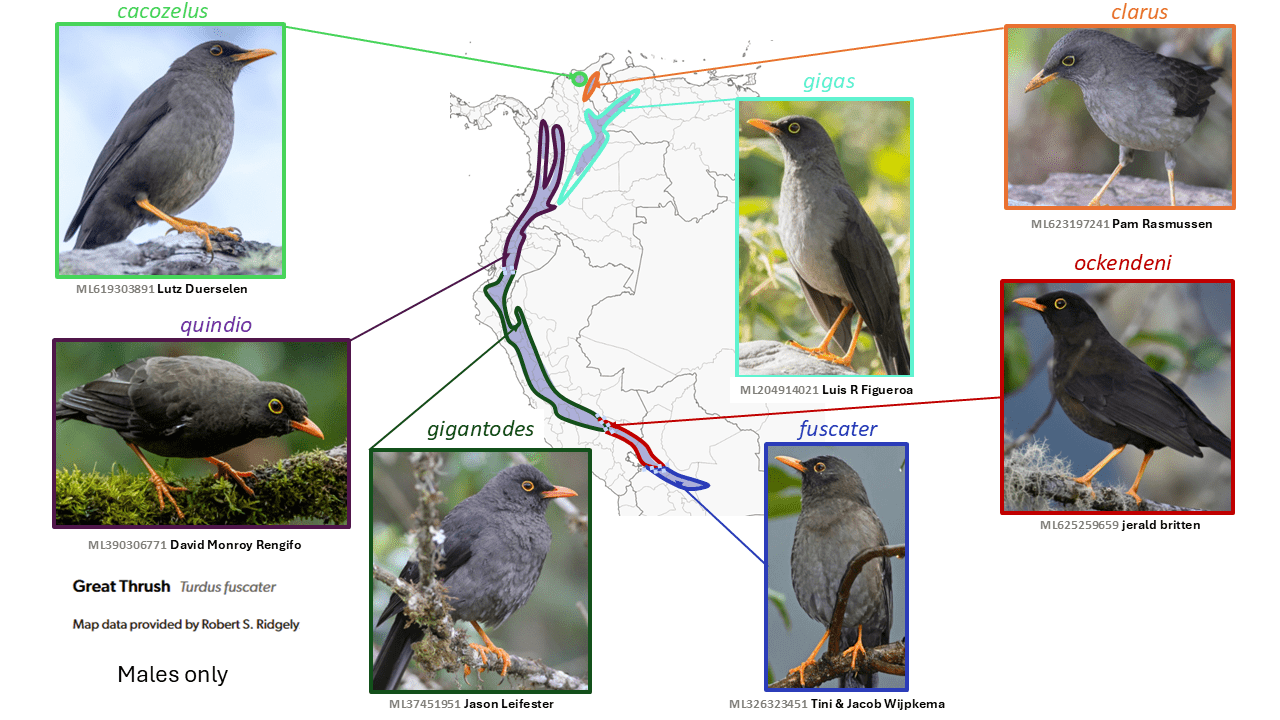
Notes: Species limits in this species complex surely need revision (see SACC proposal, which did not pass). For example, the glossy-black ockendeni, which seems to be mostly on each slopes might be locally sympatric with the slaty gigantodes in south-central Peru, and/or fuscater in western Bolivia. However, further study is needed of this and related groups before such a reassessment proceeds.
New groups in Hainan Blue Flycatcher Cyornis hainanus
Summary: (0→3 groups)
Details: Clements v2025 taxa 29113–29116
Three new groups are formed for Hainan Blue Flycatcher Cyornis hainanus:
- Hainan Blue Flycatcher (Western Orange-breasted) Cyornis hainanus dialilaemus (monotypic)
- Hainan Blue Flycatcher (Blue-breasted) Cyornis hainanus hainanus (monotypic)
- Hainan Blue Flycatcher (Eastern Orange-breasted) Cyornis hainanus klossi (monotypic)
Graphical abstract:

Notes: Distributions in some areas are very poorly known, with dialilaemus presumed to occur in northeastern India (but traditionally recorded from eastern and southern Myanmar and western and northern Thailand). Range limits based largely on Treesucon and Limparungpatthanakij (2018), Craik and Minh (2018), Cambodia Bird Guide Association (2019), Singh et al. (2020), and Yang and Chen (2024). Areas of overlap between hainanus and klossi identified in Ng et al. (2022) shown in brown hatching.
New groups in Olive-backed Flowerpecker Pachyglossa olivacea
Summary: (0→2 groups)
Details: Clements v2025 taxa 29950–29954
Two new groups are formed for Olive-backed Flowerpecker Pachyglossa olivacea
- Olive-backed Flowerpecker (Luzon) Pachyglossa olivacea parsonsi (monotypic)
- Olive-backed Flowerpecker (Mindanao) Pachyglossa olivacea olivacea/samarensis
- subspecies olivacea and samarensis
Graphical abstract:

New groups in Pygmy Flowerpecker Dicaeum pygmaeum
Summary: (0→4 groups)
Details: Clements v2025 taxa 30046–30052
Four new groups are formed for Pygmy Flowerpecker Dicaeum pygmaeum:
- Pygmy Flowerpecker (Fuga) Dicaeum pygmaeum fugaense (monotypic)
- Pygmy Flowerpecker (Luzon) Dicaeum pygmaeum pygmaeum/salomonseni
- with subspecies pygmaeum and salomonseni
- Pygmy Flowerpecker (Palawan) Dicaeum pygmaeum palawanorum (monotypic)
- Pygmy Flowerpecker (Mindanao) Dicaeum pygmaeum davao (monotypic)
Graphical abstract:

New groups in Red-banded Flowerpecker Dicaeum eximium
Summary: (0→3 groups)
Details: Clements v2025 taxa 30073–30076
Three new groups are formed for Red-banded Flowerpecker Dicaeum eximium:
- Red-banded Flowerpecker (New Britain) Dicaeum eximium layardorum (monotypic)
- Red-banded Flowerpecker (New Ireland) Dicaeum eximium eximium (monotypic)
- Red-banded Flowerpecker (Dyaul) Dicaeum eximium phaeopygium (monotypic)
Graphical abstract:

New groups in Red-browed Firetail Neochmia temporalis
Summary: (0→2 groups)
Details: Clements v2025 taxa 31023–31025
Two new groups are formed for Red-browed Firetail Neochmia temporalis:
- Red-browed Firetail (Black-vented) Neochmia temporalis minor (monotypic)
- Red-browed Firetail (Gray-vented) Neochmia temporalis temporalis (monotypic)
Graphical abstract:

New groups in Double-barred Finch Stizoptera bichenovii
Summary: (0→2 groups)
Details: Clements v2025 taxa 31032–31034
Two new groups are formed for Double-barred Finch Stizoptera bichenovii:
- Double-barred Finch (Black-rumped) Stizoptera bichenovii annulosa (monotypic)
- Double-barred Finch (White-rumped) Stizoptera bichenovii bichenovii (monotypic)
Graphical abstract:

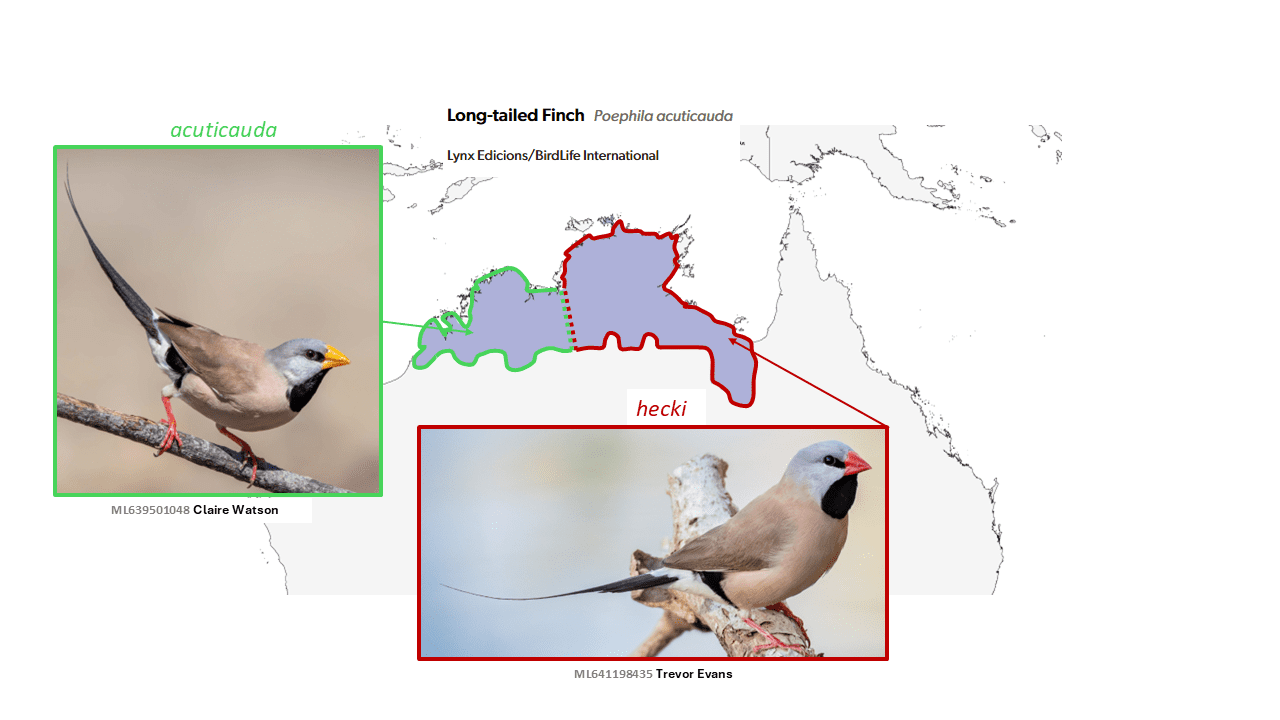
New groups in Long-tailed Finch Poephila acuticauda
Summary: (0→2 groups)
Details: Clements v2025 taxa 31043–31045
Two new groups are formed for Long-tailed Finch Poephila acuticauda:
- Long-tailed Finch (Yellow-billed) Poephila acuticauda acuticauda (monotypic)
- Long-tailed Finch (Red-billed) Poephila acuticauda hecki (monotypic)
Graphical abstract:
New groups in Australian Pipit Anthus australis
Summary: (0→2 groups)
Details: Clements v2025 taxa 31738–31745
Two new groups are formed for Australian Pipit Anthus australis:
- Australian Pipit (Papuan) Anthus australis rogersi/exiguus
- subspecies rogersi and exiguus
- Australian Pipit (Australian) Anthus australis [australis Group]
subspecies bilbali, australis, and bistriatus

New groups in New Zealand Pipit Anthus novaeseelandiae
Summary: (0→2 groups)
Details: Clements v2025 taxa 31746–31751
Two new groups are formed for New Zealand Pipit Anthus novaeseelandiae:
- New Zealand Pipit (New Zealand) Anthus novaeseelandiae [novaeseelandiae Group]
- subspecies novaeseelandiae, chathamensis, and aucklandicus
- New Zealand Pipit (Antipodes) Anthus novaeseelandiae steindachneri (monotypic)
Graphical abstract:

Recognize five groups in Evening Grosbeak Hesperiphona vespertina
Summary: (2→5 groups)
Details: Clements v2024 taxa 32085–32090
Was:
- Evening Grosbeak Coccothraustes vespertinus
Now:
- Evening Grosbeak Hesperiphona vespertina
- Evening Grosbeak (Northwestern or type 1) Hesperiphona vespertina brooksi
- Evening Grosbeak (Sierra Nevada or type 2) Hesperiphona vespertina californica
- Evening Grosbeak (Rocky Mountains or type 4) Hesperiphona vespertina warreni
- Evening Grosbeak (Eastern or type 3) Hesperiphona vespertina vespertina
- Evening Grosbeak (Mexican or type 5) Hesperiphona vespertina montana
The vocal groups as summarized by Sewell et al. (2004) correspond well with the above subspecies of Evening Grosbeak (Gillihan and Byers 2025), now also treated as groups. See Subspecies Changes and Gillihan and Byers (2025) for more details.
New groups in Dusky Chlorospingus Chlorospingus semifuscus
Summary: (0→3 groups)
Details: Clements v2025 taxa 32901–32904
Three new groups are formed for Dusky Chlorospingus Chlorospingus semifuscus:
- Dusky Chlorospingus (Northern) Chlorospingus semifuscus livingstoni (monotypic)
- Dusky Chlorospingus (Red-eyed) Chlorospingus semifuscus semifuscus (monotypic)
- Dusky Chlorospingus (El Oro) Chlorospingus semifuscus xanthothorax (monotypic)
Graphical abstract:

Notes: The new taxon xanthothorax Sanchez-Nivicela et al., 2021 of far southwestern Ecuador was formerly considered possibly an undescribed subspecies of Chlorospingus flavopectus, or as part of Chlorospingus flavopectus phaeocephalus. It was shown to be genetically nested within Chlorospingus semifuscus by Sanchez-Nivicela et al. (2021). All three taxa are relatively distinctive, however, especially in iris color.
New groups in Golden-winged Sparrow Arremon schlegeli
Summary: (0→2 groups)
Details: Clements v2025 taxa 33063–33067
Two new groups are formed for Golden-winged Sparrow Arremon schlegeli:
- Golden-winged Sparrow (Gray-backed) Arremon schlegeli canidorsum (monotypic)
- Golden-winged Sparrow (Green-backed) Arremon schlegeli schlegeli/fratruelis
- subspecies schlegeli and fratruelis
Graphical abstract:

New and redefined groups in Mangrove Yellow Warbler Setophaga petechia
Summary: (4→9 groups)
Details: Clements v2025 taxa 34097–34130
Six new groups are formed for Mangrove Yellow Warbler Setophaga petechia:
- Mangrove Yellow Warbler (Mexican) Setophaga petechia [castaneiceps Group]
- with subspecies oraria, bryanti, castaneiceps, rhizophorae, and xanthotera
- Mangrove Yellow Warbler (Ecuadorian) Setophaga petechia peruviana (monotypic)
- Mangrove Yellow Warbler (Cozumel) Setophaga petechia rufivertex (monotypic)
- Mangrove Yellow Warbler (San Andres) Setophaga petechia flavida/armouri
- subspecies flavida and armouri
- Mangrove Yellow Warbler (Greater Antillean) Setophaga petechia [albicollis Group]
- subspecies eoa, gundlachi, albicollis, cruciana, and bartholemica
- Mangrove Yellow Warbler (Martinique) Setophaga petechia ruficapilla (monotypic)
Two existing groups are redefined, to:
- Mangrove Yellow Warbler (Panama) Setophaga petechia [erithachorides Group]
- subspecies erithacorides, chrysendeta, paraguanae, cienagae, and aequatorialis
- Mangrove Yellow Warbler (Lesser Antillean) Setophaga petechia [petechia Group]
- subspecies melanoptera, babad, petechia, alsiosa, rufopileata, obscura, and aurifrons
Graphical abstract—Mexican Group:

Graphical abstract—Panama Group:

Graphical abstract—Greater Antillean Group:

Graphical abstract—Lesser Antillean Group:

Notes: All Mexican and northern Central American forms in the castaneiceps group are very similar as adult males, with very dark chestnut hoods and very lightly streaked breasts.
North-central Venezuelan cienagae might be better placed in the Lesser Antillean group. Paraguana Peninsula form paraguanae seems likely to be comprised of intergrades between Guajira Peninsula chrysendeta and cienagae.
The dark rufous-capped rufopileata (of Aruba, Curacao, and Bonaire, and disjunctly Isla Margarita and nearby islands), obscura (of Isla Los Roques and nearby islets), and aurifrons (of islas Las Aves, Los Roques, and La Orchila, off northern Venezuela) might be better treated together as an additional group.
Various other group arrangements have been proposed or adopted in a multitude of works. See under Splits for more details and relevant references.
New and redefined groups in Red-crowned Ant-Tanager Habia rubica
Summary: (5→8 groups)
Details: Clements v2025 taxa 34459–34479
Four new groups are formed for Red-crowned Ant-Tanager Habia rubica:
- Red-crowned Ant-Tanager (West Mexican) Habia rubica rosea (monotypic)
- Red-crowned Ant-Tanager (Oaxaca) Habia rubica affinis (monotypic)
- Red-crowned Ant-Tanager (East Mexican) Habia rubica holobrunnea (monotypic)
- Red-crowned Ant-Tanager (Isthmian) Habia rubica vinacea (monotypic)
One existing group for Red-crowned Ant-Tanager Habia rubica is redefined, to:
- Red-crowned Ant-Tanager (rubicoides Group) Habia rubica [rubicoides Group]
- subspecies nelsoni, rubicoides, and alfaroana
Graphical abstract—Males:

Graphical abstract—Females

Notes: It appears plausible that west Mexican affinis and rosea, both of which have pale males, could be combined into a single group (as in Howell and Webb 1995). The most distinctive group of all in terms of plumage is formed by the Amazonian taxa rhodinolaema, peruviana, and hesterna, with their gray-sided males and whitish-bellied females, and these should probably be in a separate group in future from the northern South American taxa, and they also differ strongly from the Atlantic forest taxa bahiae and rubica. The issue of species limits in the Habia rubica complex is currently under evaluation by NACC and SACC (Hernández-Baños and Ramírez-Barrera 2025), and a multispecies treatment is likely, largely based on Lavinia et al. (2015), and Ramírez-Barrera et al. (2018, 2019).
New groups in Yellow-green Grosbeak Caryothraustes canadensis
Summary: (0→3 groups)
Details: Clements v2025 taxa 34508–34513
Three new groups are formed for Yellow-green Grosbeak Caryothraustes canadensis:
- Yellow-green Grosbeak (Pirre) Caryothraustes canadensis simulans (monotypic)
- Yellow-green Grosbeak (Amazonian) Caryothraustes canadensis canadensis (monotypic)
- Yellow-green Grosbeak (Atlantic) Caryothraustes canadensis brasiliensis/frontalis
- subspecies brasiliensis and frontalis
Graphical abstract:

Notes: The Brazilian Ornithological Records Committee (Pacheco et al. 2021) now considers brasiliensis (with frontalis) a separate species from canadensis (with simulans), on the basis of Tonetti et al. (2017), but a proposal on this did not pass SACC. See also Lima (2022) regarding the validity of frontalis.
New groups in Oleaginous Hemispingus Sphenopsis frontalis
Summary: (0→3 groups)
Details: Clements v2025 taxa 34678–34685
Three new groups are added for Oleaginous Hemispingus Sphenopsis frontalis:
- Oleaginous Hemispingus (Andean) Sphenopsis frontalis frontalis/ignobilis
- subspecies frontalis and ignobilis
- Oleaginous Hemispingus (Perija) Sphenopsis frontalis flavidorsalis (monotypic)
- Oleaginous Hemispingus (Venezuelan) Sphenopsis frontalis hanieli/iterata
- subspecies hanieli and iterata
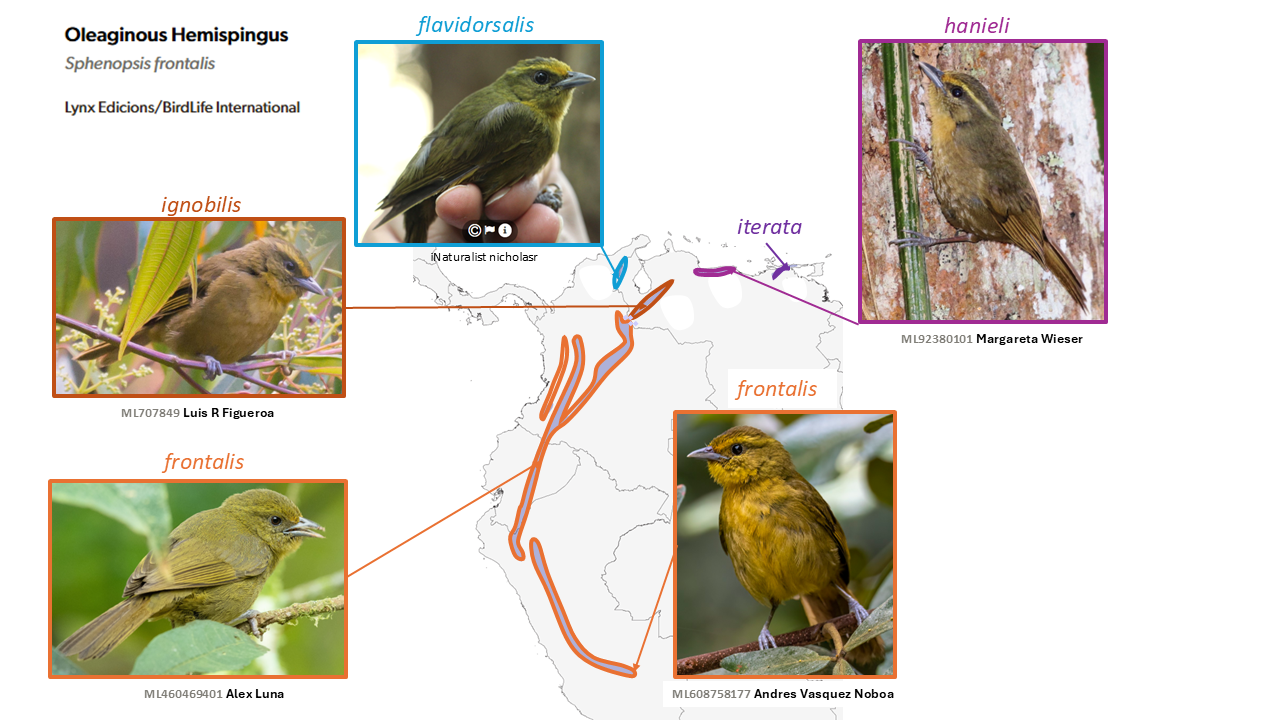
Groups deleted in Flame-crested Tanager Loriotus cristatus
Summary: (2→0 groups)
Details: Clements v2025 taxa 34751–34759
Former subspecies and monotypic group Loriotus cristatus nattereri is now considered a hybrid between Loriotus cristatus madeirae and Loriotus luctuosus luctuosus and is thus deleted (along with former group Flame-crested Tanager (Flame-crested) Loriotus cristatus [cristatus Group].
Note: See Lopes and Piacentini (2017) and Looney et al. (2025).
New and redefined groups in Capped Conebill Conirostrum albifrons
Summary: (2→3 groups)
Details: Clements v2025 taxa 35254–35262
One existing group of Capped Conebill Conirostrum albifrons is redefined, from Capped Conebill (White-capped) Conirostrum albifrons [albifrons Group] to:
- Capped Conebill (Venezuelan) Conirostrum albifrons cyanonotum (monotypic) , and
- Capped Conebill (White-capped) Conirostrum albifrons albifrons/centralandium
- subspecies albifrons and centralandium
Graphical abstract:

Groups deleted and redefined in Bananaquit Coereba flaveola
Summary: (10→9 groups)
Details: Clements v2025 taxa 35644–35691
Former Bananaquit (St. Vincent) Coereba flaveola atrata and Bananaquit (Grenada) Coereba flaveola aterrima groups are combined into a single group:
- Bananaquit (St. Vincent and Grenada) Coereba flaveola aterrima/atrata
Graphical abstract:

Notes: Although St. Vincent atrata and Grenada/Grenadines aterrima are the only Lesser Antillean forms that have black morphs (which predominate in Grenada but not on the Grenadines; Kirwan et al. 2019), they also have more typical morphs. The mutation leading to this dichromatism is believed to have a single origin (Theron et al. 2001).
In contrast, other southern Caribbean small-island taxa are black or blackish, and some have the red gape reduced or lacking. Biogeography does not favor the retention of the current Lesser Antillean group when including the Netherlands Antilles taxa, although they are similar in plumage to the other taxa in this group.
New groups in Gray Warbler-Finch Certhidea fusca
Summary: (0→3 groups)
Details: Clements v2025 taxa 35739–35747
Three new groups are formed for Gray Warbler-Finch Certhidea fusca:
- Gray Warbler-Finch (Darwin) Certhidea fusca becki (monotypic)
- Gray Warbler-Finch (San Cristobal) Certhidea fusca luteola (monotypic)
- Gray Warbler-Finch (Gray) Certhidea fusca [fusca Group]
- subspecies mentalis, fusca, bifasciata, cinerascens, and ridgwayi
Graphical abstract:

Notes: Biogeography, plumage and size variability, and songs (Brinkhuizen and Nilsson 2020) suggest that further study is needed on species limits in this complex. Formerly considered conspecific with the Green Warbler-Finch Certhidea fusca, but split as a result of a proposal based on Tonnis et al. (2005) (Jaramillo 2008).