
Birding 123 Bird Guide Gear Guide Attracting Birds Conservation Studying Birds

Bird Guide

Species Accounts

Video Gallery

Boat-tailed Grackle

Quiscalus major Order PASSERIFORMES - Family ICTERIDAE
Summary Detailed
For complete Life History Information on this species, visit Birds of North America Online.

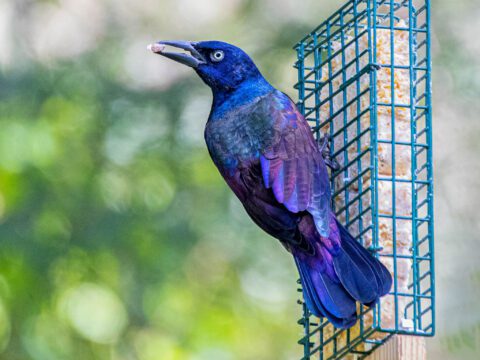
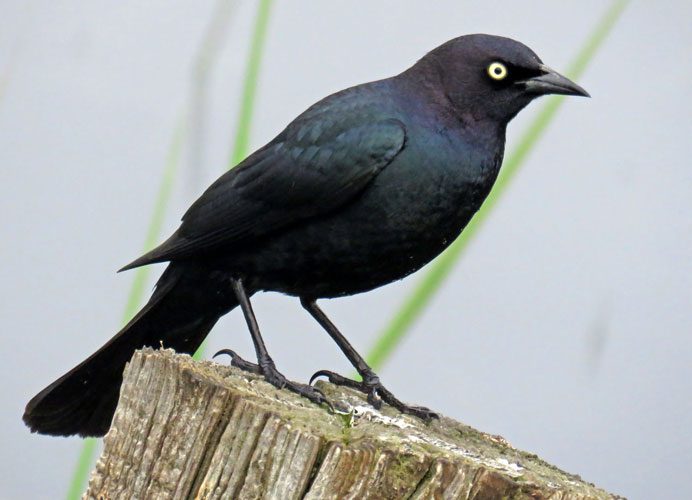
Boat-tailed Grackle, male
enlarge
Boat-tailed Grackle, male
About the photographs
Boat-tailed Grackle, female, Gulf Coast form
enlarge
Boat-tailed Grackle, female, Gulf Coast form
Menu
  1. Cool Facts
  2. Description
  3. Similar Species
  4. Sound
  5. Range
  6. Habitat
  7. Food
  8. Behavior
  9. Reproduction
  10. Conservation Status
  11. Other Names

A large, long-tailed blackbird, the Boat-tailed Grackle is found exclusively along the Gulf and Atlantic coasts of the United States. The noisy, iridescent, purple-black male is hard to miss when it displays on power lines and telephone poles. The smaller brown female is much less conspicuous, and might even be mistaken for a different species.

Cool Facts

  • Eye color in the Boat-tailed Grackle varies from region to region. Grackles along the Atlantic coast north of Florida have straw-colored eyes. Florida birds have dark eyes. Grackles west of Florida to eastern Louisiana have light eyes, but those further west have dark ones.

  • Fledglings that fall into the water can swim well for short distances, using their wings as paddles.

  • The Boat-tailed Grackle has an odd mating system: harem defense polygyny. Females cluster their nests, and the males compete to defend the entire colony and mate there. The most dominant male gets most of the copulations in a system similar to that used by many deer. But all is not as simple as it seems. Although the dominant male may get up to 87% of the copulations at a colony, DNA fingerprinting shows that he actually sires only about 25% of the young in the colony. Most of the young are fathered by noncolony males away from the colonies.

Description

  • Size: 26-37 cm (10-15 in)
  • Wingspan: 39-50 cm (15-20 in)
  • Weight: 93-239 g (3.28-8.44 ounces)

  • Large blackbird.
  • Long tail.
  • Male shiny black, female brown.

  • Bill black and as long as head.
  • Tail long and graduated.
  • Legs and feet black.

Sex Differences

Male iridescent black. Female dull brown and significantly smaller.

Male

Iridescent purple-black over entire body, wings and tail more greenish. Eye color variable from dark brown to light yellow.

Female

One-half size of male. Back and head cinnamon brown. Breast and belly paler brown or buffy. Tail and wings dark brown. Pale brown line above eye contrasts slightly with indistinct dark line through eye. Eye color variable from cream to dark brown.

Immature

Juvenile is brown like female, with streaked underparts.

Similar Species

  • Common Grackle smaller, with shorter tail and more restricted purple.
  • Great-tailed Grackle is very similar, but tail is a little longer and head is flatter; voice is different. The Gulf Coast form of Boat-tailed Grackle, the form most likely to be in the range of Great-tailed, has dark eyes while the eyes of a Great-tailed Grackle are yellow.

Sound

Song a variable series of sharp notes and harsh guttural trills. Calls sharp "chek" notes and whistles.

»listen to songs of this species

Range

Range Map
Boat-tailed Grackle

© 2003 Cornell Lab of Ornithology

Summer Range

Breeds along Atlantic Coast from New York to Florida, westward to central Texas coast.

Winter Range

Winters in most of breeding range, but leaves the most northern locations, depending on the severity of the winter.

Habitat

Found in freshwater and salt marshes, open upland habitats, cities, and agricultural fields, usually near the coast. Nests in marshes.

Food

Omnivorous. Invertebrates, frogs, grain, fruit, garbage.

Behavior

Foraging

Walks on ground and picks up food items, turns over stones with bill, sticks bill into grass or dirt and opens it to expose prey.

Other Behavior

Roosts communally all year long.

Reproduction

Nest Type

Nest is an open cup of grass, lined with soft materials such as Spanish moss, wool, leaves, and feathers. Nest placed in reeds or small shrubs, often over water.

Egg Description

Light blue, covered with brown and black scrawls, often concentrated at large end.

Clutch Size

1-5 eggs.

Condition at Hatching

Helpless with sparse brown down.

Conservation Status

Common; numbers stable.

Other Names

Quiscale des marais (French)
Tordo cola ancha (Spanish)

Sources used to construct this page:

Post, W., J. P. Poston, and G. T. Bancroft. 1996. Boat-tailed Grackle (Quiscalus major). In The Birds of North America, No. 271 (A. Poole and F. Gill, eds.). The Academy of Natural Sciences, Philadelphia, PA, and The American Ornithologists' Union, Washington, D.C.


Home | Contact Us    ©2003 Cornell Lab of Ornithology