
Birding 123 Bird Guide Gear Guide Attracting Birds Conservation Studying Birds

Bird Guide

Species Accounts

Video Gallery

Brewer's Blackbird

Euphagus cyanocephalus Order PASSERIFORMES - Family ICTERIDAE
Summary Detailed
For complete Life History Information on this species, visit Birds of North America Online.

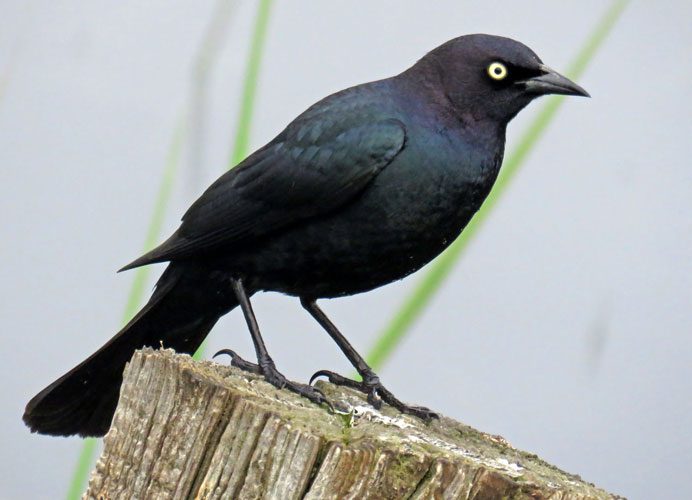
Brewer's Blackbird,	male
enlarge
Brewer's Blackbird, male
About the photographs
Brewer's Blackbird,	female
enlarge
Brewer's Blackbird, female
Menu
  1. Cool Facts
  2. Description
  3. Similar Species
  4. Sound
  5. Range
  6. Habitat
  7. Food
  8. Behavior
  9. Reproduction
  10. Conservation Status
  11. Other Names

A shiny blue-green blackbird, the Brewer's Blackbird is common in agricultural and suburban habitats of the West. It has taken advantage of human modifications of the environment to expand its range eastward.

Cool Facts

  • The Brewer's Blackbird spread its range eastward from western Minnesota in the 20th century, taking advantage of human-produced changes in landscape. Where it overlaps with the Common Grackle, the blackbird takes over the open grassy areas, while the grackle dominates in urban and suburban areas.

  • The Brewer's Blackbird nests in compact colonies, numbering from a few pairs to more than one hundred. Occasionally a pair will nest solitarily away from a colony. In the colony a female (sometimes aided by a male) defends a small area directly around her nest site.

  • Within a colony most females choose the same kind of nest site, indicating that females follow the lead of the first nest builders. A colony may change its nest preference from year to year, building all nests in small bushes one year, and in tall trees the next.

Description

  • Size: 20-25 cm (8-10 in)
  • Wingspan: 37 cm (15 in)
  • Weight: 47-67 g (1.66-2.37 ounces)

  • Medium-sized songbird.
  • Medium-long tail.
  • Bill thin and pointed.
  • Male iridescent black with purple and green highlights, female dull gray-brown.

  • Tail square or slightly rounded.

Sex Differences

Male iridescent black. Female dull gray-brown and slightly smaller.

Male

Black all over. Head and neck have purplish iridescence. Body has blue-green iridescence. Shows contrast between colors of head and body. Wing and tail edged with brown. Eyes pale yellow or white.

Female

Grayish brown. Light purplish gloss on head and neck. Faint metallic greenish sheen on body. Wings and tail darker and glossier. Sides of head paler than crown. Dark eyeline. Eyes light to dark brown.

Immature

Juvenile is similar to adult female, but paler and without gloss. Some immature males have brown feather edging.

Similar Species

  • Rusty Blackbird similar, breeds farther east and north. Rusty has shorter legs, shorter tail, thinner and more pointed bill with slight droop at tip. Male Rusty Blackbird is less glossy and shows no contrast between head and body. Female Rusty Blackbird has yellow eyes and is slate-gray rather than brownish gray. Caution: up to 10% of female Brewer's have yellow eyes.
  • Common Grackle larger, has larger and thicker bill, and longer wedge-shaped tail.
  • Shiny Cowbird male has dark eye and shorter bill.

Sound

Song a harsh whirring gurgling "schl-r-r-up." Call a sharp "tschup."

»listen to songs of this species

Range

Range Map
Brewer's Blackbird

© 2003 Cornell Lab of Ornithology

Summer Range

Breeds from southwestern Canada eastward to Ontario, southward in West to Mexico and in Midwest to northern Illinois.

Winter Range

Winters from southern British Columbia southward into southern Mexico, and eastward along the southern United States to western Florida.

Habitat

Found in a variety of habitats, but prefers open, human-modified areas, such as farmland, fields, residential lawns, and urban parks.

Food

Insects, grain, seeds, and small fruits.

Behavior

Foraging

Forages on ground, often in large flocks with other blackbirds.

Reproduction

Nest Type

Colonial nester. Nest placed on ground or in shrub, often near water. Nest an open cup of twigs, stems, and mud, lined with grass or hair.

Egg Description

Pale gray to greenish white, with variable amount of dark streaking or spotting.

Clutch Size

3-7 eggs.

Condition at Hatching

Helpless with sparse pale gray down.

Conservation Status

Widespread and abundant. Not considered threatened, but declines noticed in parts of range.

Other Names

Quiscale des Brewer (French)

Sources used to construct this page:

Martin, S. G. 2002. Brewer's Blackbird (Euphagus cyanocephalus). In The Birds of North America, No. 616 (A. Poole and F. Gill, eds.). The Birds of North America, Inc., Philadelphia, PA.


Home | Contact Us    ©2003 Cornell Lab of Ornithology