
Birding 123 Bird Guide Gear Guide Attracting Birds Conservation Studying Birds

Bird Guide

Species Accounts

Video Gallery

Broad-winged Hawk

Buteo platypterus Order FALCONIFORMES - Family ACCIPITRIDAE - Subfamily Accipitrinae
Summary Detailed
For complete Life History Information on this species, visit Birds of North America Online.

Broad-winged Hawk, adult
enlarge
Broad-winged Hawk, adult
About the photographs
Broad-winged Hawk, immature
enlarge
Broad-winged Hawk, immature
Menu
  1. Cool Facts
  2. Description
  3. Similar Species
  4. Sound
  5. Range
  6. Habitat
  7. Food
  8. Behavior
  9. Reproduction
  10. Conservation Status
  11. Other Names

A small, stocky, forest-dwelling hawk of eastern deciduous forests, the Broad-winged Hawk is hard to see on its nesting grounds. It becomes more conspicuous on migration when it congregates into flocks and passes by hawk migration lookouts in the thousands.

Cool Facts

  • The Broad-winged Hawk comes in two color phases: the common light phase and a rare dark phase. The dark form is entirely sooty brown with a tail like the light morph, and with whitish flight feathers contrasting with the dark wing linings. It is found primarily in the northwestern part of the range, and accounts for less than 0.1% of migrants observed.
  • The Broad-winged Hawk completely leaves its breeding grounds in the fall and winter. Huge numbers of migrating broad-wings can be seen at hawk watches across the East. It usually migrates in large flocks or "kettles" that can range from a couple of individuals to thousands.

  • A recent study attached satellite transmitters to the backs of four Broad-winged Hawks and followed them as they migrated south in the fall. The hawks migrated an average of 7,000 km (4,350 mi) to northern South America, and traveled an average of 111 km (69 mi) each day. Once at the wintering grounds, the hawks did not move around much, staying on average within 2.6 square km (1 square mi).

Description

  • Size: 34-44 cm (13-17 in)
  • Wingspan: 81-100 cm (32-39 in)
  • Weight: 265-560 g (9.35-19.77 ounces)

  • Medium-sized hawk.
  • Body stout.
  • Wings broad.
  • Wings pale, with dark trailing edge.
  • Tail medium-short.
  • Tail dark with one thick white band in middle, and one thinner near tail base and tip.
  • Face dark.
  • Chest reddish, reddish barring along sides.
  • Throat white.

  • Rare dark morph is sooty all over, with whiter flight feathers.
  • Wingtips slightly pointed in flight, giving wing a "flame-like" shape.
  • Beak black, grading to gray-blue.
  • Cere over bill yellow.
  • Legs and feet light yellow.
  • Eyes amber to brown in light morph, red in dark morph.

Sex Differences

Sexes look alike; female slightly larger.

Immature

Juvenile similar to adult, but underparts white with streaks down center of breast, and tail buff with thin dark bands.

Similar Species

  • Red-shouldered Hawk has reddish shoulders, a more solid orange chest, longer legs, barring on the wing feathers, and its wingtips are less pointed. The Red-shouldered Hawk also has a banded tail, but the white bands are narrower than the black, while the Broad-winged Hawk's central white band is as wide as the black bands.
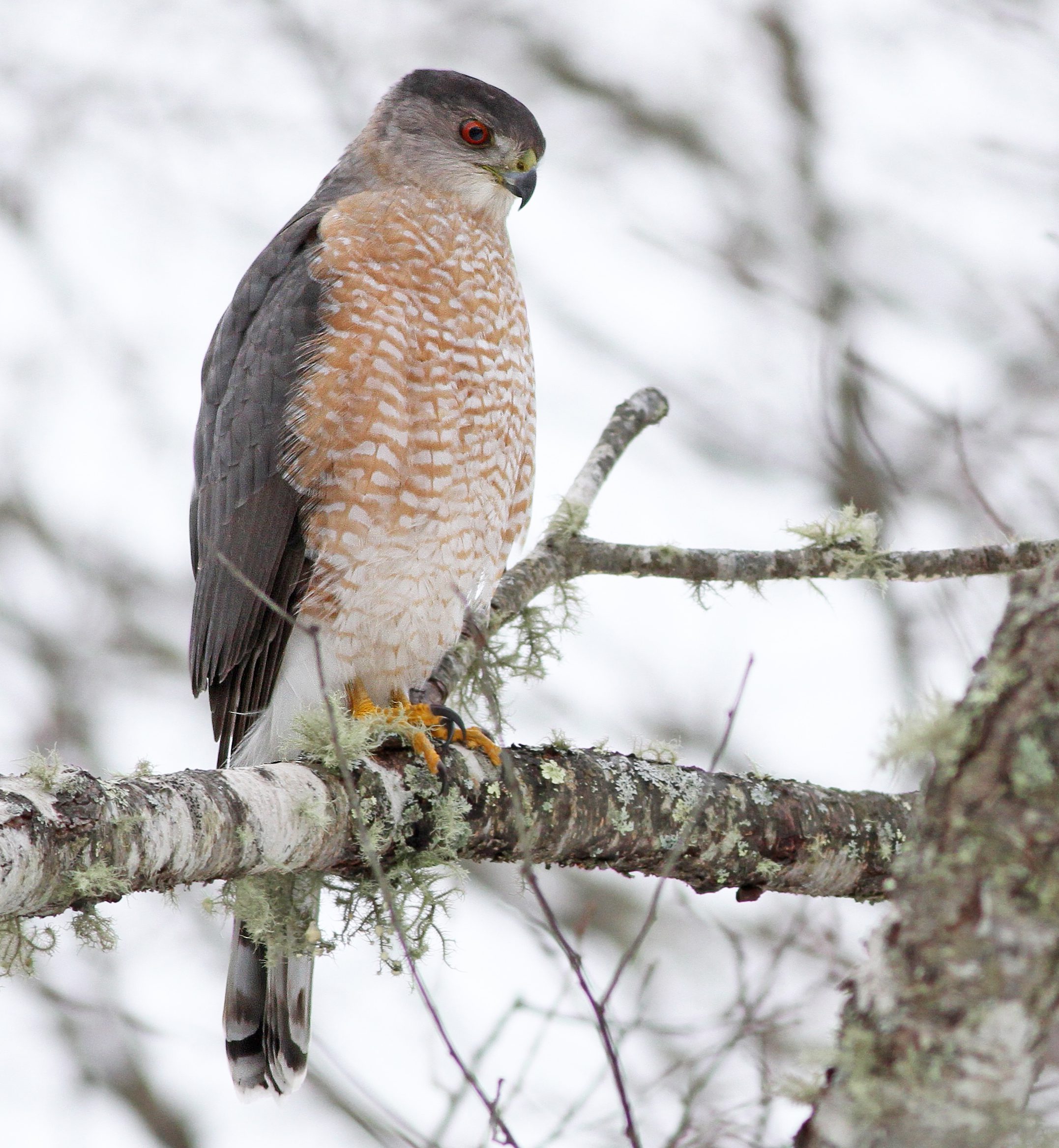
  • Cooper's Hawk has a much longer tail that extends well beyond the wing tips, a paler face, and a dark cap.

Sound

Call a thin, high whistled "kee-eee."

»listen to songs of this species

Range

Range Map
Broad-winged Hawk

© 2003 Cornell Lab of Ornithology

Summer Range

Breeds from Ontario to Nova Scotia, southward to Texas and northern Florida, and westward to central Alberta. Also in Caribbean.

Winter Range

Winters from southern Mexico southward to South America, and in Caribbean. Some winter in southern Florida.

Habitat

Breeds in continuous deciduous or mixed-deciduous forest. Winters in tropical forests.

Food

Small mammals, birds, reptiles, amphibians, and large insects.

Behavior

Foraging

Drops on prey from perch in canopy.

Reproduction

Nest Type

Large bowl of sticks, lined with bark chips. Often decorated with green twigs. May be placed on old crow or squirrel nest.

Egg Description

White or slightly bluish, with brownish patches or dots.

Clutch Size

Usually 2-3 eggs. Range: 1-5.

Condition at Hatching

Helpless, eyes open, covered in white down.

Conservation Status

Populations stable or increasing.

Other Names

Petite Buse (French)
Busardo aliancho (Spanish)

Sources used to construct this page:

  1. Goodrich, L. J., S. C. Crocoll, and S. E. Senner. 1996. Broad-winged Hawk (Buteo platypterus). In The Birds of North America, No. 218 (A. Poole and F. Gill, eds.). The Academy of Natural Sciences, Philadelphia, PA, and The American Ornithologists' Union, Washington, D.C.
  2. Haines, A. M., M. J. McGrady, M. S. Martell, B. J. Dayton, M. B. Henke, and W. S. Seegar. 2003. Migration routes and wintering locations of Broad-winged Hawks tracked by satellite telemetry. Wilson Bulletin 115: 166-169.


Home | Contact Us    ©2003 Cornell Lab of Ornithology