
Birding 123 Bird Guide Gear Guide Attracting Birds Conservation Studying Birds

Bird Guide

Species Accounts

Video Gallery

Round Robin, the Cornell Blog of Ornithology

Cape May Warbler

Dendroica tigrina Order PASSERIFORMES - Family PARULIDAE
Summary Detailed
For complete Life History Information on this species, visit Birds of North America Online.

Cape May Warbler, male, breeding plumage
enlarge
Cape May Warbler, male, breeding plumage, May
About the photographs
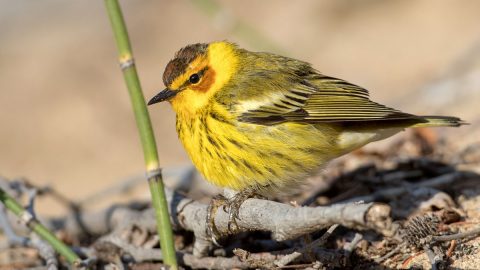
Cape May Warbler, 1st fall female
enlarge
Cape May Warbler, 1st fall female
Menu
  1. Cool Facts
  2. Description
  3. Similar Species
  4. Sound
  5. Range
  6. Habitat
  7. Food
  8. Behavior
  9. Reproduction
  10. Conservation Status
  11. Other Names

The Cape May Warbler breeds across the boreal forest of Canada and the northern United States, where the fortunes of its populations are largely tied to the availability of spruce budworms, its preferred food. Striking in appearance but poorly understood, the species spends its winters in the West Indies, collecting nectar with its unique curled, semitubular tongue.

Cool Facts

  • The tongue of the Cape May Warbler is unique among warblers. It is curled and semitubular, and is used to collect nectar during winter.
  • The common name of the species comes from Cape May, New Jersey, where Alexander Wilson first described it. After that first time, Cape May Warblers were not recorded in Cape May for more than 100 years.

  • The average clutch size of the Cape May Warbler (six) is greater than that of other warblers. This large clutch size may allow Cape May Warbler populations to expand rapidly during outbreaks of their preferred prey, spruce budworms.

  • The nest of the Cape May Warbler was not accurately described until the early 20th century.

Description

  • Size: 12-13 cm (5-5 in)
  • Wingspan: 19-22 cm (7-9 in)
  • Weight: 9-12 g (0.32-0.42 ounces)

  • Small songbird.
  • Yellow chest with thin black stripes.
  • Reddish and yellow face.
  • Pale sides of neck contrast with darker face.
  • Wingbars.
  • Yellowish rump.

Light-colored sides of neck contrast with darker face. Thin, sharply pointed bill. White spots in tail. Eyes dark. Legs dark.

Sex Differences

Male bright yellow with chestnut cheeks and white wing patches. Female duller and without chestnut face or white wing patches.

Male

Breeding (Alternate) Plumage: Chestnut or orange-brown cheek patches, contrasting with bright yellow sides of neck. Throat and breast yellow with crisp black streaks. Rump bright yellow. Crown, and nape blackish. Narrow black stripe through eye. Back olive with black streaking. Large white patch in wing. White under tail. Nonbreeding (Basic) Plumage: duller overall, with less distinct facial markings.

Female

Breeding (Alternate) Plumage: Head and back olive-gray. Sides of neck, throat, and breast pale yellow. Streaks on breast and sides narrow and gray. Rump yellow. Two wing bars on each wing. Nonbreeding (Basic) Plumage: Duller and less olive. Streaking less distinct.

Immature

Similar to adult. Immature females may be extremely dull gray overall, with only a hint of yellow on the rump.

Similar Species

  • Fall Yellow-rumped Warbler has streaks on the flanks only, not on the central breast and belly, a larger rump patch, and black streaks on the back.
  • Palm Warbler is yellow under the tail, not white, wags its tail, and has a streaked back.

Sound

Song a thin, high-pitched note repeated four to eight times. Call note is a high chip.

»listen to songs of this species

Range

Range Map


© 2004 Cornell Lab of Ornithology

Summer Range

Breeds across the Canadian boreal forest, from Alberta to the Atlantic coast, and southward to northern United States.

Winter Range

Winters throughout the northern Caribbean and on the Caribbean coast of Central America.

Habitat

Breeds in coniferous forest. Winters in various habitats, including settled areas.

Food

Insects, especially spruce budworms, during the breeding season; nectar and insects in winter.

Behavior

Foraging

Usually picks insects from vegetation while perched, but also hawks insects. Curled tongue aids in collection of nectar.

Reproduction

Nest Type

A bulky cup of sphagnum moss, twigs, pine needs, and bark, lined with hair and feathers. Placed near top of spruce tree.

Egg Description

White with reddish-brown blotches.

Clutch Size

4-9 eggs.

Conservation Status

Use of certain combinations of insecticides to control spruce budworms causes steep declines in Cape May Warbler numbers. Other pesticides may have no effect. Logging, especially in the western portion of the species' range, may eventually pose risks to the Cape May Warbler because of reduced availability of the mature forests needed to support spruce budworms.

Other Names

Paruline tigrée (French)
Renita tigre (Spanish)

Sources used to construct this page:

Baltz, M. E., and S. C. Latta. 1998. Cape May Warbler (Dendroica tigrina). In The Birds of North America, No. 332 (A. Poole and F. Gill, eds.). The Birds of North America, Inc., Philadelphia, PA.


Home | Contact Us    ©2003 Cornell Lab of Ornithology