
Birding 123 Bird Guide Gear Guide Attracting Birds Conservation Studying Birds

Bird Guide

Species Accounts

Video Gallery

Carolina Chickadee

Poecile carolinensis Order PASSERIFORMES - Family PARIDAE
Summary Detailed
For complete Life History Information on this species, visit Birds of North America Online.
Menu
  1. Cool Facts
  2. Description
  3. Similar Species
  4. Sound
  5. Range
  6. Habitat
  7. Food
  8. Behavior
  9. Reproduction
  10. Conservation Status
  11. Other Names

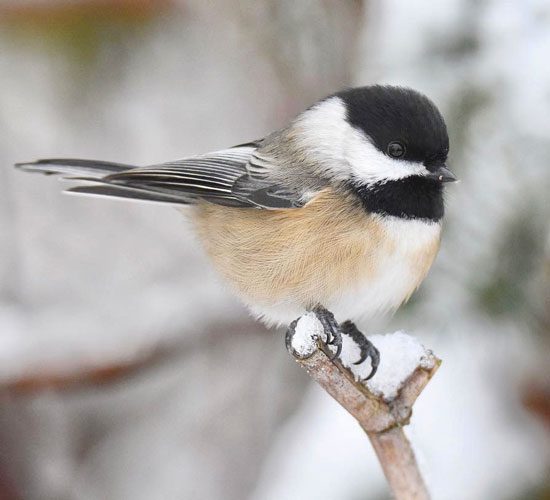
A southeastern counterpart to the more widespread Black-capped Chickadee, the Carolina Chickadee lives only in the United States. The two species are similar in appearance and social behavior, but the Carolina is slightly smaller and more dully colored.

Cool Facts

  • Go here to take a look at what goes on inside a chickadee nestbox, through the help of a Nest Box Cam provided by The Birdhouse Network at the Cornell Lab of Ornithology.
  • Where the two species ranges come in contact, the Carolina and Black-capped chickadees occasionally hybridize. Hybrids can sing the songs of either species, or might sing something intermediate.

  • In winter, Carolina Chickadees live in flocks of two to eight birds and defend areas against other flocks. Dominant birds in these flocks establish breeding territories in the summer that were part of the winter flock's range.

  • The pair bond between a male and female Carolina Chickadee can remain intact for several years. The probability that a pair will remain together seems to vary among populations, with nearly all pairs remaining together in subsequent years in a study in Texas, but only half staying together in a study in Tennessee. If a nest attempt fails, a female may seek out a new male on a different territory.

Description

  • Size: 10-12 cm (4-5 in)
  • Wingspan: 15-20 cm (6-8 in)
  • Weight: 8-12 g (0.28-0.42 ounces)

  • Small, short-billed bird.
  • Black cap.
  • Black bib.
  • White cheeks.

  • Back unstreaked gray.
  • Underparts whitish.
  • Wings and tail dark grayish.
  • Flanks gray or brownish.
  • Upper wing feathers with no or only little white edging.
  • Tail rather long.
  • Bill black.
  • Legs and feet gray.

Sex Differences

Sexes alike.

Immature

Like adult.

Similar Species

  • Extremely similar to Black-capped Chickadee. The slightly larger Black-capped Chickadee has more white in its wings, especially on the edges of the greater wing coverts and edges of the outer secondaries. Black-capped has a slightly larger black bib that is more ragged on the edges. The back of the white face patch is bright white in Black-capped Chickadee and more grayish in Carolina Chickadee. Songs differ, with Black-capped singing a two or three-note song, and Carolina singing a four-note song. Additional information on distinguishing Carolina and Black-capped chickadees can be found here

    Sound

    Calls suggest name: "chick-a-dee-dee." Song is whistled four to six notes with first and third higher in pitch, second and fourth lower, "fee-bee-fee-bay."

    »listen to songs of this species

    Range

    Range Map
    Carolina Chickadee

    © 2003 Cornell Lab of Ornithology

    Summer Range

    Resident from central New Jersey westward to southeastern Kansas and central Texas, southward to Gulf Coast and northern Florida.

    Habitat

    Deciduous and mixed deciduous/coniferous woodlands, swamps, riparian areas, open woods and parks. Also in suburban and urban areas.

    Food

    Insects, spiders, seeds, and fruits.

    Behavior

    Foraging

    Gleans insects from foliage and tree bark, often hanging upside down to do so. Holds food items against branch under feet to peck them. Readily uses bird feeders.

    Reproduction

    Nest Type

    Nest in holes, typically in dead trees or rotten branches. Will use nest boxes. Nest within hole made of coarse materials such as moss, lined with softer material like fur.

    Egg Description

    Rather round. White marked with fine spots of reddish brown, often concentrated around larger end.

    Clutch Size

    3-10 eggs.

    Condition at Hatching

    Helpless with tufts of down.

    Conservation Status

    Shows slight, but significant population decreases across range.

    Other Names

    Mésange minime, Mésange de Caroline (French)
    Paro enmascarado carolinense (Spanish)

    Sources used to construct this page:

    Mostrom, A. M., R. L. Curry, and B. Lohr. 2002. Carolina Chickadee (Poecile carolinensis).In The Birds of North America, No. 636 (A. Poole and F. Gill, eds.). The Birds of North America, Inc., Philadelphia, PA.


Home | Contact Us    ©2003 Cornell Lab of Ornithology