
Chestnut-sided Warbler, male, breeding plumage
About the photographs
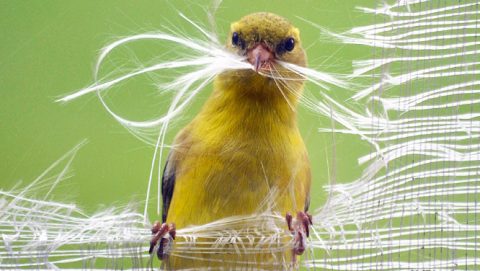
Chestnut-sided Warbler, female
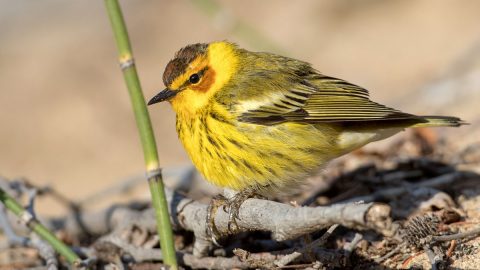
Chestnut-sided Warbler, non-breeding plumage
Menu
- Cool Facts
- Description
- Similar Species
- Sound
- Range
- Habitat
- Food
- Behavior
- Reproduction
- Conservation Status
- Other Names
A common bird of second growth and scrubby forests, the Chestnut-sided Warbler is distinctive in appearance. No other warbler combines a greenish-yellow cap, a white breast, and reddish streaks down the sides.
Cool Facts
- On the wintering grounds in Central America the Chestnut-sided Warbler joins in mixed-species foraging flocks with the resident antwrens and tropical warblers. An individual warbler will return to the same area in subsequent years, joining back up with the same foraging flock it associated with the year before.
- The Chestnut-sided Warbler sings two basic song types: one is accented at the end (the pleased-to-MEETCHA song), and the other is not. The accented songs are used primarily to attract a female and decrease in frequency once nesting is well under way. The unaccented songs are used mostly in territory defense and aggressive encounters with other males. Some males sing only unaccented songs, and they are less successful at securing mates than males that sing both songs.
Description
- Size: 10-11 cm (4-4 in)
- Wingspan: 18-21 cm (7-8 in)
- Small songbird.
- Forehead yellow.
- Black mustache stripe on face.
- Underparts white.
- Chestnut streak along sides.
- Bold yellowish wingbars.
- Thin bill.
- Large white spots in outer three tail feathers.
- Frequently cocks tail up above back like a gnatcatcher or wren.
Sex Differences
Sexes similar, but breeding plumaged female duller, with greener back, paler face, and with less extensive chestnut sides. In nonbreeding plumage, female without chestnut on sides.
Male
Breeding (Alternate) plumage: Crown bright yellow, with white edge at front. Nape pale gray streaked with black. Back striped yellow and black. Tail blackish. Black stripe from bill to behind eye. Black mustache stripe. Cheek white. Throat, chest, belly, and under tail white. Sides with long narrow chestnut streak. Two broad yellowish wingbars. Flight feathers outlined in pale yellow or white.
Nonbreeding (Basic) plumage: Back, nape, and crown yellowish green. Some dark streaking on rump. Sides of head and neck pale gray. White eyering. Underparts dull white. Long thin streak of chestnut along sides. Two broad yellowish wingbars. Flight feathers outlined in pale yellow or white. Eyes dark. Legs dark.
Female
Breeding (Alternate) plumage: Chestnut streak on sides less extensive than on male. Wings with two broad yellowish wingbars. Crown greenish yellow. Dull black or slaty line through eye. Dull black or slaty mustache stripe. Cheek whitish. Back green with black streaks.
Nonbreeding (Basic) plumage: Back, nape, and crown yellowish green. Some dark streaking on rump. Sides of head and neck pale gray. White eyering. Underparts dull white. Thin streak of chestnut along sides; may be absent. Two broad yellowish wingbars. Flight feathers outlined in pale yellow or white. Eyes dark. Legs dark.
Immature
Immature resembles fall adult, but streaks on back finer. Immature female without chestnut on sides.
Similar Species
- Bay-breasted Warbler also has chestnut on sides, but in breeding plumage face is dark and throat and crown are chestnut. In nonbreeding plumage Bay-breasted is dusky underneath and lacks the bright yellow-green of a chestnut-sided.
Sound
Song a series of musical notes, usually accented at the end: "pleased, pleased, pleased to MEETCHA."
»listen to songs of this species
Range
Range Map
© 2003 Cornell Lab of Ornithology
Summer Range
Breeds from central Saskatchewan eastward to Nova Scotia, southward to northern Minnesota, southern Pennsylvania, and south in Appalachians to northern Georgia.
Winter Range
Winters in Central America, from southern Mexico to Panama.
Habitat
- Breeds in early successional deciduous woods.
- Winters in moist tropical forest.
Food
Insects and other arthropods, occasionally fruit.
Behavior
Foraging
Gleans insects from the bottom of leaves.
Reproduction
Nest Type
Nest an open cup woven of bark strips, weed stems, grasses, and plant down. Lined with fine grasses, hair or rootlets. Placed in small crotch of shrub or within a group of thin vertical stems, less than 2 m (6.5 ft) from ground.
Egg Description
Creamy white or greenish with brown speckles.
Clutch Size
Usually 4 eggs. Range: 3-5.
Condition at Hatching
Helpless with sparse down.
Conservation Status
Populations increased in 19th century, slightly decreasing now.
Other Names
Paruline ā flancs marron (French)
Reinita de costillas castaņas (Spanish)
Sources used to construct this page:
- Dunn, J. L., and Garrett, K. L. 1997. A Field Guide to Warblers of North
America. Houghton Mifflin Co., Boston.;
- Richardson, M., and D. W. Brauning. 1995. Chestnut-sided Warbler (Dendroica pensylvanica). In The Birds of North America, No. 190 (A. Poole and F.
Gill, eds.). The Academy of Natural Sciences, Philadelphia, PA, and The
American Ornithologists' Union, Washington, D.C.