
Birding 123 Bird Guide Gear Guide Attracting Birds Conservation Studying Birds

Bird Guide

Species Accounts

Video Gallery

Round Robin, the Cornell Blog of Ornithology

Common Grackle

Quiscalus quiscula Order PASSERIFORMES - Family ICTERIDAE
Summary Detailed
For complete Life History Information on this species, visit Birds of North America Online.

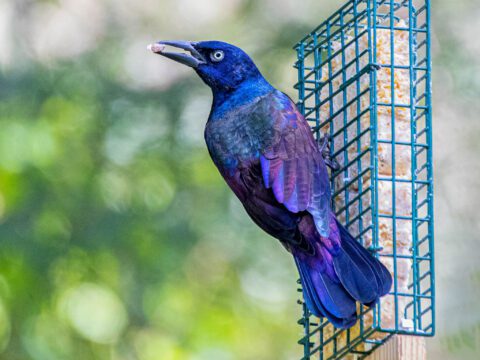
Common Grackle	adult	male
enlarge
Common Grackle, adult male bronzed form
About the photographs
Common Grackle female
enlarge
Common Grackle female, coastal race
Menu
  1. Cool Facts
  2. Description
  3. Similar Species
  4. Sound
  5. Range
  6. Habitat
  7. Food
  8. Behavior
  9. Reproduction
  10. Conservation Status
  11. Other Names

A familiar sight on suburban lawns, the Common Grackle can be recognized by its iridescent purple and bronze plumage and long, keel-shaped tail. It's expanding its range into the far West, but is most common in the East.

Cool Facts

  • The Common Grackle is an opportunistic forager, taking advantage of whatever food sources it can find. It will follow plows for invertebrates and mice, wade into water to catch small fish, and sometimes kill and eat other birds at bird feeders.

  • The Common Grackle commonly engages in anting, allowing ants to crawl on its body and secrete formic acid, possibly to rid the body of parasites. In addition to ants, it has been seen using walnut juice, lemons and limes, marigold blossoms, choke cherries, and mothballs in a similar fashion.

  • The Common Grackle has benefited from human activities. The clearing of the Eastern forests was to its liking. The expansion of agriculture, along with the use of mechanical crop harvesters, improved overwinter survival by increasing the supply of waste grain. In the West, the Common Grackle has moved into new areas by following the planting of ornamental trees.

Description

  • Size: 28-34 cm (11-13 in)
  • Wingspan: 36-46 cm (14-18 in)
  • Weight: 74-142 g (2.61-5.01 ounces)

  • Large blackbird.
  • Iridescent black all over.
  • Long tail, keel-shaped in flight.
  • Eyes yellow.

  • Bill black and moderately long and stout.
  • Head, neck, and breast glossy purplish-blue or green.
  • Widespread bronzed form has brassy bronze body, contrasting with purplish head.
  • Coastal purple form has entire body glossed purple.

Sex Differences

Female slightly smaller and less glossy.

Immature

Juvenile is dull brown with dark brown eyes.

Similar Species

  • European Starling has a short tail and a long pointed yellow bill.
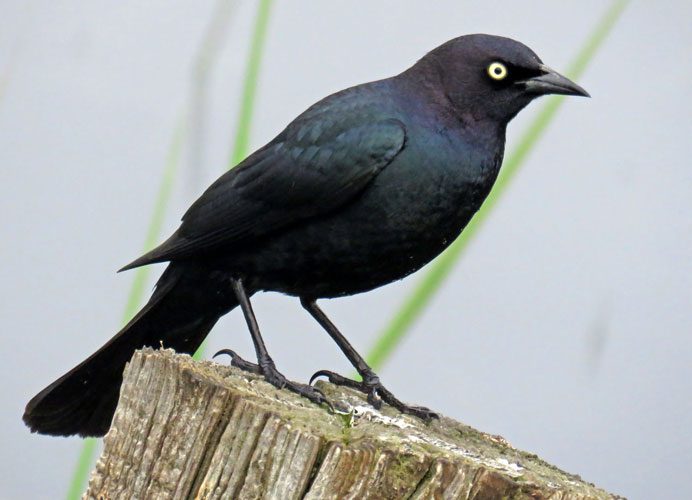
  • Brewer's and Rusty blackbirds are smaller, have shorter tails without a keel, and shorter more pointed bills.
  • Boat-tailed and Great-tailed grackles are much larger with longer, more keeled tails. They have less iridescence on the body, are never bronzy, and the females are tan.

Sound

Song a harsh, unmusical "readle-eak," like a rusty gate. Call a sharp, harsh "chack."

»listen to songs of this species

Range

Range Map
Common_Grackle_AllAm

© 2003 Cornell Lab of Ornithology

Summer Range

Breeds from northeastern British Columbia, eastern Idaho, and eastern New Mexico eastward to the Atlantic and Gulf coasts.

Winter Range

Winters from southern Minnesota and southern New England southward.

Habitat

Found in a variety of open areas with scattered trees, including open woodland, boreal forest, swamps, marshes, agricultural areas, urban residential areas, and parks.

Food

Primarily insects, other invertebrates, grain, seeds, acorns, and fruit. Also fish, small birds, mice, and frogs.

Behavior

Foraging

Forages on ground, often in large flocks with other blackbirds.

Reproduction

Nest Type

Nest is a bulky cup of woody stems, leaves, grass, string, bark, and other materials. Lined with mud and fine grasses or hair. Placed in small tree, usually a conifer, suspended between two branches or placed on a limb.

Egg Description

Light blue to gray, with dark scrawls and spots, often concentrated at large end.

Clutch Size

Usually 1-7 eggs.

Condition at Hatching

Helpless with sparse brown down.

Conservation Status

Abundant and widespread, extending its range west. Eastern populations declining from an all-time high that occurred around 1970.

Other Names

Quiscale bronzé (French)
Zanate norteño (Spanish)

Sources used to construct this page:

Peer, B. D., and E. K. Bollinger. 1997. Common Grackle (Quiscalus quiscula). In The Birds of North America, No. 271 (A. Poole and F. Gill, eds.). The Academy of Natural Sciences, Philadelphia, PA, and The American Ornthologists' Union, Washington, D.C.


Home | Contact Us    ©2003 Cornell Lab of Ornithology