
Birding 123 Bird Guide Gear Guide Attracting Birds Conservation Studying Birds

Bird Guide

Species Accounts

Video Gallery

Cooper's Hawk

Accipiter cooperii Order FALCONIFORMES - Family ACCIPITRIDAE - Subfamily Accipitrinae
Summary Detailed
For complete Life History Information on this species, visit Birds of North America Online.

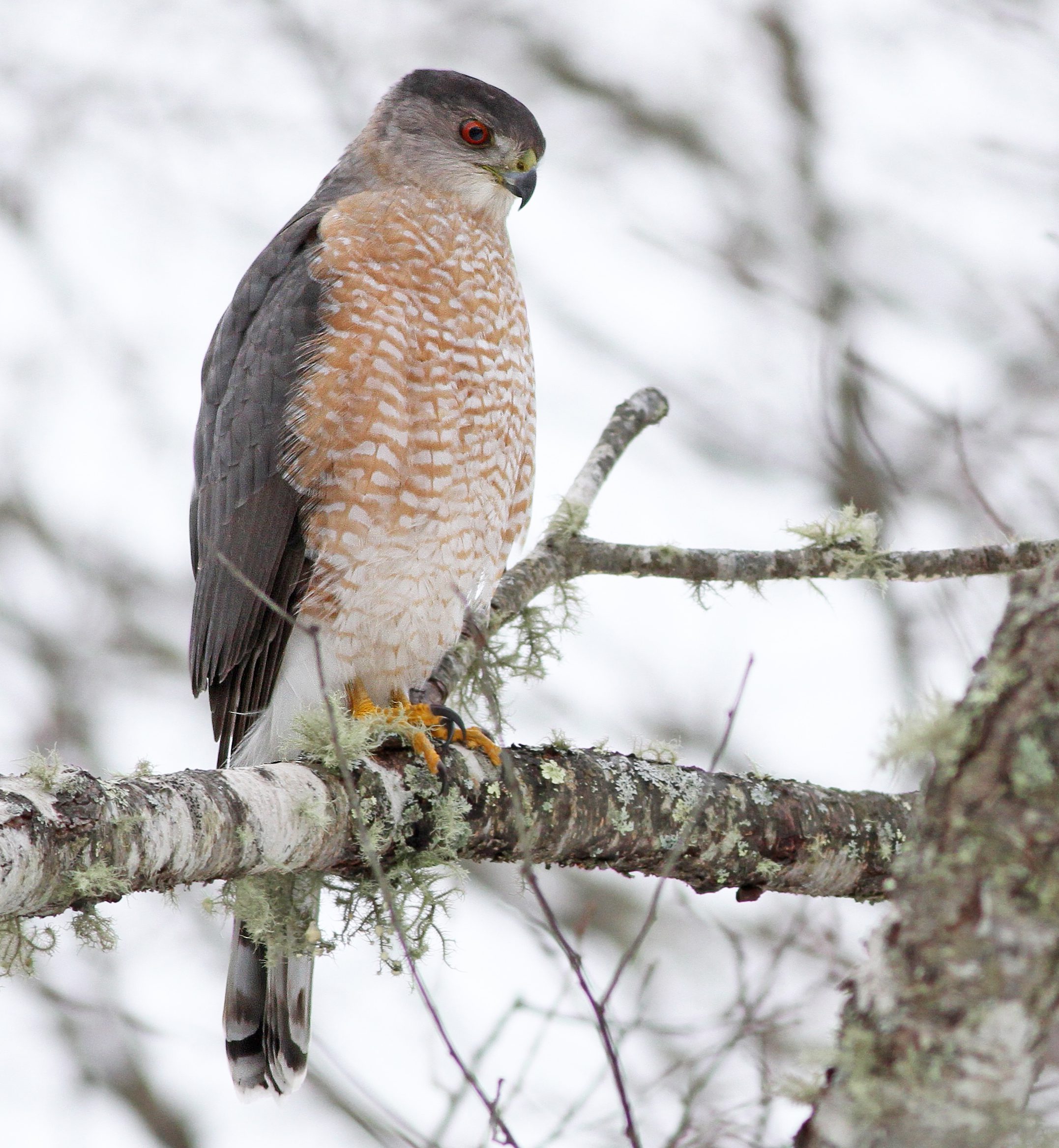
Cooper's Hawk, adult
enlarge
Cooper's Hawk, adult
About the photographs
Cooper's Hawk, immature
enlarge
Cooper's Hawk, immature
Menu
  1. Cool Facts
  2. Description
  3. Similar Species
  4. Sound
  5. Range
  6. Habitat
  7. Food
  8. Behavior
  9. Reproduction
  10. Conservation Status
  11. Other Names

A medium-sized hawk of the forest, the Cooper's Hawk specializes in eating birds. It is built for fast flight through the obstacle course of trees and limbs.

Cool Facts

  • Dashing through vegetation to catch birds is a rather dangerous lifestyle. A recent study found that 23 percent of all Cooper's Hawks examined had healed fractures in the bones of the chest, especially of the furcula or wishbone.
  • A Cooper's Hawk captures a bird with its feet, and will squeeze it repeatedly to kill it. It does not bite the prey to kill it in the fashion of falcons, but holds it away from its body until it dies. It has been known to drown its prey, holding a bird under water until it stops moving.

  • Large numbers of Cooper's Hawks can be seen on migration, especially at hawk watches such as Hawk Mountain, Pennsylvania; Cape May, New Jersey, Goshute Mountain Range, Nevada, or Braddock Bay, New York. Autumn movements generally begin in late August and continue through early November. Young Cooper's Hawks tend to migrate about a week earlier than adults, and females tend to go earlier than males by a few days.

Description

  • Size: 39-50 cm (15-20 in)
  • Wingspan: 62-90 cm (24-35 in)
  • Weight: 250-597 g (8.83-21.07 ounces)

  • Medium-sized hawk.
  • Tail long, rounded, and barred.
  • Wings short and rounded.
  • Back dark gray or gray-brown.
  • Underparts barred reddish and white.

  • Dark crown contrasts with nape.
  • Legs yellow.
  • Eyes orange or red.
  • Tail ends in white tail band.

Sex Differences

Sexes similar in plumage; female larger.

Immature

Juvenile brown on back and wings. Underparts with coarse brown streaks. Underwing white with dark brown barring. Eyes yellow.

Similar Species

  • Very similar in plumage to Sharp-shinned Hawk. Sharp-shinned Hawk has proportionately shorter tail, square at the tip. Sharp-shinned Hawk is less robust and has a proportionately smaller head. Adult Sharp-shinned Hawk has a dark head that does not contrast much with its back, giving it a more hooded and less capped appearance. Juvenile Sharp-shinned Hawk has more streaking underneath and less white on the tip of the tail. In flight, the larger head of the Cooper's Hawk is apparent, sticking out farther in front of the wings. For more information developed by Project FeederWatch to separate the two species, go here.
  • Northern Goshawk is larger, with a very stout body. The goshawk is striped light gray below and has a strong white eyestripe. Its tail is shorter and broader, and the wings are longer and less rounded. Juvenile goshawk has distinct, but not white, eyestripe, thick streaks below on a buffy background, and an irregularly barred tail.
  • Broad-winged Hawk has a shorter tail that barely extends beyond the wingtips when perched. Its tail has only a few black and white bands.

Sound

Alarm call is a series of sharp "cak"s.

»listen to songs of this species

Range

Range Map
Cooper's Hawk

© 2003 Cornell Lab of Ornithology

Summer Range

Breeds across southern Canada southward to southern United States and into central Mexico.

Winter Range

Winters throughout the United States and Mexico.

Habitat

Breeds in deciduous, mixed, and coniferous forests. Becoming more common in suburban and urban areas.

Food

Medium-sized birds and mammals.

Behavior

Foraging

Captures birds from low, stealthy approach-flight or after a short chase. Uses cover, including manmade structures, to conceal approach. In open areas may drop on prey from high flight. Captures birds at bird feeders.

Reproduction

Nest Type

Open bowl of sticks lined with bark flakes and occasionally rimmed with green vegetation. Placed in main crotch or against the trunk of a live tree. Often placed on top of old crow, squirrel, or other hawk nest.

Egg Description

White to bluish white.

Clutch Size

Usually 3-5 eggs. Range: 1-7.

Condition at Hatching

Helpless and covered in white down.

Conservation Status

Declines of the Cooper's Hawk in the late 1940s and 1950s were blamed on DDT and pesticide contamination. Populations started increasing in the late 1960s, but it is still listed as threatened or of special concern in a number of states. Appears to be adapting to breeding in urban areas, which may help increase populations. Project FeederWatch data indicate stable or increasing numbers over the last 15 years. For graphs of regional trends of the Cooper's Hawk from PFW data, go here.

Other Names

Épervier de Cooper (French)
Ésmerejón de Cooper (Spanish)

Sources used to construct this page:

  1. Rosenfield, R. N., and J. Bielefeldt. 1993. Cooper's Hawk (Accipiter cooperii). In The Birds of North America, No. 75 (A. Poole, and F. Gill, eds.). The Academy of Natural Sciences, Philadelphia, PA, and The American Ornithologists' Union, Washington, D.C.
  2. Roth, A. J., G. S. Jones, and T. W. French. 2002. Incidence of naturally-healed fractures in the pectoral bones of North American Accipiters. Journal of Raptor Research 36: 229-230.


Home | Contact Us    ©2003 Cornell Lab of Ornithology