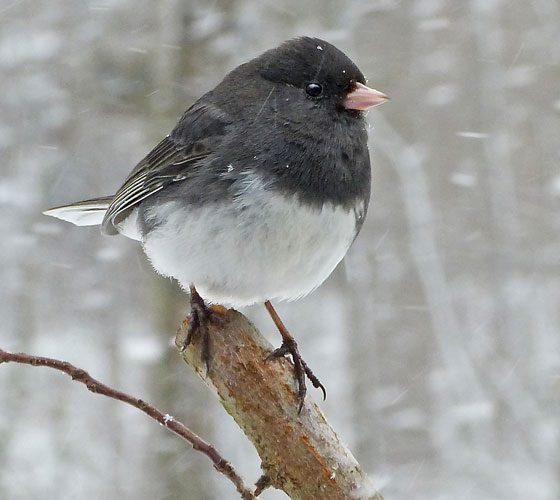

Dark-eyed Junco, adult male, slate-colored form
About the photographs
Dark-eyed Junco, adult female, slate-colored form
Dark-eyed Junco, adult male, Oregon form
Dark-eyed Junco, adult female, Oregon form
Dark-eyed Junco, adult, pink-sided form
Dark-eyed Junco, adult, gray-headed form
Dark-eyed Junco, red-backed form, Heber AZ
Dark-eyed Junco, white-winged form
Menu
- Cool Facts
- Description
- Similar Species
- Sound
- Range
- Habitat
- Food
- Behavior
- Reproduction
- Conservation Status
- Other Names
A widespread and common small sparrow, the Dark-eyed Junco is most familiar as a winter visitor to bird feeders. It comes in several distinctly different looking forms, but all are readily identified as "juncos" by their plain patterning, dark hood, and white outer tail feathers.
Cool Facts
- Juncos are the "snowbirds" of the middle latitudes. In the eastern United States, they appear in all but the most northern states
only in the winter, and then retreat each spring. Some juncos in the
Appalachian Mountains remain there all year round, breeding at the higher
elevations. These residents have shorter wings than the migrants that join
them each winter. Longer wings help the migrants fly long distances.
- The Dark-eyed Junco includes five forms that were once considered separate species. The "slate-colored junco" is the grayest, found from Alaska to Texas and eastward. The "Oregon junco" is boldly marked blackish and brown, with a distinct dark hood, and is found in the western half of the continent. The "gray-headed junco" has a brown back and gray sides and lives in the central Rocky Mountains. The "white-winged junco" is all gray with white wingbars, and breeds only near the Black Hills of South Dakota. The "Guadalupe junco" of Baja California is dull and brownish. Two other forms may be distinguishable: the "pink-sided junco," a pale version of the Oregon junco, living in the northern Rocky Mountains, and the "red-backed junco," a gray-headed junco with a dark upper bill, found in mountains near the Mexican border.
- The Dark-eyed Junco is a common bird at winter bird feeders across North America. Data from Project FeederWatch show that it is often the most common feeder bird in an area, and it is on the top-ten lists of all regions except the Southeast and South-Central (where it is 11th and 12th, respectively). To view the top-25 lists of feeder birds from across the continent, go to the Project FeederWatch Data Retrieval page.
Description
- Size: 14-16 cm (6-6 in)
- Wingspan: 18-25 cm (7-10 in)
- Weight: 18-30 g (0.64-1.06 ounces)
- Medium-sized sparrow.
- Unstreaked gray or brown, no wingbars (usually).
- Gray to black hood.
- Belly white.
- White outer tail feathers.
- Eyes dark. Legs pink.
- "Slate-colored junco" uniformly colored, with pale brown to dark gray back, hood, and sides.
- "Oregon junco" with well defined dark to dull gray hood, brown back and flanks.
- "Pink-sided junco" with pearly gray hood, lighter throat, small black mask (eyes and lores), dull brown back, pinkish cinnamon sides and flanks.
- "Gray-headed junco" with light gray hood and sides, a well defined reddish back, and a small black face mask.
- "Red-backed junco" like gray-headed, but bill with dark upper mandible.
- "White-winged junco" pale gray back, hood, and sides, with two weak white wingbars,
and much white in the tail.
Sex Differences
Sexes similar, but females average paler and browner.
Immature
Juvenile similar to adult, but with fine streaking on chest, head, and back.
Similar Species
- No other sparrow is so plainly marked with white outer tail feathers.
- Yellow-eyed Junco has yellow, not dark eyes, reddish in the wings, and walks, not hops on ground.
Sound
Song is a musical trill. Calls a hard "tick," "smack," and a short twittering trill.
»listen to songs of this species
Range
Range Map
© 2003 Cornell Lab of Ornithology
Summer Range
Breeds from western Alaska eastward to Newfoundland, southward in mountains to southern California and northern Georgia.
Winter Range
Winters from southern Canada to northern Mexico and northern Florida.
Habitat
Breeds in coniferous and mixed forest. Winters in fields, suburbs, cemeteries, chaparral, parks, gardens, grassy dunes, and fencerows.
Food
Seeds and insects.
Behavior
Foraging
Feeds primarily on ground. Scratches in litter with both feet. Forages in flocks.
Reproduction
Nest Type
Nest an open cup with foundation of rootlets, dried leaves, moss, and bark strips. Lined with fine grass stems, hair, or moss setae. Usually placed in small cavity on sloping bank or rock face, among roots of toppled tree, or along sloping road cut.
Egg Description
Bluish white, covered in brownish speckles.
Incubation period 12-13 days.
Clutch Size
3-5 eggs.
Condition at Hatching
Helpless with tufts of dark gray down.
Chicks fledge in 9-12 days.
Conservation Status
Common.
Other Names
Junco ardoisé (French)
Junco ojo oscuro (Spanish)
Sources used to construct this page:
Nolan, V., Jr., E. D. Ketterson, D. A. Cristol, C. M. Rogers, E. D. Clotfelter, R. C. Titus, S. J. Schoech, and E. Snajdr. 2002. Dark-eyed Junco (Junco hyemalis). In The Birds of North America, No. 716 (A. Poole and F. Gill, eds.). The Birds of North America, Inc., Philadelphia, PA.