
Birding 123 Bird Guide Gear Guide Attracting Birds Conservation Studying Birds

Bird Guide

Species Accounts

Video Gallery

Eastern Bluebird

Sialia sialis Order PASSERIFORMES - Family TURDIDAE
Summary Detailed
For complete Life History Information on this species, visit Birds of North America Online.

Eastern Bluebird 	adult	male
enlarge
Eastern Bluebird, adult male
About the photographs
Eastern Bluebird 	adult	female
enlarge
Eastern Bluebird, adult female

Eastern Bluebird juvenile
enlarge
Eastern Bluebird juvenile

Eastern Bluebird nest
enlarge
Eastern Bluebird nest

Eastern Bluebird eggs
enlarge
Eastern Bluebird eggs
Menu
  1. Cool Facts
  2. Description
  3. Similar Species
  4. Sound
  5. Range
  6. Habitat
  7. Food
  8. Behavior
  9. Reproduction
  10. Conservation Status
  11. Other Names

The red, white, and blue Eastern Bluebird is a familiar and welcomed tenant of birdhouses in suburban yards, parks, and golf courses. The popularity of "bluebird trails" and the erection of nest boxes across the country have led to increased bluebird populations in many areas.

Cool Facts

  • Life inside a bluebird nestbox is very active. Go here to take a look at what goes on, through the help of a Nest Box Cam provided by The Birdhouse Network at the Cornell Lab of Ornithology. 

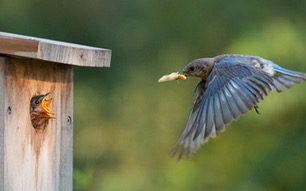
  • The male Eastern Bluebird does a "Nest Demonstration Display" at the nest cavity to attract the female. He brings nest material to the hole, goes in and out, and waves his wings while perched above it. That is pretty much his contribution to nest building; only the female Eastern Bluebird builds the nest and incubates the eggs.

  • Eastern Bluebirds typically have more than one successful brood each year. See a Birdscope article for data from The Birdhouse Network that show this graphically. Young produced in early nests usually leave their parents in summer, but young from later nests frequently stay with their parents over the winter.

  • Clutch size varies with latitude and longitude, with bluebirds farther north and farther west having larger clutches. For a discussion of this phenomenon based on data from The Birdhouse Network , click here or here.

Description

  • Size: 16-21 cm (6-8 in)
  • Wingspan: 25-32 cm (10-13 in)
  • Weight: 28-32 g (0.99-1.13 ounces)

  • Medium-sized songbird; small thrush.
  • Head large and round.
  • Wings and tail blue.
  • Chest reddish-orange.

  • Body chunky.
  • Tail short.
  • Bill black, short, and stout.
  • Some blue on both sexes.

Sex Differences

Male dark blue with bright reddish chest. Female drab gray-blue with duller reddish chest.

Male

Head, back, wings, and tail bright blue. Throat, chest, and flanks red-orange, extending onto sides of neck. Chin white or red-orange. Lower belly and undertail white. Outer tail feather with narrow white border.

Female

Duller and not as extensively blue as male. Blue-gray upperparts, with gray-brown wash across back. May have suggestion of white eyering. Wings and tail washed with dull blue. Underparts red-orange, paler than male. Belly and undertail white. White on outer tail feather broader than on male.

Immature

Juvenile with spotted chest and back, blue in wings and tail. Immature similar to adults, but duller.

Similar Species

  • Western Bluebird male has dark throat and chestnut extending onto back.
  • Female bluebirds are all similar in appearance. Western and Mountain bluebirds have dark or dusky, not white, chins; little contrast between white of belly and reddish on chest; throat color does not extend onto side of neck.
  • Mountain Bluebird has gray chest with little if any orange, longer bill, longer legs, and longer wings that nearly reach the end of the tail when folded.

Sound

Song a rich warbling whistle broken into short phrases: "Tu-wheet-tudu." Also a dry chatter.

»listen to songs of this species

Range

Range Map
Eastern_Bluebird_AllAm

© 2003 Cornell Lab of Ornithology

Summer Range

Breeds across eastern North America from southeastern Saskatchewan to Nova Scotia, southward to central Texas and Florida. Also southeastern Arizona through central Mexico to northern Nicaragua.

Winter Range

Winters in southern part of breeding range, from Kansas to Connecticut and south. Also to southeastern New Mexico and west Texas. In mild winters, may be found farther north.

Habitat

Open habitat with little or no understory and sparse groundcover, such as orchards, clear-cuts, parks, and large lawns in suburban and urban areas.

Food

Insects and small fruits.

Behavior

Foraging

Hunts from perches and drops onto ground to catch prey. Some flycatching and gleaning.

Reproduction

Nest Type

Woven of grasses or pine needles. Lined with fine grass, hair, or feathers. Placed in tree cavities and snags, and frequently in nest boxes.

Egg Description

Color: Pale blue and unmarked, occasionally white.

Egg size: 18.0-24.4 mm x 14.7-19.3mm
(0.71-0.96 in x 0.58-0.76 in)

Incubation period: 11-19 days.

Clutch Size

Usually 3-7 eggs.

Condition at Hatching

Naked and helpless with some patches of down.
Chicks fledge in 17-19 days.

Conservation Status

Populations declined in 1960s and 1970s, but increased thereafter. Increased popularity of nest box campaigns probably responsible for increases. Vulnerable to competition from introduced nest-hole competitors, such as European Starlings and House Sparrows. Common and increasing in eastern North America.

Other Names

Merlebleu de l'Est (French)
Azulejo garganta canela (Spanish)

Sources used to construct this page:

Gowaty, P. A., and J. H. Plissner. 1998. Eastern Bluebird (Sialia sialis). In The Birds of North America, No. 381 (A. Poole and F. Gill, eds.). The Birds of North America, Inc., Philadelphia, PA.


Home | Contact Us    ©2003 Cornell Lab of Ornithology