
Menu
- Cool Facts
- Description
- Similar Species
- Sound
- Range
- Habitat
- Food
- Behavior
- Reproduction
- Conservation Status
- Other Names
Breeding across the tundra from Nunavut to Siberia, across Russia, and in Greenland, the Greater White-fronted Goose has one of the largest ranges of any species of goose in the world. In North America, however, it is common only west of the Mississippi River, where it is found in large flocks in wetlands and croplands.
Cool Facts
- The Tule goose is a large, dark subspecies of the
Greater White-fronted Goose. This form breeds just around Cook Inlet in
Alaska, and numbers only about 7,500. It winters in the Sacramento Valley of
California, where it meets the more widespread subspecies. The Tule goose uses
primarily marshes while the other form forages in open fields.
- As is true of many geese, Greater White-fronted Goose
pairs stay together for years and migrate together, along with their
offspring. White-front family bonds can last longer than in most geese, and
some young stay with their parents through the next breeding season. Parent
and sibling associations may continue throughout their lives.
- A smaller, but very similar goose is found in northern
Asia and Europe. It is known as the Lesser White-fronted Goose and is the
reason our goose is known as the "Greater." Dwarf species seem to have
appeared repeatedly in geese. Other similar pairs are the Ross's and Snow
geese and the small and large forms of the Canada Goose.
- The Greater White-fronted Goose subspecies that breeds
in Greenland usually winters in Ireland and Scotland. It occasionally turns up
on the East Coast of North America. It is slightly larger than the typical
American form, and has a brighter orange (less pink) bill, but telling them
apart definitively is difficult.
Description
- Size: 64-81 cm (25-32 in)
- Wingspan: 135 cm (53 in)
- Weight: 1951-3311 g (68.87-116.88 ounces)
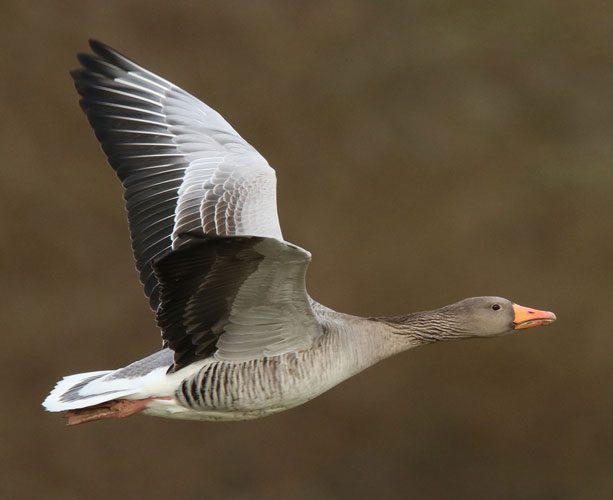
- Medium-sized goose.
- Body gray-brown.
- Forehead and base of bill white.
- Belly speckled with black.
- Legs orange.
- Bill pinkish to orange.
- Rump white.
- Flanks and undertail white.
- Tail dark with white tip.
- Eyes dark.
- Thin white stripe along side.
- Back feathers dark with tan tips.
Sex Differences
Sexes look alike, male slightly larger
Immature
Slightly smaller and lighter than adult. Lacks white forehead and black belly marks. Bill light pinkish. Legs yellow-orange
Similar Species
- The least distinctively marked of American geese. Most likely to be
confused with domestic goose. Various breeds of domestic
geese may have a white line behind bill, overall gray body, and orange bill
and feet. Domestics lack the black belly markings, and have thicker necks and
bigger bellies.
- Canada Goose has black neck and head with white cheek
patch.
- Blue form of Snow Goose has all white head and white in
the wings. Juvenile is blue-gray not brownish, and has a white, not black
tail.
Sound
Call a high-pitched laughing or yelping, consisting of two or three notes.
»listen to songs of this species
Range
Range Map
© 2004 Cornell Lab of Ornithology
Summer Range
Breeds from western Alaska eastward to Nunavut. Also across northern Russia and in Greenland.
Winter Range
Winters inland along the Pacific states from southern British Columbia southward to southern Mexico, and from central Mexico to the Mississippi River. Also in eastern Asia and British Isles.
Habitat
Breeds along tundra wetlands. Winters in agricultural fields, marshes, bays, and lakes.
Food
Seeds, grain, grasses, sedges, berries.
Behavior
Foraging
Gleans grain from fields, grazes on grass, forages in shallow water by tipping-up.
Reproduction
Nest Type
Nest a scrape in the ground lined with plant material and down feathers.
Egg Description
White to tan, stained during incubation.
Clutch Size
1-8 eggs.
Condition at Hatching
Covered with down and eyes open. Leaves nest within 24 hours of hatching and has the ability to swim and feed.
Conservation Status
Populations increasing. Pacific population had a severe decline in the 1970s and 1980s, but is recovering. Tule goose subspecies is vulnerable because of its low population size and restricted distribution.
Other Names
Oie rieuse (French)
Ganzo frente blanca (Spanish)
White-fronted Goose (English)
Sources used to construct this page:
- Bellrose, F. C. 1976. Ducks, Geese, and Swans of North America. Stackpole Books, Harrisburg, PA.
-
Ely, C. R., and A. X. Dzubin. 1994. Greater White-fronted Goose (Anser albifrons). In The Birds of North America, No. 131 (A. Poole and F.
Gill, eds.). The Academy of Natural Sciences, Philadelphia, PA, and The
American Ornithologists' Union, Washington, D.C.