
Birding 123 Bird Guide Gear Guide Attracting Birds Conservation Studying Birds

Bird Guide

Species Accounts

Video Gallery

House Wren

Troglodytes aedon Order PASSERIFORMES - Family TROGLODYTIDAE
Summary Detailed
For complete Life History Information on this species, visit Birds of North America Online.

House Wren
enlarge
House Wren
About the photographs
House Wren nest
enlarge
House Wren nest

House Wren eggs
enlarge
House Wren eggs
Menu
  1. Cool Facts
  2. Description
  3. Similar Species
  4. Sound
  5. Range
  6. Habitat
  7. Food
  8. Behavior
  9. Reproduction
  10. Conservation Status
  11. Other Names

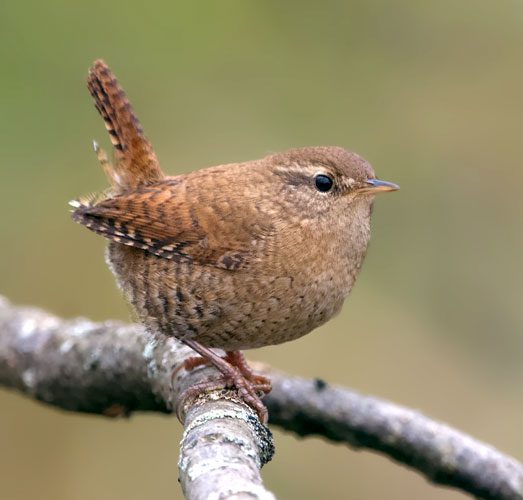
A frequent visitor to birdhouses, the House Wren is a common sight and sound in backyards across the country. The suburban-loving little brown bird often takes over all the birdhouses in its general vicinity, keeping all other species from using them.

Cool Facts

  • The House Wren will puncture eggs of other species nesting in nest boxes. Sometimes it breeds in a usurped nest box; other times it is nesting nearby.

  • Male House Wrens returning to the North to breed in their first year are more likely to settle close to an established male than farther from it. Experienced males tend to settle farther apart. Young males may take clues from more experienced males about what areas are good nesting sites.

  • The House Wren has one of the largest ranges of any songbird in the New World. It breeds from Canada, through the West Indies, through Central America, southward to the southernmost point of South America. Some of the subspecies living south of the United States have been considered as separate species.

  • When a male House Wren claims a cavity for nesting he begins bringing sticks. He may put more than 400 sticks into one cavity. When a female pairs with the male she takes over nest building and adds the nest cup and lining.

Description

  • Size: 11-13 cm (4-5 in)
  • Wingspan: 17 cm (7 in)
  • Weight: 10-12 g (0.35-0.42 ounces)

  • Small brown songbird.
  • Moderately short tail often held cocked over back.
  • Thin pointed bill.

  • Head and back moderate to dark brown; rufous to gray-brown.
  • Throat and chest light gray brown.
  • Wings and tail with black barring.
  • Indistinct pale eyeline.
  • Some barring on flanks and under tail.

Sex Differences

Sexes alike.

Immature

Similar to adult.

Similar Species

  • Winter Wren is smaller and darker, with a shorter tail, stronger barring on the belly and flanks, and a more distinct, but still dull eyestripe.
  • Carolina and Bewick's wrens have paler bellies and distinct white eyestripes.

Sound

Song a bubbling musical series of complicated whistled notes and trills. Call a sharp "chek."

»listen to songs of this species

Range

Range Map
House Wren

© 2003 Cornell Lab of Ornithology

Summer Range

Breeds from southern Canada southward to central California, central New Mexico, northern Arkansas, and northern Georgia. Other forms found from Mexico southward throughout South America and the West Indies.

Winter Range

Winters in the southern United States and Mexico, from California, Texas, and central Arkansas, to southern Maryland and southward to Gulf Coast and throughout Florida.

Habitat

  • Breeds along forest edges and in open woodlands, city parks, and residential areas with trees.
  • Winters in thickets, shrubby areas, residential yards and gardens, chaparral, and riparian areas.

Food

Small terrestrial invertebrates.

Behavior

Foraging

Gleans insects from leaves and shrubs.

Reproduction

Nest Type

Nest a stick platform with a nest cup lined with grass, bark, hair, and feathers. Nest placed in tree cavity or nest box.

Egg Description

Color: White or pinkish white, with small spots or blotches of reddish brown.

Egg size: 14.7-19.1 mm x 11.2-13.7 mm.
(0.58-0.75 in x 0.44-0.54 in)

Incubation period: Usually 12 days. Range 9-16 days.

Clutch Size

3-10 eggs.

Condition at Hatching

Helpless with only wisps of down.
Chicks fledge in 15-17 days.

Conservation Status

Populations have increased over the long- and short-term across the continent.

Other Names

Troglodyte familier (French)
Chivirín saltapared (Spanish)

Sources used to construct this page:

Johnson, L. S. 1998. House Wren (Troglodytes aedon). In The Birds of North America, No. 380 (A. Poole and F. Gill, eds.). The Birds of North America, Inc., Philadelphia, PA.


Home | Contact Us    ©2003 Cornell Lab of Ornithology