
Birding 123 Bird Guide Gear Guide Attracting Birds Conservation Studying Birds

Bird Guide

Species Accounts

Video Gallery

Little Blue Heron

Egretta caerulea Order CICONIIFORMES - Family ARDEIDAE
Summary Detailed
For complete Life History Information on this species, visit Birds of North America Online.

Little Blue Heron, adult
enlarge
Little Blue Heron, adult
About the photographs
Little Blue Heron, juvenile
enlarge
Little Blue Heron, juvenile
Menu
  1. Cool Facts
  2. Description
  3. Similar Species
  4. Sound
  5. Range
  6. Habitat
  7. Food
  8. Behavior
  9. Reproduction
  10. Conservation Status
  11. Other Names

A smallish heron of the southeastern United States, the Little Blue Heron breeds in various freshwater and estuarine habitats. It is the only heron species in which first-year birds and adults show dramatically different coloration: first-year birds are pure white, while adults are blue.

Cool Facts

  • The Snowy Egret tolerates the close proximity of white Little Blue Herons more than that of dark Little Blue Herons. A white Little Blue Heron catches more fish in the company of Snowy Egrets than when alone. This relationship may be one reason why young Little Blue Herons stay white for a year.
  • Another advantage of white plumage is that young Little Blue Herons are more readily able to integrate into mixed-species flocks of white herons, thus gaining a measure of protection against predators.

Description

  • Size: 56-74 cm (22-29 in)
  • Wingspan: 100-105 cm (39-41 in)
  • Weight: 296-412 g (10.45-14.54 ounces)

  • Medium-sized, slender heron.
  • All dark.
  • Long neck, bill, and legs.
  • Bill dark.

  • Body slate-blue.
  • Head and neck dark purplish.
  • Bill gray or blue at base with black tip.
  • Long thin, pointed plumes on back of head and back during breeding.
  • Eyes green when breeding, otherwise yellow.
  • Face skin glossy turquoise blue when breeding, otherwise dull greenish.
  • Legs and feet black during breeding, otherwise gray to grayish green.

Sex Differences

Sexes similar; female slightly smaller.

Immature

White, with pale, black-tipped bill and greenish legs. Enters adult plumage in the first spring after hatching and may be pied white and blue.

Similar Species

  • Tricolored Heron is slightly larger and thinner, and has white belly, white line down throat, and white head plumes.
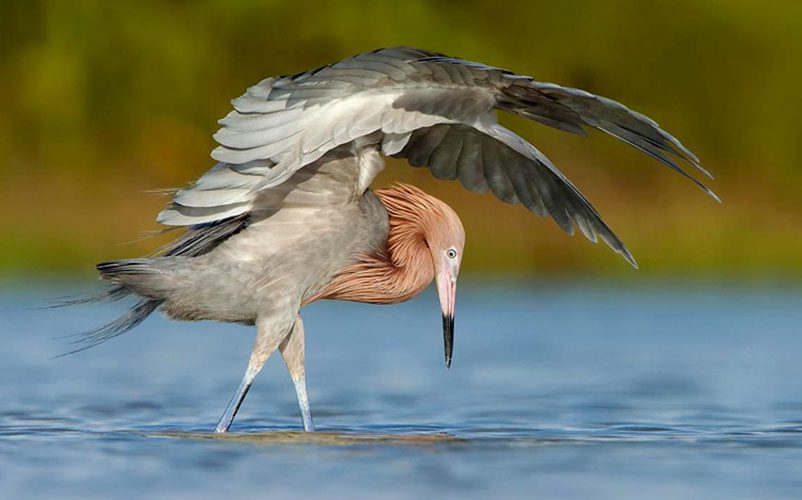
  • Reddish Egret has more reddish neck and head, fluffier neck feathers, a pink base to the bill, and is restricted to salt water.
  • Immature Little Blue Heron resembles other white herons. Snowy Egret has black bill, yellow feet, and yellow skin in front of eyes.
  • Great Egret is larger, has a mostly yellow bill, and deep black legs.
  • Great White Heron, the white form of the Great Blue Heron, is much larger, and has a heavier bill without a dark tip.
  • The white form of the Reddish Egret has a dark or bi-colored bill, but with a pink, not gray base, is larger and shaggier, has darker legs, and is found only in salt water.
  • Cattle Egret is much shorter and stockier, has a thick, usually yellow bill, and often has a reddish wash over the head, back, and chest.

Sound

A loud, nasal squawk in aggression or territorial defense.

»listen to songs of this species

Range

Range Map


© 2004 Cornell Lab of Ornithology

Summer Range

Breeds in the southeastern United States, from the southern Ohio and Missouri River valleys to the Gulf Coast of Texas and Florida, and up the Atlantic Coast to New England. Also breeds on both coasts of Mexico, throughout the Caribbean, and northern South America.

Winter Range

Winters along the coasts of the southeastern United States, from New Jersey to Florida and south Texas; also winters in the Caribbean, Mexico, Central America, and South America.

Habitat

Swamps, estuaries, rivers, ponds, and lakes.

Food

Small fish, amphibians, and aquatic invertebrates.

Behavior

Foraging

Forages slowly and methodically, walking slowly, peering, and moving along to a new spot.

Displays

In courtship, male points bill straight upward and suddenly extends and withdraws neck.

Reproduction

Nest Type

A platform of long sticks, lined with green vegetation. Nests in colonies with other herons. Nest placed in trees or shrubs.

Egg Description

Pale bluish green.

Clutch Size

1-6 eggs.

Condition at Hatching

Covered in white down; eyes partially open and can hold head up just after hatching.

Conservation Status

Declining in much of its range in the United States. Because it does not bear long showy plumes in breeding adult plumage, the Little Blue Heron largely escaped serious population declines from feather hunting for the millinery trade. Habitat loss and human-caused changes in local water dynamics are the most serious threats.

Other Names

Petit héron bleu, Aigrette bleue, Crabier bleu (French)
Garza azul, Garceta azul (Spanish)

Sources used to construct this page:

Rodgers, J. A., Jr., and H. T. Smith. 1995. Little Blue Heron (Egretta caerulea). In The Birds of North America, No. 145 (A. Poole and F. Gill, eds.). The Academy of Natural Sciences, Philadelphia, and The American Ornithologists' Union, Washington, D.C.


Home | Contact Us    ©2003 Cornell Lab of Ornithology