
Birding 123 Bird Guide Gear Guide Attracting Birds Conservation Studying Birds

Bird Guide

Species Accounts

Video Gallery

Northern Flicker

Colaptes auratus Order PICIFORMES - Family PICIDAE
Summary Detailed
For complete Life History Information on this species, visit Birds of North America Online.

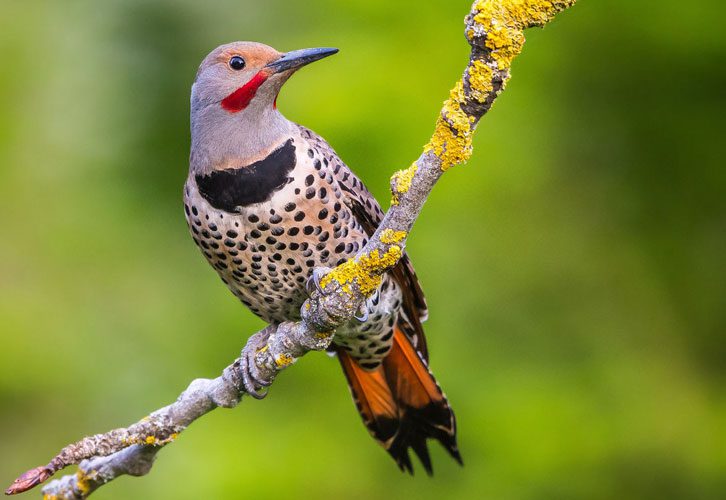
Northern Flicker, 	adult	male,	yellow-shafted
enlarge
Northern Flicker, adult male, yellow-shafted
About the photographs
Northern Flicker, adult	female,	yellow-shafted
enlarge
Northern Flicker, adult female, yellow-shafted

Northern Flicker,	adult	male,	red-shafted
enlarge
Northern Flicker, adult male, red-shafted

Northern Flicker, female, red-shafted
enlarge
Northern Flicker, female, red-shafted
Menu
  1. Cool Facts
  2. Description
  3. Similar Species
  4. Sound
  5. Range
  6. Habitat
  7. Food
  8. Behavior
  9. Reproduction
  10. Conservation Status
  11. Other Names

A common ant-eating woodpecker of open areas, the Northern Flicker has two color forms found in different regions. The yellow-shafted form is common across the eastern and northern parts of North America, while the red-shafted form is the one found in the West.

Cool Facts

  • Although it can climb up the trunks of trees and hammer on wood like other woodpeckers, the Northern Flicker prefers to find food on the ground. Ants are its favorite food, and the flicker digs in the dirt to find them. It uses its long barbed tongue to lap up the ants.

  • The red-shafted and yellow-shafted forms of the Northern Flicker formerly were considered different species. The two forms hybridize extensively in a wide zone from Alaska to the panhandle of Texas. A hybrid often has some traits from each of the two forms and some traits that are intermediate between them. The Red-shafted Flicker also hybridizes with the Gilded Flicker, but less frequently, and the Gilded Flicker is considered a separate species.

  • The Northern Flicker is one of the few North American woodpeckers that is strongly migratory. Flickers in the northern parts of the range move south for the winter, although a few individuals often stay rather far north.

Description

  • Size: 28-31 cm (11-12 in)
  • Wingspan: 42-51 cm (17-20 in)
  • Weight: 110-160 g (3.88-5.65 ounces)

  • Medium to large woodpecker.
  • Grayish brown.
  • Barred on top, spotted below.
  • Black crescent on chest.
  • Rump white, conspicuous in flight.
  • Yellow or red patches in wings obvious in flight.

Back grayish brown with dark barring. Underparts off-white or buffy with numerous small black spots. Back of neck gray. Tail black above. Eye black. Feet gray.
Yellow-shafted (Eastern and Northern) form: Central shaft and undersides of wing and tail feathers bright yellow. Face and throat tan. Crown gray. Red crescent on nape of neck. Male with black mustache mark.
Red-shafted (Western) form: Central shaft and undersides of wing and tail feathers bright salmon red. Face and throat gray. Crown brown. Male with red mustache mark. Female with brown mustache mark on gray face.

Sex Differences

Male with black or red mustache stripe. Female without mustache stripe, or with brown one.

Immature

Juvenile resembles adult, but colors duller. Both sexes of juvenile yellow-shafted form have black mustache; only male Red-shafted Flickers have red mustache.

Similar Species

  • Gilded Flicker very similar, has yellow wings but a gray face and red mustache.

    Sound

    Call a long series of loud "wik-wik-wik" notes. Also a softer "wik-a-wik-a-wik-a," and a strong single-note "peah."

    »listen to songs of this species

    Range

    Range Map
    Northern Flicker

    © 2003 Cornell Lab of Ornithology

    Summer Range

    Breeds across North America, from Alaska and northern Canada southward to Cuba and Central America. Red-shafted form breeds from southeastern Alaska through British Columbia, western North Dakota, and Colorado, southward into Mexico.

    Winter Range

    Winters from southern Canada southward.

    Habitat

    Found in open woodlands and forest edge, including cities and suburbs.

    Food

    Insects, primarily ants. Also fruits and seeds.

    Behavior

    Foraging

    Forages primarily on ground, digging in soil.

    Reproduction

    Nest Type

    Digs hole in tree, usually dead tree. Cavity unlined.

    Egg Description

    White.

    Clutch Size

    3-12 eggs.

    Condition at Hatching

    Naked and helpless.

    Conservation Status

    Widespread and common, but populations declining.

    Other Names

    Pic flamboyant (French)
    Carpintero alirrojo, Pic-palo lombricero (Red-shafted Flicker) (Spanish)

    Sources used to construct this page:

    Moore, W. S. 1995. Northern Flicker (Colaptes auratus). In The Birds of North America, No. 166 (A. Poole and F. Gill, eds.). The Academy of Natural Sciences, Philadelphia, PA, and The American Ornithologists' Union, Washington, D.C.


Home | Contact Us    ©2003 Cornell Lab of Ornithology