
Birding 123 Bird Guide Gear Guide Attracting Birds Conservation Studying Birds

Bird Guide

Species Accounts

Video Gallery

Purple Finch

Carpodacus purpureus Order PASSERIFORMES - Family FRINGILLIDAE - Subfamily Carduelinae
Summary Detailed
For complete Life History Information on this species, visit Birds of North America Online.

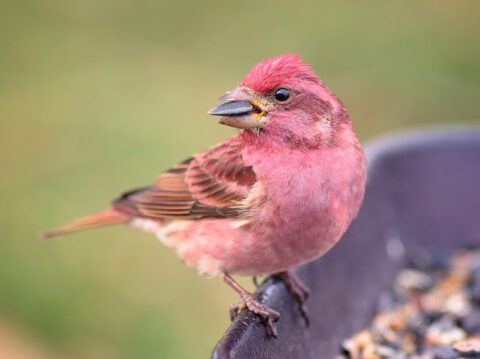
Purple Finch, male
enlarge
Purple Finch, male
About the photographs
Purple Finch, female
enlarge
Purple Finch, female
Menu
  1. Cool Facts
  2. Description
  3. Similar Species
  4. Sound
  5. Range
  6. Habitat
  7. Food
  8. Behavior
  9. Reproduction
  10. Conservation Status
  11. Other Names

Formerly the common red finch at eastern bird feeders, the Purple Finch has been displaced in many areas by the introduced House Finch. The raspberry- or rose-colored Purple Finch lives primarily in coniferous woods and visits most of the eastern United States only in the winter.

Cool Facts

  • The Purple Finch feeds on flowers by crushing the base to get the nectar and leaving the upper flower undamaged. In a similar action, it often feeds on the seeds of fruits rather than the pulp.

  • The decline of the Purple Finch in the East may be partly explained by competition with the introduced House Finch. In aggressive interactions, the House Finch nearly always wins. A population decline was noted with the introduction of the House Sparrow too, nearly 100 years earlier.

  • Two subspecies of the Purple Finch are recognized, a Pacific Coast form and the more widespread form. The Pacific form differs by having a different wing shape and duller colors. The songs differ too, with Eastern birds singing a more leisurely series of warbles spanning a wider range of notes.

Description

  • Size: 12-15 cm (5-6 in)
  • Wingspan: 22-26 cm (9-10 in)
  • Weight: 18-31 g (0.64-1.09 ounces)

  • Medium-sized finch.
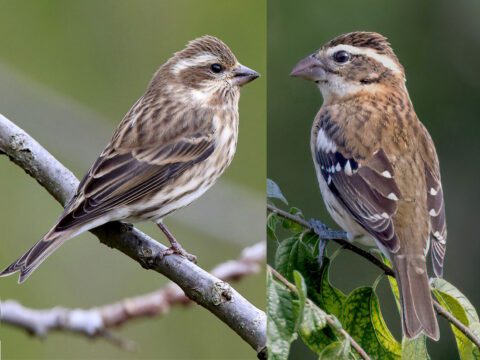
  • Male raspberry-red on head and chest; female brown and striped.
  • Bill relatively thick and pointed.

Tail notched.

Sex Differences

Male red, female brown-and-white striped.

Male

Raspberry-red spread uniformly over head, neck, upperparts, and sides. Lower belly and undertail coverts unmarked white. Darker face patch and malar stripe usually visible.

Female

Back, chest, and sides streaked dark brown and gray. Strong pale eyestripe. Dark ear patch and malar stripe. Belly white with some streaks.

Immature

Immature identical to female.

Similar Species

  • House Finch slimmer with longer, unnotched tail, and less pointed beak. House Finch male with bright red on forehead and chest only, back brown, and distinctly streaked flanks. Female House Finch dull gray brown face without pale eyestripe or malar stripe.
  • Cassin's Finch male is brightest red on crown, with little red on back of neck, and bill is more pointed. Female Cassin's Finch with less pronounced facial pattern and streaked undertail coverts. For more discussion on distinguishing these three species, go here.

    Sound

    Song a series of warbles, sometimes including imitations of songs of other birds. Call note a short low "tek."

    »listen to songs of this species

    Range

    Range Map
    Purple Finch

    © 2003 Cornell Lab of Ornithology

    Summer Range

    Breeds from southwestern Yukon eastward across Canada, southward into the northeastern United States, and in the mountains to Virginia, and southward along the Pacific Coast to southern California.

    Winter Range

    Winters along the Pacific Coast and from southeastern Canada southward to Gulf Coast, from central Texas to northern Florida. For a look at winter movements, go here.

    Habitat

    • Breeds primarily in cool coniferous forests.
    • Also in suburban areas, orchards, and deciduous forests.
    • Winters in areas where food is available.

    Food

    Seeds, buds, blossoms, nectar, fruit of trees, and occasionally insects. For a look at food preferences as determined by BirdSource project participants, go here.

    Behavior

    Foraging

    Feeds on outer portion of tree branches, occasionally on ground.

    Reproduction

    Nest Type

    Nest an open cup of twigs, sticks, and roots, lined with fine grasses, fibers, and hair. Placed out on branch of conifer tree, usually with an overhanging branch.

    Egg Description

    Pale greenish blue with dark spots concentrated at large end.

    Clutch Size

    Usually 4 eggs. Range: 2-7.

    Condition at Hatching

    Helpless with little down

    Conservation Status

    Declining in many parts of range. In the East, competition with the introduced House Finch may be responsible for the decline.

    Other Names

    Roselin pourpré (French)
    Gorrión purpúreo (Spanish)

    Sources used to construct this page:

    Wootton, J. T. 1996. Purple Finch (Carpodacus purpureus). In The Birds of North America, No. 208 (A. Poole and F. Gill, eds.). The Academy of Natural Sciences, Philadelphia, PA, and The American Ornithologists' Union, Washington, D.C.


Home | Contact Us    ©2003 Cornell Lab of Ornithology