
Birding 123 Bird Guide Gear Guide Attracting Birds Conservation Studying Birds

Bird Guide

Species Accounts

Video Gallery

Red-tailed Hawk

Buteo jamaicensis Order FALCONIFORMES - Family ACCIPITRIDAE - Subfamily Accipitrinae
Summary Detailed
For complete Life History Information on this species, visit Birds of North America Online.

Red-tailed Hawk, adult, light form
enlarge
Red-tailed Hawk, adult, light morph
About the photographs
Red-tailed Hawk, light form, juvenile
enlarge
Red-tailed Hawk, light form, juvenile

Red-tailed hawk, intermediate form, adult
enlarge
Red-tailed hawk, intermediate form, adult

Red-tailed Hawk, intermediate form,juvenile
enlarge
Red-tailed Hawk, rufous/dark morph, juvenile

Red-tailed Hawk, dark form, juvenile
enlarge
Red-tailed Hawk, dark morph, juvenile
Menu
  1. Cool Facts
  2. Description
  3. Similar Species
  4. Sound
  5. Range
  6. Habitat
  7. Food
  8. Behavior
  9. Reproduction
  10. Conservation Status
  11. Other Names

The most common and widespread hawk in North America, the Red-tailed Hawk is a bird of open country. It is frequently seen sitting on utility poles where it watches for rodents in the grass along the roadside.

Cool Facts

  • The "Harlan's Hawk" was once considered a separate species. It breeds in Alaska and northwestern Canada, and winters on the southern Great Plains. This very dark form has a marbled white, brown, and gray tail instead of a red one. Many individuals intermediate between Harlan's and more typical Red-tailed Hawks can be found.

  • The raspy cry of the Red-tailed Hawk is used in movies to represent any eagle or hawk anywhere in the world.

  • In the courtship display a pair of Red-tailed Hawks soars in wide circles at a great height. The male dives down in a steep drop, then shoots up again at nearly as steep an angle. He repeats this maneuver several times, then approaches the female from above. He extends his legs and touches or grasps her briefly. The pair may grab onto one other and may interlock their talons and spiral toward the ground.

Description

  • Size: 45-65 cm (18-26 in)
  • Wingspan: 114-133 cm (45-52 in)
  • Weight: 690-1460 g (24.36-51.54 ounces)

  • Large hawk.
  • Wings long and broad.
  • Tail broad and red.
  • Most commonly with pale chest and dark band across belly.

  • Extremely variable in appearance with light and dark forms.
  • Tail reddish on top, with dark band near end.
  • Tail lighter red below; unbanded.
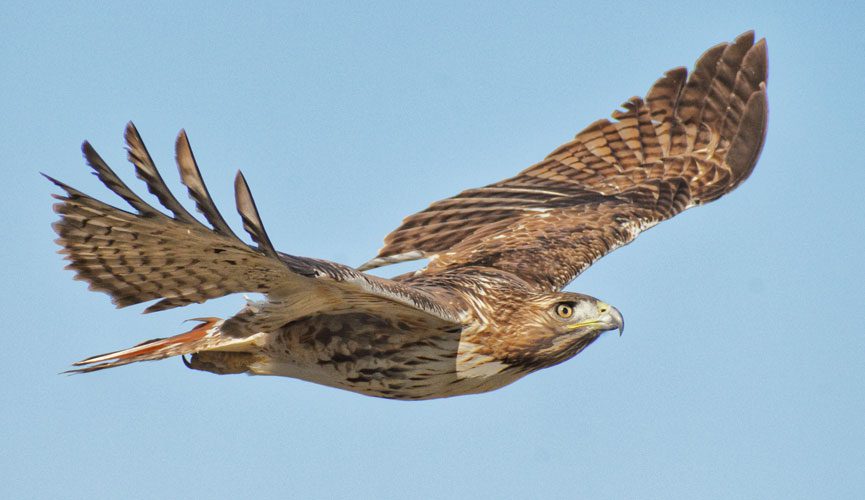
  • Light forms: Head darkish brown. Throat dark or white. Chest white or with rusty streaks. Dark band of streaks across belly variable, from very dark to nearly absent. Dark patches at leading edge of wing, and dark trailing edge. Back dark brown with white mottling; white forming loose "V" on shoulders. May show pale eyestripe.
  • Dark form: Dark brown all over. May be rufous on chest. Tail red on top. In flight, front of wings dark, flight feathers pale, with dark trailing edge.
  • "Harlan's Hawk" is a dark form without red on tail.

Sex Differences

Sexes look alike; female larger.

Immature

Juvenile similar to adult, but more streaked, and has brown tail with several dark bars across it.

Similar Species

  • Red-shouldered Hawk has a banded tail and is more uniformly colored. Red tail separates dark form from all other hawks.

Sound

Call a raspy, scraping, screamed "kree-eee-ar."

»listen to songs of this species

Range

Range Map
Red-tailed Hawk

© 2003 Cornell Lab of Ornithology

Summer Range

Breeds from Alaska to Labrador, southward to Mexico and the Caribbean, down to Panama.

Winter Range

Winters from southern Canada southward.

Habitat

Found in open areas with scattered elevated perches, including agricultural areas, fields, pasture, parkland, broken woodland, and scrub desert.

Food

Small and medium-sized mammals, birds, reptiles.

Behavior

Foraging

Sit-and-wait predator, usually watching from elevated perch. Also hovers in strong wind.

Reproduction

Nest Type

Large bowl of sticks in tall tree or on cliff ledge. Lined with bark, green twigs, and other items.

Egg Description

White, marked with brown blotches.

Clutch Size

1-5 eggs.

Condition at Hatching

Helpless and covered with white down.

Conservation Status

Populations increasing in much of North America, apparently in response to the widespread establishment of open, wooded parkland in place of grassland or dense forest.

Other Names

Buse à queue rousse (French)
Aguililla parda (Spanish)

Sources used to construct this page:

Preston, C. R., and R. D. Beane. 1993. Red-tailed Hawk (Buteo jamaicensis). In The Birds of North America, No. 52 (A. Poole, and F. Gill, eds.). The Academy of Natural Sciences, Philadelphia, PA, and The American Ornithologists' Union, Washington, D.C.


Home | Contact Us    ©2003 Cornell Lab of Ornithology