
Birding 123 Bird Guide Gear Guide Attracting Birds Conservation Studying Birds

Bird Guide

Species Accounts

Video Gallery

Rose-breasted Grosbeak

Pheucticus ludovicianus Order PASSERIFORMES - Family CARDINALIDAE
Summary Detailed
For complete Life History Information on this species, visit Birds of North America Online.

Rose-breasted Grosbeak male
enlarge
Rose-breasted Grosbeak male
About the photographs
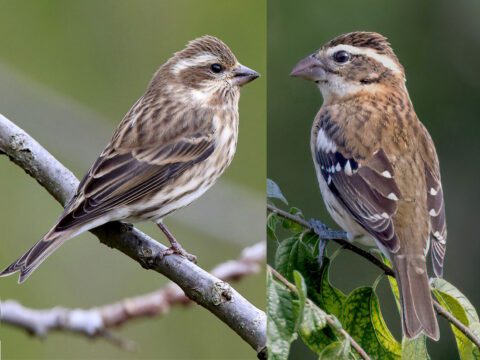
Rose-breasted Grosbeak female
enlarge
Rose-breasted Grosbeak female
Menu
  1. Cool Facts
  2. Description
  3. Similar Species
  4. Sound
  5. Range
  6. Habitat
  7. Food
  8. Behavior
  9. Reproduction
  10. Conservation Status
  11. Other Names

The male Rose-breasted Grosbeak, boldly patterned in black, white, and rose, is easily identified. The drab, striped female, however, is more of a challenge, resembling a large sparrow or finch. A common bird of forests and second growth, the grosbeak's song is like that of the robin, only as sung by an opera singer, being mellower and more sweetly melodic.

Cool Facts

  • The Rose-breasted Grosbeak hybridizes with the Black-headed Grosbeak where their ranges overlap in the Great Plains. Hybrids can look like either parent species, or be intermediate in pattern, with various combinations of pink, orange, and black. Hybridization occurs most often where the densities of both species are low, and only rarely when densities are high.
  • In areas of overlap with the Black-headed Grosbeak, male Rose-breasted Grosbeaks responded equally to songs of both species. When presented with mounted birds, however, they attacked the Rose-breasted Grosbeak mount more. The males directed their attacks primarily at the white rump and flanks of the model, suggesting that the white rump is a more important stimulus than the red chest.

  • The nest of the Rose-breasted Grosbeak is so thinly constructed that eggs often can be seen from below through the nest.

  • The male Rose-breasted Grosbeak participates in incubation of the eggs, accounting for about 1/3 of the time during the day (the female incubates over night). Both sexes sing quietly to each other when they exchange places. The male will sing his normal song while near or actually on the nest.

Description

  • Size: 18-21 cm (7-8 in)
  • Wingspan: 29-33 cm (11-13 in)
  • Weight: 39-49 g (1.38-1.73 ounces)

  • Medium-sized, stocky songbird.
  • Large, thick, pale, cone-shaped bill.
  • White flash in wings in flight.
  • Male distinctive with black hood, red chest, and white belly.

  • Bill pink-white to slate gray.
  • Eyes dark brown.
  • Legs and feet grayish blue, with soles lighter.

Sex Differences

Male strikingly colored, with black back and hood, red chest, white rump and belly. Female streaked brown and white.

Male

Breeding (Alternate) plumage: Rosy red triangular breast patch. Black head and upperparts, sometimes with a few brown feathers. White underparts. White patches on wing; form wingbars at rest, large white spot in flight. White spots on outermost three feathers of black tail. Red wing linings. White rump; sometimes pink, usually with some dark marks.
Nonbreeding (Basic) plumage: Similar to breeding, but black feathers on upperparts have buff tips that partially hide the black. On head they create a buff center crown-stripe and face stripes. Throat and chin mottled black and pink. Pink breast dull. Resembles female, but wings and tail are deep black with white.

Female

Dull black crown stripes, with pale center stripe. White stripe over eye, brown face mask. Back brown with dark streaks. Chin, throat, and lower cheeks creamy white. Neck, breast, sides, and flanks cream or buff, with narrow or heavy black streaks. Amount of buff color and size and thickness of streaking is variable. Belly and under tail white. Rump olive brown. Tail brown. Two white wingbars. Some white in wings shown in flight. Yellowish to orange wing linings. Dark brown upperparts with brown streaks on breast.

Immature

Immature similar to adult female, but wings and tail browner, breast more buffy and with more indistinct streaks. Immature fall male has brownish chest, usually with some pink, and red wing linings. First-summer male (Alternate I) similar to adult, but with more brownish wing and tail, and usually some brown body feathers.

Similar Species

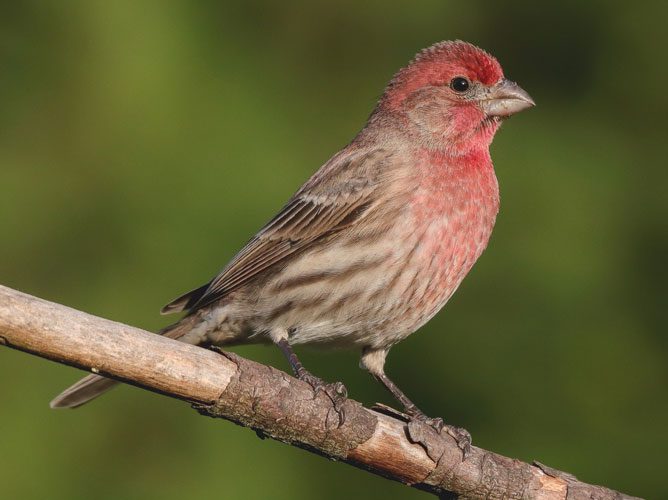
  • Purple Finch female resembles female Rose-breasted Grosbeak, but is smaller, smaller headed, has a distinct moustache stripe, a dark bill, and lacks white in wings.
  • Black-headed Grosbeak male is distinctive orange and black, but the female is very similar to female Rose-breasted Grosbeak. Black-headed Grosbeak has paler, narrower, and less streaking on the underparts, especially in center of breast, is more yellowish buff rather than white on head and nape, has lemon yellow, not buffy yellow wing linings, and a dark upper bill.

Sound

Song a slow, rich warble, like a robin that has taken singing lessons. Call a sharp "squeak," like a sneaker on a gym floor.

»listen to songs of this species

Range

Range Map
Rose-breasted Grosbeak

© 2003 Cornell Lab of Ornithology

Summer Range

Breeds from southern Yukon southeastward to northern North Dakota, eastward to Newfoundland, and southward to Nebraska, New Jersey, and in the mountains to northern Georgia.

Winter Range

Winters from southern Mexico to northern South America and the Caribbean.

Habitat

Breeds in deciduous and mixed woodlands, especially at the edges, second-growth woodlands, orchards, suburban parks and gardens. Winters in open tropical forest

Food

Insects, seeds, fruits, and buds.

Behavior

Foraging

Gleans insects from foliage and branches. Will use bird feeders.

Reproduction

Nest Type

A loose, open cup of sticks, twigs, grasses, weed stems, decayed leaves or straw, lined with fine twigs, rootlets, or hair. Placed in trees, shrubs, or vines.

Egg Description

Pale green or blue with reddish brown blotches and speckles.

Clutch Size

Usually 4 eggs. Range: 1-5.

Condition at Hatching

Helpless, with sparse down.

Conservation Status

Common. No significant changes in populations noted.

Other Names

Cardinal à poitrine rose (French)
Picogrueso pechirrosado (Spanish)

Sources used to construct this page:

Wyatt, V. E., and C. M Francis. 2002. Rose-breasted Grosbeak (Pheucticus ludovicianus). In The Birds of North America, No. 692 (A. Poole and F. Gill, eds.). The Birds of North America, Inc., Philadelphia, PA.


Home | Contact Us    ©2003 Cornell Lab of Ornithology