
Birding 123 Bird Guide Gear Guide Attracting Birds Conservation Studying Birds

Bird Guide

Species Accounts

Video Gallery

Sharp-shinned Hawk

Accipiter striatus Order FALCONIFORMES - Family ACCIPITRIDAE - Subfamily Accipitrinae
Summary Detailed
For complete Life History Information on this species, visit Birds of North America Online.

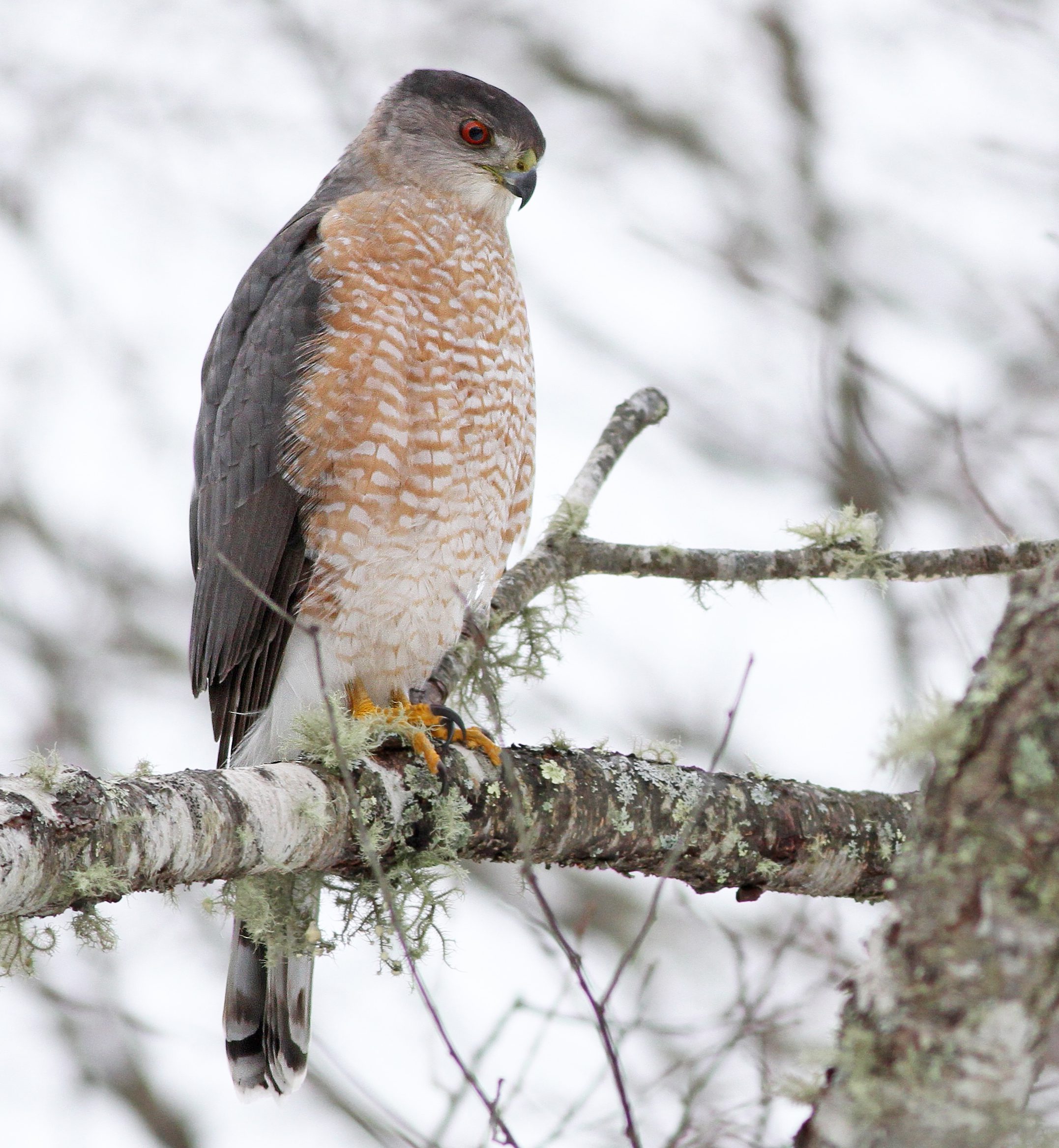
Sharp-shinned Hawk 	adult
enlarge
Sharp-shinned Hawk, adult
About the photographs
Sharp-shinned Hawk, 	juvenile
enlarge
Sharp-shinned Hawk, juvenile
Menu
  1. Cool Facts
  2. Description
  3. Similar Species
  4. Sound
  5. Range
  6. Habitat
  7. Food
  8. Behavior
  9. Reproduction
  10. Conservation Status
  11. Other Names

A small hawk, the Sharp-shinned Hawk is a regular visitor to bird feeders, where it eats birds, not seed. The male and female show a greater disparity in size than any other American hawk; the female is nearly twice the weight of the male.

Cool Facts

  • After the young leave the nest, the adults pass food to the young in mid-air. The parents give the prize to the first young hawk to reach them, hovering briefly and kicking the prey outward just as the fledgling arrives.

  • Sharp-shinned Hawk numbers declined during the DDT pesticide years (mid-1940s to 1972), but rebounded after DDT was banned.

  • Sharp-shinned Hawks migrate south out of Canada in the fall and are observed at hawk watches in very large numbers. The hawks follow similar landscape features and often are concentrated in certain areas. Over 11,000 Sharp-shinned Hawks were seen on one October day at Cape May Point, New Jersey.

  • The habit of hunting around bird feeders has been suggested as an explanation for the decrease in numbers of Sharp-shinned Hawks seen at eastern hawk watches. Fewer hawks may be migrating south, preferring instead to stay farther north near a dependable food source: feeder birds.

Description

  • Size: 24-34 cm (9-13 in)
  • Wingspan: 43-56 cm (17-22 in)
  • Weight: 87-218 g (3.07-7.7 ounces)

  • Small hawk.
  • Tail long, barred, and ends with a square tip.
  • Wings short and rounded.
  • Adults with blue-gray back and wings, reddish barring on underparts.

  • Crown and back similar in color.
  • Eyes red.
  • Undertail coverts white.
  • Toes long and yellow.

Sex Differences

Sexes similar in plumage; female substantially larger.

Female

Adult female somewhat browner on back and less heavily barred than male.

Immature

Juveniles brown on back and wings. Underparts with coarse brown streaks. Thin white eyestripe. Underwing white with dark brown barring. Eyes yellow.

Similar Species

  • Very similar in plumage to Cooper's Hawk. Cooper's Hawk has proportionately longer tail, rounded at the tip. Cooper's Hawk is more robust and has a proportionately larger head. Adult Cooper's Hawk has a dark cap that contrasts with its back. Juvenile Cooper's Hawk has less streaking underneath and more white on the tip of the tail. In flight, the larger head of the Cooper's Hawk is apparent, sticking out farther in front of the wings. For more information separating the two species go to here.
  • Merlin is similar to juvenile, but its wingtips nearly reach the end of the tail, not less than half way down as in Sharp-shinned Hawk. Merlin has long, pointed wings in flight, not rounded.

Sound

Call a series of sharp "kik" notes.

»listen to songs of this species

Range

Range Map
Sharp-shinned_Hawk_AllAm

© 2003 Cornell Lab of Ornithology

Summer Range

Breeds from central Alaska, throughout most of Canada, south to the northern states and through the Appalachians to northern Alabama, in the East. Largely absent through much of the Midwest and the Great Plains. Breeds locally throughout western United States, south through central Mexico and Central America. Also in Caribbean and much of South America.

Winter Range

Winters along coast from southern Alaska southward, and from southern Canada through most of the United States.

Habitat

  • Nests in forests, usually with conifers.
  • Generally not present in small woodlots and open areas.
  • Winters in larger variety of habitats, including urban and suburban areas.

Food

Mostly small birds; some large insects and small mammals.

Behavior

Foraging

Captures birds from low, stealthy approach-flight or after a short chase. Uses cover, including man-made structures, to conceal approach. Captures birds at bird feeders.

Displays

Both males and females may engage in "slow flight" territorial displays in which the birds fly with stiff, slow, exaggerated wing beats while exposing white undertail coverts. Both sexes may give the "kik-kik-kik" call during these flights.

Reproduction

Nest Type

Nest is a platform made of conifer twigs, placed on horizontal limb in dense tree.

Nest Description

Nests built in mature trees against trunk, supported by one or more large branches and generally shaded from above. Males may show a high degree of territory fidelity, with several old nests located within a small area. Height: 6 - 18 meters (20 - 60 feet). Nest a substantial platform of large, often fresh, twigs broken from branches. Center lined with bark chips. Males assist in building the nest. Old nests of Cooper's Hawks, crows, and other species may be refurbished and reused.

Egg Description

White to bluish white, some marked with splotches of brown.

Clutch Size

Usually 4-5 eggs. Range: 3-8.

Condition at Hatching

Covered in white down, with eyes open.

Conservation Status

The Sharp-shinned Hawk is listed as a species of concern in several states and provinces. Although migration-count data have indicated a decline in populations, breeding survey data indicate an increase. Like most raptors, this species is poorly monitored and its precise habitat requirements are poorly known. In particular, understanding its sensitivity to forest fragmentation and various land-use practices will be important for conserving future populations.

Other Names

Épervier brun (French)
Gavilán pajarero (Spanish)

Sources used to construct this page:

Bildstein, K. L., and K. Meyer. 2000. Sharp-shinned Hawk (Accipiter striatus). In The Birds of North America, No. 482 (A. Poole and F. Gill, eds.). The Birds of North America, Inc., Philadelphia, PA.


Home | Contact Us    ©2003 Cornell Lab of Ornithology