
Birding 123 Bird Guide Gear Guide Attracting Birds Conservation Studying Birds

Bird Guide

Species Accounts

Video Gallery

Whimbrel

Numenius phaeopus Order CHARADRIIFORMES - Family SCOLOPACIDAE - Subfamily Scolopacinae
Summary Detailed
For complete Life History Information on this species, visit Birds of North America Online.
Menu
  1. Cool Facts
  2. Description
  3. Similar Species
  4. Sound
  5. Range
  6. Habitat
  7. Food
  8. Behavior
  9. Reproduction
  10. Conservation Status
  11. Other Names

One of the most wide-ranging shorebirds in the world, the Whimbrel breeds in the Arctic in the eastern and western hemispheres, and migrates to South America, Africa, south Asia, and Australia. It uses its long, down-curved bill to probe deep in the sand of beaches for invertebrates, but also feeds on berries and insects.

Cool Facts

  • Some migrating Whimbrels make a nonstop flight of 4,000 km (2,500 miles) from southern Canada or New England to South America.
  • Four distinct subspecies of Whimbrel are recognized: one breeds in North America, one from Iceland to northwest Siberia, one in southern Russia, and one in eastern Siberia. The American form was formerly considered a separate species, the Hudsonian Curlew. Whereas the Eurasian forms have white backs, and some white rumps, the American form has a brown rump and back.

  • In many regions, the primary winter food of the Whimbrel is crab. The curve of the Whimbrel's bill nicely matches the shape of fiddler crab burrows. The bird reaches into the crab's burrow, extracts the crab, washes it if it is muddy, and sometimes breaks off the claws and legs before swallowing it. Indigestible parts are excreted in fecal pellets.

Description

  • Size: 44 cm (17 in)
  • Weight: 310-493 g (10.94-17.4 ounces)

  • Large shorebird.
  • Long, down-curved bill.
  • Long neck.
  • Long legs.
  • Streaked and buffy overall.
  • Crown dark with a distinct light stripe in the middle.

  • Belly white.
  • Sides barred.
  • Bill dark brown with paler base.
  • Tail brown and barred.
  • Rump and back brown.
  • Legs grayish.
  • Eyes dark brown.

Sex Differences

Sexes similar in plumage, but female larger on average.

Immature

Similar to adult, but back with light spots, crown stripe less distinct, breast more buff, and with finer streaking on neck and chest.

Similar Species

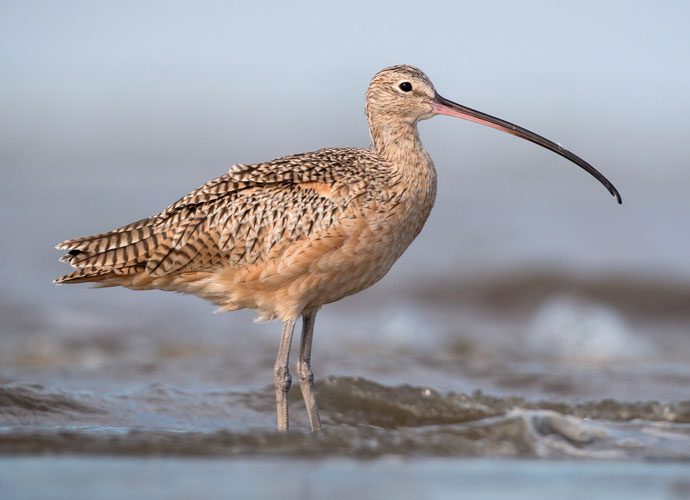
  • Long-billed Curlew has an extremely long bill, lacks the dark crown striping, has a buff belly, and is cinnamon-colored under the wings.
  • Bristle-thighed Curlew has a bright cinnamon rump and upper tail.

Sound

A loud, rolling twitter. Displaying Whimbrel also utters a low whistle, sometimes repeated and/or followed by a trill.

»listen to songs of this species

Range

Range Map


© 2004 Cornell Lab of Ornithology

Summer Range

Breeds along the coasts of Alaska and northern Canada as far eastward as Hudson Bay. Also in northern Europe and Russia.

Winter Range

Winters on both coasts of the United States, from northern California and North Carolina southward. Also along coasts and offshore islands from Mexico to Chile and Brazil. Old World populations winter in Africa, Asia, and Australia.

Habitat

Breeds in various tundra habitat, from wet lowlands to dry heath. In migration, frequents various coastal and inland habitats, including fields and beaches. Winters in tidal flats and shorelines, occasionally visiting inland habitats.

Food

Primarily marine invertebrates, especially small crabs, but also insects, berries, and even flowers during breeding season.

Behavior

Foraging

In intertidal habitats in winter, inserts bill to various depths to pick prey. Locates prey visually. Picks berries with tip of bill, releases and catches berry in throat.

Reproduction

Nest Type

A shallow bowl on the ground, usually lined with leaves.

Egg Description

Blue-green to brownish or buff.

Clutch Size

Usually 4 eggs. Range: 2-5.

Condition at Hatching

Downy and active, may leave nest within one to two hours.

Conservation Status

Numbers declined sharply during 19th century, because of hunting for sport and food. No definitive information is available on current population trends. The greatest current threat to the species is loss of coastal wetland habitat; environmental contamination, including cadmium wastes from mining in Chile, also poses increasing risks to the species.

Other Names

Courlis corlieu (French)
Zarapito trinador (Spanish)
Hudsonian Curlew (English)

Sources used to construct this page:

Skeel, M. A., and E. P. Mallory. 1996. Whimbrel (Numenius phaeopus). In The Birds of North America, No. 219 (A. Poole and F. Gill, eds.). The Academy of Natural Sciences, Philadelphia, PA, and the American Ornithologists' Union, Washington, D.C.


Home | Contact Us    ©2003 Cornell Lab of Ornithology