
Birding 123 Bird Guide Gear Guide Attracting Birds Conservation Studying Birds

Bird Guide

Species Accounts

Video Gallery

Winter Wren

Troglodytes troglodytes Order PASSERIFORMES - Family TROGLODYTIDAE
Summary Detailed
For complete Life History Information on this species, visit Birds of North America Online.

enlarge
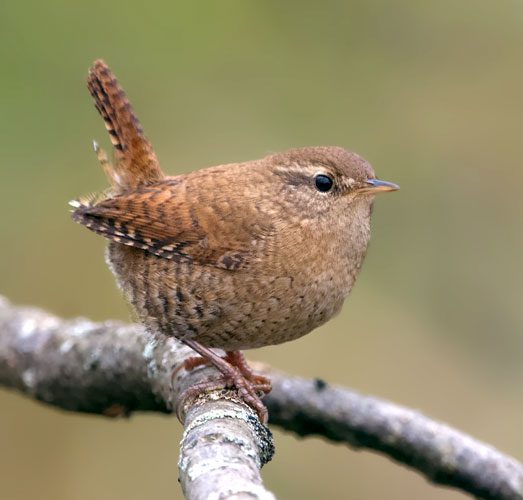
Winter Wren, adult; Long Is., NY; April
About the photographs
Menu
  1. Cool Facts
  2. Description
  3. Similar Species
  4. Sound
  5. Range
  6. Habitat
  7. Food
  8. Behavior
  9. Reproduction
  10. Conservation Status
  11. Other Names

Small in stature and incomparably energetic in voice, the Winter Wren inhabits moist forests and other habitats across much of North America. It is the only wren to be found outside the Americas, occurring also in Europe, Asia, and north Africa, with 35 or more recognized subspecies.

Cool Facts

  • Per unit weight, the Winter Wren delivers its song with 10 times more power than a crowing rooster.
  • Winter Wrens in western North America have more complex songs than eastern Winter Wrens. The western songs have about 36 notes per second on average, while the eastern songs have 16 notes per second.

  • Wrens probably originated in the New World, and the Winter Wren is the only one of the 78 species that is found outside the Americas. According to one hypothesis, the Winter Wren may have colonized the Old World by crossing over the Bering Straits during an interglacial period.

  • Winter Wrens sometimes roost communally in cold weather. In one case, 31 individuals were found together in a nest box in western Washington.

  • The Winter Wren sometimes builds several nests in a single breeding season. Nests are used for roosting or for repeated breeding attempts.

Description

  • Size: 8-12 cm (3-5 in)
  • Wingspan: 12-16 cm (5-6 in)
  • Weight: 8-12 g (0.28-0.42 ounces)

  • Very small, dark bird.
  • Short tail, usually cocked upward.
  • Uniform dark brown plumage overall.
  • Thin, pointed bill.

  • Fine dark barring on wings, tail, and underparts.
  • Faint pale stripe above eyes.
  • Throat slightly paler than rest of plumage.
  • Upper bill black, lower mandible brown.
  • Eyes dark brown.
  • Legs light brown.

Sex Differences

Sexes look alike.

Immature

Similar to adult, but darker.

Similar Species

  • House Wren has a longer tail and lighter color, especially on the throat and breast, and the barring on its flanks does not extend forward of the legs.

Sound

Song is a remarkable continuous stream of melodious notes and trills, lasting 5 to 10 seconds. Songs vary by region. Call is a sharp or husky note, uttered singly or in pairs.

»listen to songs of this species

Range

Range Map
Winter Wren

© 2004 Cornell Lab of Ornithology

Summer Range

Breeds from coastal Alaska southward to northern California, Idaho, and Montana, and across Canada to the Great Lakes, the Maritime Provinces, and the eastern United States, as far southward as the southern Appalachians. Also breeds throughout Europe, Asia, and north Africa.

Winter Range

Winters throughout much of far-western portion of breeding range, including Pacific Coast; also winters across most of the United States, from eastern Washington to southern California, and from southern New England to Florida. Old World populations winter in Europe, Asia, and north Africa.

Habitat

Breeds in many different habitat types, from cliff faces to riparian areas to various forests; occurs in greatest densities in coniferous forests. Prefers areas with fallen logs and other dead wood.

Food

Invertebrates, including insects, insect larvae, millipedes, spiders, and others.

Behavior

Foraging

Feeds methodically in low shrubs, on the ground, near the bases of trees, and around fallen dead wood.

Reproduction

Nest Type

Domed structure with entrance hole on side, made of moss, bark, twigs, rootlets, grass, feathers, hair, and decayed wood, lined with feathers and hair. Placed in hole. May use existing cavities, such as woodpecker holes, excavate holes in banks, or build nests on root bases and branches.

Egg Description

White, with variable reddish brown spotting.

Clutch Size

Usually 5-7 eggs. Range: 1-9.

Condition at Hatching

Helpless with little down.

Conservation Status

Populations generally stable or increasing in most of range. Loss and fragmentation of preferred old-growth coniferous habitat in western North America may pose a threat.

Other Names

Troglodyte mignon (French)
Chivirín chochín (Spanish)
Wren (British) (English)

Sources used to construct this page:

Hejl, S. J., J. A. Holmes, and D. E. Kroodsma. 2002. Winter Wren (Troglodytes troglodytes). In The Birds of North America, No. 623 (A. Poole and F. Gill, eds.). The Birds of North America, Inc., Philadelphia, PA.


Home | Contact Us    ©2003 Cornell Lab of Ornithology