
Birding 123 Bird Guide Gear Guide Attracting Birds Conservation Studying Birds

Bird Guide

Species Accounts

Video Gallery

Round Robin, the Cornell Blog of Ornithology

Wood Duck

Aix sponsa Order ANSERIFORMES - Family ANATIDAE - Subfamily Anatinae
Summary Detailed
For complete Life History Information on this species, visit Birds of North America Online.

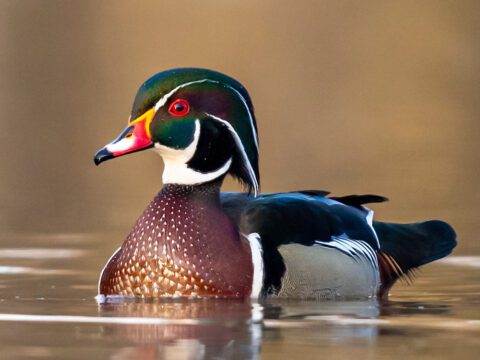
Wood Duck, male, breeding plumage
enlarge
Wood Duck, male, breeding plumage
About the photographs
Wood  Duck, female
enlarge
Wood Duck, female, Iroquois NWR NY

Wood Duck, male, non-breeding plumage
enlarge
Wood Duck, male, non-breeding plumage
Menu
  1. Cool Facts
  2. Description
  3. Similar Species
  4. Sound
  5. Range
  6. Habitat
  7. Food
  8. Behavior
  9. Reproduction
  10. Conservation Status
  11. Other Names

A colorful duck of wooded swamps and streamsides, the Wood Duck is one of only a few North American ducks that nest in trees. Many people consider it to be the most beautiful of all waterfowl.

Cool Facts

  • Natural cavities for nesting are scarce, and the Wood Duck readily uses nest boxes provided for it. If nest boxes are placed too close together, many females lay eggs in the nests of other females. These "dump" nests can have up to 40 eggs.

  • The Wood Duck nests in trees near water, sometimes directly over water, but other times up to 2 km (1.2 mi) away. After hatching, the ducklings jump down from the nest tree and make their way to water. The mother calls them to her, but does not help them in any way. The ducklings may jump from heights of up to 89 m (290 ft) without injury.

  • The Wood Duck is a popular game bird, and is second only to the Mallard in numbers shot each year in the United States.

  • Wood Ducks pair up in January, and most birds arriving at the breeding grounds in the spring are already paired. The Wood Duck is the only North American duck that regularly produces two broods in one year.

Description

  • Size: 47-54 cm (19-21 in)
  • Wingspan: 66-73 cm (26-29 in)
  • Weight: 454-862 g (16.03-30.43 ounces)

  • Medium-sized duck.
  • Crest on head.
  • Long tail.
  • White patches in face.

  • Long, broad wings.
  • Small triangular bill.
  • Iridescent blue-green patch (speculum) on rear of wing, with white trailing edge.
  • Male colorful and distinctive.

Sex Differences

Male brightly patterned, female dull gray brown.

Male

Breeding (Alternate) Plumage: Head iridescent green and purple. Long crest green, purple. Thin white line extending from bill, over the eye, to the back of the crest. Throat white with two finger-like projections onto face and neck. Bill red, with thin yellow at base and dark tip. Eyes red. Chest deep reddish. White stripe extending up side of chest; black bar behind it. Sides yellowish gold, bordered in black and surrounded by white line. Back black with metallic sheen. Undertail reddish violet. Tail black with bronzy sheen. Belly white.
Nonbreeding (Basic) Plumage: Head and body gray. Head without long crest, but bushy. Throat white with extension up face and neck. Crown dark. Thin white line extending behind eye. Wings iridescent bluish. Bill dull red.

Female

Bushy crest on head. Head and cheek gray with bronze and purple sheen. White area around eye, tapers to rear. Chin and throat white. Upperparts olive or gray with metallic sheen. Breast gray-brown with tan streaks. Belly and under tail white. Sides brown. Tail dark. Bill dark with thin white line at base.

Immature

Similar to adult female. Upperparts brownish gray. Cheek light gray. White circle around eye. Throat white, with projections onto face and neck in males. Crown dark. Dark stripe extending back from eye.

Similar Species

  • Breeding male unmistakable.
  • Female Hooded Merganser similarly shaped and in same habitats, but lacks white around eye, lacks any streaking on body, and has white, not green, in the speculum.

Sound

Female makes loud "oo-eek, oo-eek" when disturbed and taking flight. Male has thin, rising and falling zeeting whistle.

»listen to songs of this species

Range

Range Map
Wood Duck

© 2003 Cornell Lab of Ornithology

Summer Range

Breeds from southern Canada, throughout the eastern half of the United States, southward to Cuba. In the West, breeds from British Columbia southward along Pacific Coast to southern California, and at scattered locations inland.

Winter Range

Winters in southern three-quarters of breeding range, and in Southwest.

Habitat

Found in forested wetlands, including along rivers, swamps, marshes, ponds, and lakes.

Food

Seeds, acorns, fruits, aquatic and terrestrial invertebrates.

Behavior

Foraging

Moves rapidly and pecks and dabbles on water surface. May tip-up or dive for submerged food items.

Reproduction

Nest Type

Nest in preformed cavities in trees or nest boxes. Lined with down from female's breast.

Egg Description

Glossy creamy white to tan.

Clutch Size

Usually 6-15 eggs. Range: 6-40.

Condition at Hatching

Hatch covered in down and able to leave the nest soon after.

Conservation Status

Declined dramatically in late 19th century, but recovered in 20th. Current populations stable or increasing.

Other Names

Canard branchu (French)
Pato de charreteras (Spanish)

Sources used to construct this page:

Hepp, G. R., and F. C. Bellrose. 1995. Wood Duck (Aix sponsa). In The Birds of North America, No. 169 (A. Poole and F. Gill, eds.). The Academy of Natural Sciences, Philadelphia, PA, and The American Ornithologists' Union, Washington, D.C.


Home | Contact Us    ©2003 Cornell Lab of Ornithology