
Birding 123 Bird Guide Gear Guide Attracting Birds Conservation Studying Birds

Bird Guide

Species Accounts

Video Gallery

Wood Thrush

Hylocichla mustelina Order PASSERIFORMES - Family TURDIDAE
Summary Detailed
For complete Life History Information on this species, visit Birds of North America Online.
Menu
  1. Cool Facts
  2. Description
  3. Similar Species
  4. Sound
  5. Range
  6. Habitat
  7. Food
  8. Behavior
  9. Reproduction
  10. Conservation Status
  11. Other Names

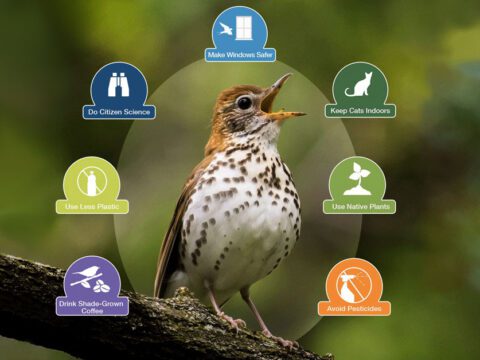
One of the most common woodland birds of the East, the Wood Thrush is best known for its hauntingly beautiful song. A large and heavily spotted thrush, it is a bird of the interior forest, seldom seen outside the deep woods. Its susceptibility to cowbird parasitism has made it a heavily studied species.

Cool Facts

  • Declines in Wood Thrush populations have been linked to acid rain and forest fragmentation by studies conducted by the Cornell Lab of Ornithology's Bird Population Studies, using data from the Birds in Forested Landscapes project. For more information about the study and its findings, go here.
  • The Brown-headed Cowbird frequently parasitizes the nests of Wood Thrushes. In some parts of the Midwest all of the Wood Thrush nests contain at least one cowbird egg, and some may contain up to eight.

  • After the young leave the nest, the parents divide up the brood with each parent feeding only half.

  • A Wood Thrush often returns to the same breeding territory in successive years. It also may return to the same wintering area each year.

  • Has been observed "anting." Anting occurs when a bird picks up a single ant or group of ants and rubs them on its feathers. The purpose of this behavior is not well understood. It is thought that birds may be able to acquire defensive secretions from the ants possibly used for some medicinal purpose. Also may be a supplement to the bird's own preen oil.

Description

  • Size: 19-21 cm (7-8 in)
  • Wingspan: 30-34 cm (12-13 in)
  • Weight: 40-50 g (1.41-1.77 ounces)

  • A large forest thrush, just slightly smaller than an American Robin.
  • Back brown, chest white with large dark spots.

  • Reddish-brown on the head and more olive-brown on the back.
  • White underparts with large dark spots from throat to belly.
  • White eyering.
  • Legs pinkish.

Sex Differences

Sexes alike

Immature

Juvenal plumage similar to adults but with tawny spots and streaks on back, neck, and wings.

Similar Species

  • Veery is reddish but not bright rufous, and has very few indistinct spots on chest.
  • Hermit Thrush has reddish tail, but the rest of the upperparts are dark brown. Spots on chest are relatively indistinct and they do not reach the belly.
  • Brown Thrasher is similar in color but has a long tail, wingbars, and streaks, not spots, on the chest. It lives in scrubby areas rather than forests, but the two species can overlap on migration.

Sound

Song a series of yodeled phrases with a pause in between each phrase, and complex, flute-like notes. "ee-oh-lay." Calls a rapid "pit-pit-pit." Nocturnal flight call an emphatic buzzy "heeh," on one tone or only slightly descending.

»listen to songs of this species

Range

Range Map
Wood Thrush

© 2003 Cornell Lab of Ornithology

Summer Range

Breeds in eastern North America, from southern Ontario, southwestern Quebec, New Brunswick, and Nova Scotia southward to northern Florida, westward to the eastern parts of the Great Plains in Texas, to eastern Oklahoma, Kansas, Nebraska, and South Dakota. May be slowly expanding its range northward.

Winter Range

In lowlands of Central America, from southern Mexico to western Panama; rarely in southeastern United States.

Habitat

Breeds in the interior and edges of deciduous and mixed forests, generally in cool, moist sites, often near water.

Detailed Habitat

Requires moderate to dense understory and shrub density with a lot of shade, moist soil, and decaying leaf litter. Shows much variation in habitat use, from mature deciduous forests in the Southeast, to shrubby second-growth forests and suburban parks in the Northeast to riparian habitats in the Great Plains. Winters in lowland tropical forests. Most numerous in interior understory of tropical primary, closed-canopy, semi-evergreen, broad-leaved, and mixed palm forests at 50-1000 m elevation.

Food

Eats beetles, ants, moths, caterpillars, millipedes, and isopods. In the late summer and fall eats more fruit: spicebush, foxgrape, blueberry, holly, elderberry, Virginia creeper, pokeweed, dogwood, black cherry, and black gum.

Behavior

Foraging

Forages by gleaning and probing in the leaf litter on the forest floor. Always forages under the forest canopy, hops and then pauses to scatter leaves to find prey. Sometimes hawks or hovers to glean insects or fruit from vegetation above the ground. Young are fed small insects and some fruit.

Displays

Sings from an exposed perch, usually in the lower canopy or mid-story. Often flushes from the forest floor. When performing an agonistic display (a behavior used to threaten another bird), there may be brief physical contact between males with feet or bill if defending a territory or nest. Other aggressive displays are fairly passive: wing and tail flicks, raised crests, and puffing up of breast feathers. Observed to be aggressive toward robins, Veeries, Blue Jays, and other species.

Courtship

The male arrives and establishes a territory several days before the female arrives on the breeding ground. The female leads silent circular flights about 3-6 ft (1-1.8 m) from the ground, with the male chasing the female. Generally six or more flights take place in succession. In between each flight the pair perches together and may feed one another.

Reproduction

Nest Type

Open cup of leaves and grasses lined with mud, placed on lower limbs of tree or shrub.

Nest Description

Nest site: On the lower limbs of a tree or shrub, hidden among leaves in a shady area. Generally near or against the trunk. Also found in a crotch or fork supported by small branches. May be anchored to a branch with mud.
Height: Usually 10-13 ft (3-4 m) above ground; 2-70 ft (0.5-21 m) possible.
Nest: Nest is made of dead leaves, dried grasses, bark, and moss, with a middle layer of mud. Often contains pieces of white paper or cloth. The cup is molded by the female as she packs the base and sides with her body during the building process. The cup is lined with fine rootlets. Female builds the nest in approximately three to six days.

Egg Description

Smooth, blue-green, with no markings.

Clutch Size

3-4 eggs.

Condition at Hatching

Naked with small patches of down.

Conservation Status

Even though it is one of the most common species of Eastern forests, the Wood Thrush is of high conservation concern because of steady, long-term population declines, nearly throughout its range. This species has declined 43% overall since 1966. This species seems to be dependent on large tracts of mature forest in some parts of its range, but is tolerant of disturbance in other areas. In winter, it is highly vulnerable to tropical deforestation in the lowlands of Central America. Understanding the precise breeding habitat requirements of this species, and how they vary geographically, will be important for reversing population declines and maintaining future populations. Listed on the Audubon Watchlist.

Other Names

Grive des bois (French)
Zorzal del Bosque, Zorzal maculado, Zorzal pechimanchado, Tordo maculado (Spanish)

Sources used to construct this page:

  1. Roth, R. R., M. S. Johnson, and T. J. Underwood. 1996. Wood Thrush (Hylocichla mustelina). In The Birds of North America, No. 246 (A. Poole and F. Gill, eds.). The Academy of Natural Sciences, Philadelphia, PA, and The American Ornithologists' Union, Washington, D.C.
  2. Evans, W. E., and M. O'Brian. Flight Calls of the Birds of Eastern North America. CD, self-published.


Home | Contact Us    ©2003 Cornell Lab of Ornithology