
Feeder Pests and Predators: Mammals
Squirrels
Although it can be fun to watch a persistent squirrel finagle its
way to your bird food, it's less amusing if they eat up all your seeds,
chew holes in your feeders, and discourage your feeder birds from
visiting. Squirrels can leap several feet horizontally or from above
onto your feeder. Position your feeders so that they are at least 10
feet away from jumping-off points.
One way to outwit these furry-tailed rodents is to distract them by
feeding them peanuts or dried ears of corn in a location some distance
from your feeders. But this tactic might not work for long. You can
also try "squirrel-proof" bird feeders. But beware: we've watched one
squirrel after another outwit numerous varieties.
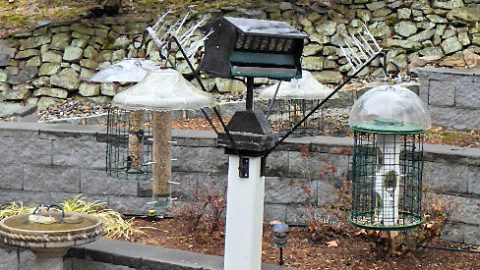
Squirrel
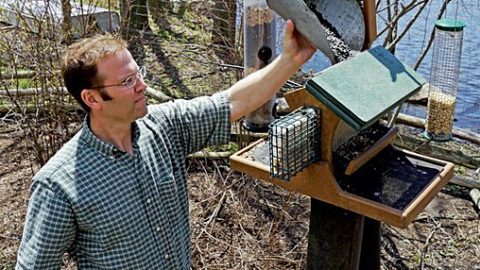
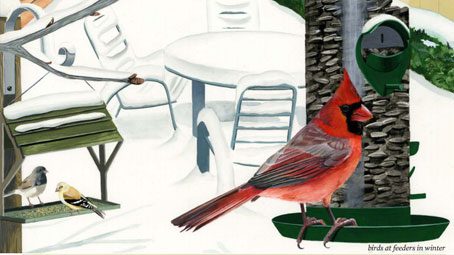
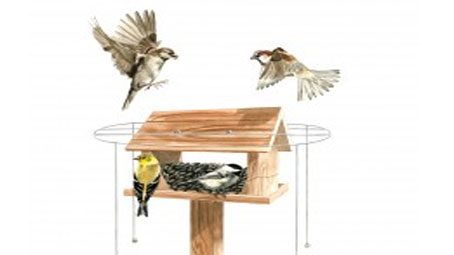
baffles are a good bet. These are barriers, often shaped like an
inverted bowl, that are placed between squirrels and feeders, as shown
in the photo at left. Usually when a squirrel lands on a baffle, it
simply slides off. On pole-mounted feeders, baffles should be fixed in
place under the feeder. On hanging feeders, a tilting baffle—at least
18 inches in diameter—should be installed above the feeder. As an
alternative to commercially-made plastic baffles, bird watchers have
used old vinyl records, plastic salad bowls, two-liter soda bottles,
even stove pipes.
If your feeder is hung from a horizontal line, another anti-squirrel
tactic is to thread the line through several lengths of plastic tubing,
end to end; the tubing should spin when a squirrel tries to walk on it.
Alternatively, some people have tried suspending feeders on a three- to
four-foot length of monofilament fishing line instead of wire—it's too
thin for squirrels to climb on.
Try a hopper-style feeder specifically designed to deter squirrels.
Most use a spring-loaded or counter-weighted gate that closes off
access to the seed ports under the squirrel's weight. This weight
adjustment can be changed to selectively exclude larger, undesirable
birds as well.
Yet another way to keep squirrels from your birdseed is a "squirrel
spooker." As the squirrel climbs up a feeder pole to reach your feeder,
it climbs over a moveable sleeve. Because of the squirrel's added
weight, the sleeve slips down or spins around, dumping the surprised
squirrel onto the ground. Once the squirrel has let go, the sleeve
automatically moves back into place.
Some bird watchers have been using seeds that are coated with hot
pepper or capsaicin products. Theoretically, squirrels avoid the coated
seed while birds are unaffected.
We do not recommend coating feeder poles with grease, oil, or glycerin
as an anti-squirrel strategy. As well as being potentially toxic to
wildlife, these substances can also mat fur and feathers, causing them
to lose their insulative properties. This may lead to the animal
freezing to death.
If you can't dissuade your squirrels from chewing your feeders to get
at the seeds inside, consider buying a feeder made of a durable
material like Lexan. Also there are feeders available with
metal-reinforced seed ports. Some of these come with guarantees against
destruction by squirrels.
Other ideas can be found in many magazine articles and books that have
been written about ways to outwit squirrels at your bird feeder.
BirdNotes--What Can You Do About Squirrels?
Download this issue of BirdNotes as a PDF document.
House Cats
Cats are the most numerous pets in North America. Unfortunately they
kill millions of birds each year. Ground-feeding and ground-nesting
birds and fledglings are at greatest risk. Feeder birds are also easy
prey. And although kitty may not actually sit INSIDE the feeder, like
the one pictured at right is, she may hide in the shrubbery nearby
awaiting a chance to pounce.
So, if you own a cat, we strongly recommend that you keep it indoors to
reduce the needless loss of birdlife. The American Bird Conservancy has
created the Cats Indoors! campaign to increase awareness of the
problem. For more information contact: American Bird Conservancy, 1250
24th Street, NW, Suite 400, Washington, DC 20037. Phone: (202)
778-9666. Or go to their website here.
Rats
Rats and other pest rodents are attracted to seeds droppped beneath feeders. Once a population is established, it can be very difficult to discourage. The first step is to discontinue feeding for a couple of weeks to encourage the rodent population to disperse. Next, consider ways to feed without any waste falling to the ground. There are several feeders available that will catch dropped seeds, but most of the catch trays aren't big enough to really do the job. You may want to look into constructing a large catch tray to place (off the ground) or hang under your feeders that you can clean or remove each night. The key is to prevent rodents from getting to the seed. It's important to clean any catch tray that you construct, because bird droppings contaminated with Salmonella bacteria may survive on the catch tray and spread disease among your birds.
Bears
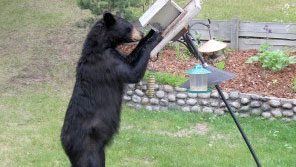
Imagine waking up one night and seeing a bear pulling your feeder down to steal a midnight snack! Wildlife agencies from the following states issue precautions about feeding birds in areas with bears: Alaska, Arizona, California, Colorado, Connecticut, Florida, Minnesota, Montana, New Hampshire, New Jersey, New Mexico, Nevada, New York, Pennsylvania, and Wyoming.
Here are some of their suggestions:
- Don't feed birds during months when bears are most active—late March through November.
- Bring all of your feeders in at night.
- Hang feeders 10 feet above ground and 6 feet away from tree trunks.
- Don't leave spilled birdseed lying on the ground.
- Keep your birdseed supply indoors.
- Don't hang your bird feeder from your front porch.
- If you do have a bear in your yard, don't approach it.
Other Mammals
If bears, raccoons, deer, or moose become a nuisance the best tactic is to make your feeders inaccessible with fencing. If that approach is impractical, you'll probably have to take down your feeders temporarily. Like hawks, mammals will find new foraging places. If your mammalian visitors appear only at night, take in your feeders at dusk.