
How to Choose a Spotting Scope
April 6, 2007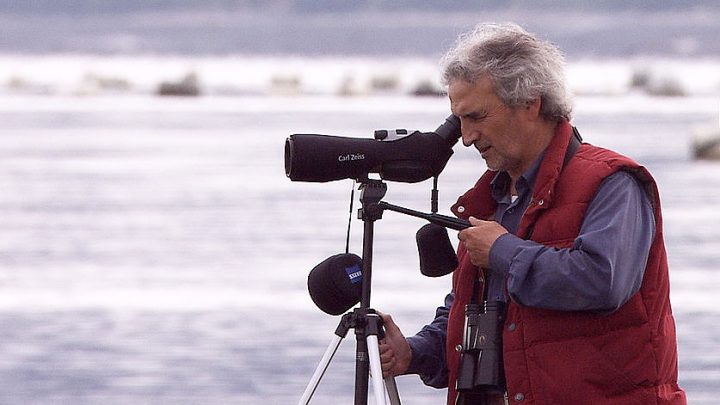
Binoculars are great for close-up birding and can be helpful for giving you clues to faraway birds. But for distant birds you’ll be amazed at what a difference a spotting scope makes. You’ll be able to find more birds, and you’ll distinguish field marks on distant waterfowl, shorebirds, and hawks that may be impossible to see with binoculars. At closer ranges you’ll admire intricate plumage details you never saw before. And if you have a smartphone or a digital camera, you’ll have all you need to enjoy digiscoping.
As with binoculars, there are a number of optical and design characteristics to keep in mind when you’re considering buying a spotting scope. We’ll cover some important ones here, and give you shopping tips to help you make the best choice. And we’ll give you one basic tip right up front: don’t try to use an astronomy telescope for bird watching. Their magnification is usually too high, they’re hard to sight through, and they are often not weatherproofed.
Magnification power
Spotting scopes are medium-range telescopes, usually with a magnification power between 15x and 60x. To change magnification power, they have either interchangeable fixed-length eyepieces or a single zoom eyepiece.
When you’re scanning an area with a spotting scope it’s best to start with a low power eyepiece or the lowest setting on a zoom eyepiece (for instance in the 20x to 30x range). Once you’ve located the birds you want to examine closely you can switch to higher power.
Zoom lenses
Zoom lenses change magnification power from 20x to as high as 60x with a single, simple adjustment. They offer a definite advantage for bird watching, allowing convenient scanning at low power and a quick shift to higher power for looking at details. But as with camera lenses, zoom lenses don’t gather light as well as fixed lenses. Also, as magnification increases, any scope (or binocular) will suffer from less light, narrower field of view, and more vibration. High powers also magnify the effects of haze and shimmering heat distortion seen over water and other flat expanses.
Twenty years ago, a good zoom lens was hard to find, and the costs (both optically and dollar-wise) were large. Nowadays, many mid-priced scopes have excellent zoom lenses. At high power, top quality zooms give image sharpness and clarity almost as good as at low magnification, so buy the highest-quality scope you can afford.

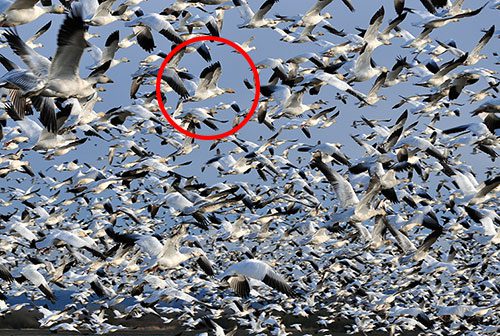
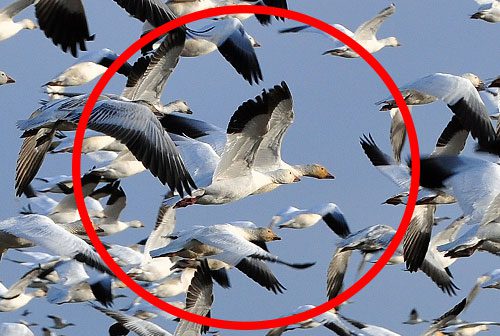
Binoculars can get you only so close to a group of birds, like these Snow Geese. For better views of faraway birds, use a scope. This is the view you'd get of the same flock through a spotting scope at a middle magnification of around 30x—much better for picking out details. Photo by -jon via Birdshare.
Glass quality
Top spotting scope lenses are made with fluorite-coated, HD (high density), or ED (extra-low dispersion) glass. The difference in brightness and image clarity between these high-quality scopes and those made by the same manufacturers using standard glass is particularly noticeable in low-light viewing conditions (such as in late evening) and at high power. You should base your decision whether to go with high quality, high priced glass on the kind of birding you plan to do.
Light-gathering capacity
Like binoculars, the light-gathering capacity of a spotting scope is indicated by the size of the objective lens (the one farthest from your eye). Depending on the model, this value is typically between about 50 mm and 100 mm. Larger objective lenses providing brighter images in general, but they also make scopes heavier and harder to pack in luggage.
Related Stories
Eyepiece placement
Another consideration when selecting a spotting scope is eyepiece placement. Some scope models have eyepieces configured for straight-through viewing, making it easy to quickly locate and follow a subject. This seems like a natural design, but many bird watchers prefer a different approach, the 45-degree angled eyepiece. This style makes viewing above the horizon easier, works with shorter tripods (which are inherently more stable), and makes birding much more convenient when you’re in a group of people of different heights.
Eye relief
Eyeglass wearers should pay attention to the amount of eye relief offered by the scope. With longer eye relief, the optics direct the focal point farther back behind the eyepiece so the eyeglass wearer can see a complete field of view. Eye relief is given in millimeters in the model’s technical specifications. Generally, 12–15 mm of eye relief is adequate for most eyeglass wearers. As with binoculars, some scope designs have folding or moveable rubber eyecups to accommodate non-eyeglass wearers.
Focusing mechanism
In spotting scopes, focusing is normally done in one of two ways. With a focusing collar, the whole barrel of the scope is knurled or rubberized and you just twist the whole barrel to make the image sharper. The other design uses a smaller focus knob typically mounted on the top of the scope near the eyepiece. These are slower to use but permit more precise focusing. Your hand size and dexterity may be an issue here, so try each style to find your preference.
Shopping Tips
If you’re using a fixed eyepiece, look for something between 20x and 30x for general purpose birding. Because of the effects of heat distortion and loss of light, beware of fixed focal length eyepieces larger than 45x unless they are top quality.
Many birders prefer the versatility of a zoom lens. Many modern, mid-priced scopes have excellent zoom lenses. Just don’t try to cut corners here—low-priced zoom lenses will probably lose light and give you poor viewing at middle and high magnifications.
Look for an objective lens of at least 60 mm in diameter to provide a bright image. If you want to do a lot of digiscoping, you’ll want your scope to deliver the brightest image possible to your camera. Look for an objective lens around 85 mm.
Beware of cheap spotting scopes. The shortcuts the manufacturer made to produce a low-cost product will only give you poor field performance and a splitting headache. Today, a few hundred dollars will buy you a good quality scope, and if you are willing to pay a thousand or more you will get an excellent optical instrument that, taken care of properly, will last a lifetime.
Buy a good tripod. Even the brightest, crispest, most powerful scope won’t provide a good image if it’s mounted on a flimsy tripod. Look for a rigid, sturdy tripod with as few leg adjustments as possible. Flip locks on the legs are a good, quick way to extend and retract the tripod and to adjust for uneven ground.

All About Birds
is a free resource
Available for everyone,
funded by donors like you
American Kestrel by Blair Dudeck / Macaulay Library