
Chuck-will’s-widow (CWWI)
Antrostomus carolinensis

Range
The range of the Chuck-will’s-widow spans across the southeastern quadrant of the continental U.S. and includes the Caribbean islands. The range extends south into Mexico where it hugs the Gulf and continues into northwestern South America. The Chuck-will’s-widow’s breeding range is mostly isolated to the American south and southeast with the north end of the range ending in the Midwest with pockets of population in Indiana, Ohio, West Virginia, and some northeastern states on the coast. The species’ year-round range is southern Florida, including The Florida Keys.
Additional Maps
Identification
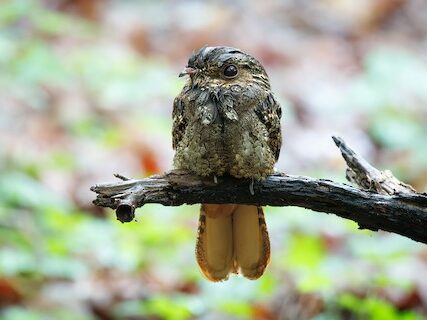
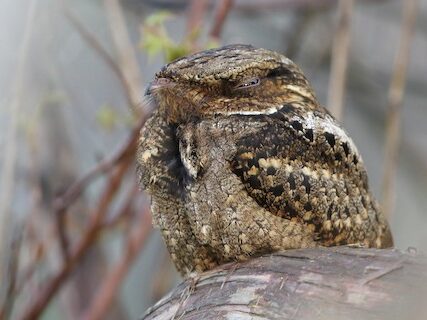
The Chuck-will’s-widow is a large cinnamon-brown nightjar that is more often heard than seen. The upperparts of Chuck-will’s-widows are a mottled brown, black, and buff. The breast is mottled blackish and tawny olive. Underparts of the Chuck-will’s-widow go from a cinnamon to a pale buff and barred brown. The tail is long and rounded, being longer than the wingtips in most cases. The tail is tipped with cinnamon buff; males have white on the inner web of the outer three retricies and the white is not present in females or juveniles.
Males have a white half “collar” at the bottom of their face; this half-collar is buff in females and juveniles. The call, for which it’s named, is often heard at night and transcribed as chuck-will’s-wid-ow or chuk, wee-O, wee-O. This call is unique and is often used to identify the Chuck-will’s-widow as it is not easily confused with the call of other nightjars.
Habitat
The Chuck-will’s-widow can be found in mixed forests, pine, oak-hickory, and deciduous forests in its breeding range. Openings in forest appear to be important to the habitat of the Chuck-will’s-widow. Openings include scrub, forest gaps, and pasture. In its non-breeding range, the Chuck-will’s-widow can be found in brush, second-growth forests, and the edges of forested areas.
Conservation Status
- Listed as Vulnerable by Alabama State Species of Greatest Conservation Need
- Listed as Vulnerable by Arkansas State Species of Greatest Conservation Need (pg 1609)
- Listed as Near Threatened by BirdLife International
- Listed as Threatened in Illinois by the Illinois Department of Natural Resources
- Listed as Near Threatened by The International Union for Conservation of Nature
- Listed as Vulnerable by Louisiana State Species of Greatest Conservation Need (pg 24)
- Listed as Vulnerable by Mississippi State Species of Greatest Conservation Need
- Listed as Vulnerable by Missouri State Species of Greatest Conservation Need
- Listed as G5 – Secure by Nature Serve
- Listed as Vulnerable by North Carolina State Species of Greatest Conservation Need (pg 48)
- A Species of Concern in Ohio by the Ohio Department of Natural Resources
- Listed as Vulnerable by Texas State Species of Greatest Conservation Need (pg 36)
Threats to Conservation
Adult Chuck-will’s-widows are sensitive to human activity near nest sites, resulting in the abandonment of nest sites. However, after disturbance, they may move their nest to a new location. Another threat to the conservation of the Chuck-will’s-widow is a loss of habitat causing an overlap in habitat use with the Whip-poor-will and leading to competition. This competition did not previously exist to this extent; it is now causing the population of the Chuck-will’s-widow to decline due to less access to resources.
Funding Opportunities
- Agricultural Conservation Easement Program (ACEP)
- America the Beautiful Challenge
- Carolina Bird Club Conservation Grants
- Community Forest Program
- ConocoPhillips Partnership for Public and Private Land Managers
- Conservation Nation Grant Program
- Conservation Partners Legacy Grant Program
- Environmental Quality Incentives Program (EQIP)
- Florida’s State Wildlife Grants Program
- Land Trust Bird Conservation Initiative Small Grant Program
- Land and Water Conservation Fund Grant Program
- Natural Areas Research Grant
- Natural Legacy Program
- Nature Works
- Neotropical Migratory Bird Conservation Act (NMBCA) Grant
- North American Wetlands Conservation
- NRCS Wetland Mitigation Banking Program
- Partners for Fish and Wildlife
- Regional Conservation Partnership Program (RCPP)
- Texas State Wildlife Grants
- The Lawrence Foundation- Environmental Grants
- The Migratory Bird Program
- Tribal Wildlife Grants
- U.S. Fish and Wildlife Services Cooperative Endangered Species Conservation Fund
- Wildlife Habitat Grant Program