
Golden-winged Warbler (GWWA)
Vermivora chrysoptera
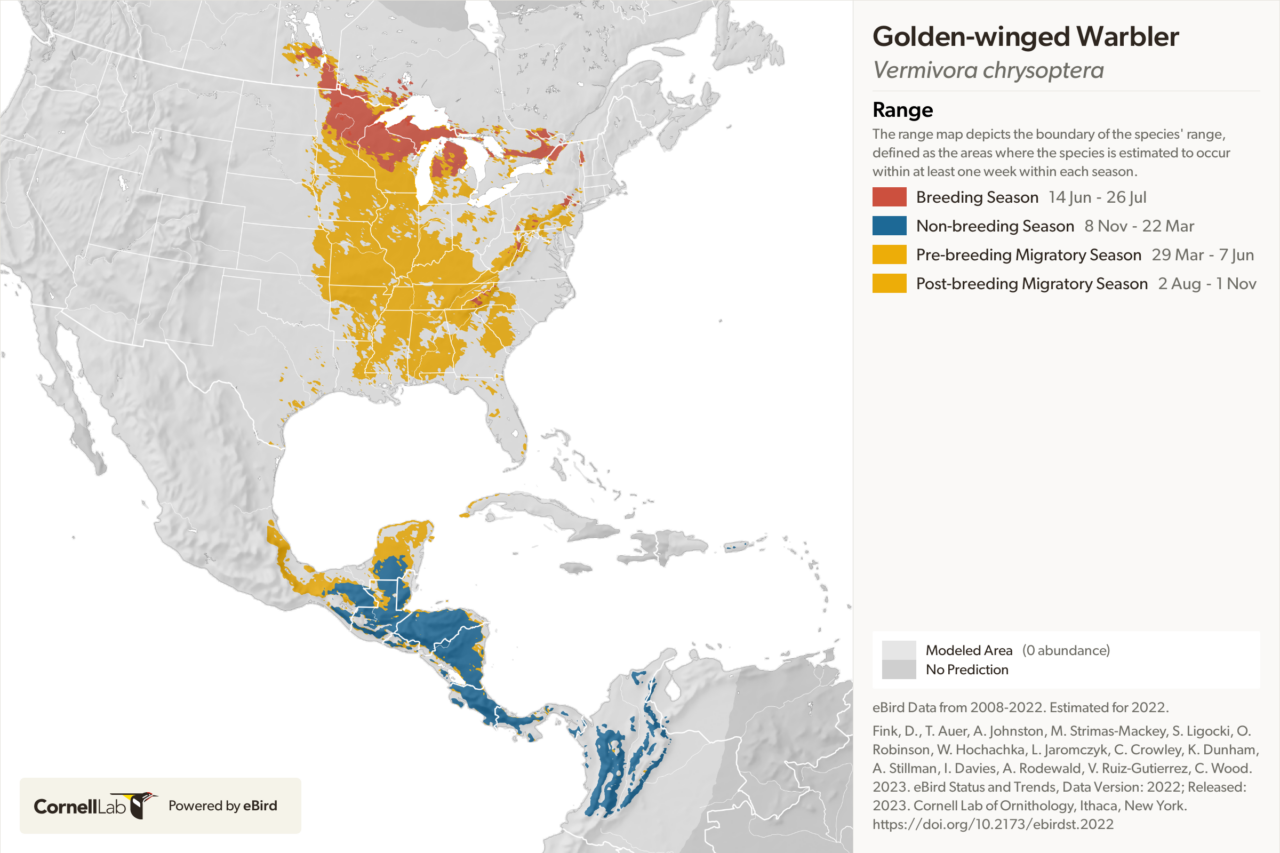
Range
In the United States, Golden-winged Warblers inhabit shrublands and young forests in the Mid-Atlantic, Great Lakes, and Southeast regions.
Additional Maps
Identification
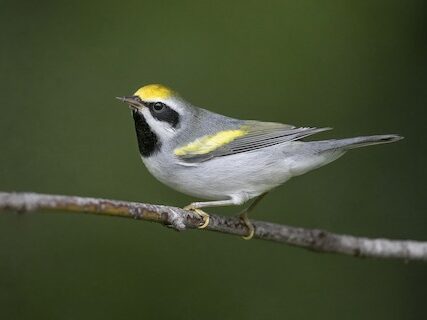
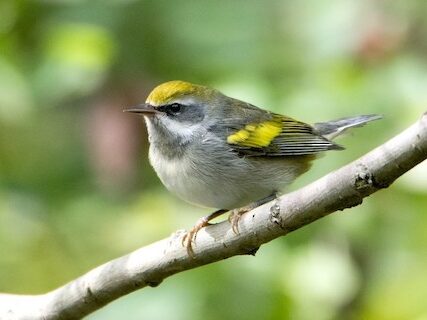
Golden-winged Warblers are small, silvery gray birds with golden patches on their heads and wings. Distinctive if seen well; note the black-and-white face pattern with a yellow crown and large yellow patch on the wing. Female warblers are a washed-out version of male warblers. The Golden-Winged Warbler frequently hybridizes with Blue-winged Warbler.
This warbler’s song is a high-pitched buzzy song, usually three to four notes with the first note highest, but variable; occasionally identical to Blue-winged Warbler but typically higher and finer. Identification of Golden-winged Warblers by sight is crucial because both the Blue-winged and Golden-winged warblers have been known to sing each other’s songs.
Habitat
Golden-winged Warblers breed in tangled, shrubby habitats such as regenerating clear-cuts, abandoned farms, mine lands, utility corridors, and shrub wetlands. The Golden- winged Warbler displays a strong preference for moderate shrubs and tree cover. In the Northeast U.S., the ideal habitat for this warbler is a mixture of native and non-native grasses, light shrub distributions, and scattered trees—ideally small/young saplings. The Golden-winged Warbler is a common resident of swamps, swamp forests, and wetlands. Warblers in these habitats occupy larger trees with a preference for alders, willows, and red maples. Nesting success is high in these habitats.
Successful breeding requires mosaics of shrubby, open areas for nesting and mature forest habitats, which offer cover for fledglings from predators like hawks. The Golden-winged Warbler frequently hybridizes with the Blue-winged Warbler, which can be found in drier woodland or woodland border habitats. Golden-winged and Blue-winged Warblers can be found in similar population sizes in poorly drained successional fields.
Conservation Status
- Listed as Vulnerable by Alabama State Species of Greatest Conservation Need
- Listed as Vulnerable by Florida State Species of Greatest Conservation Need (pg 88)
- Listed as Vulnerable by Georgia State Species of Greatest Conservation Need (pg A-4)
- Listed as Near Threatened by the International Union for Conservation of Nature (IUCN). The overall population of the Golden-winged Warbler is decreasing.
- Listed as Vulnerable by Louisiana State Species of Greatest Conservation Need (pg 24)
- Listed as Bird Species of Greatest Conservation Need by the 2015-2025 Maryland State Wildlife Action Plan
- Listed as Special Concern by the New York State Department of Environmental Conservation
- Listed as Species of Greatest Conservation Need by the 2015-2025 Pennsylvania Wildlife Action Plan
- Listed as a Tipping Point Species by Road to Recovery
- Listed as Special Concern in Virginia by the Virginia Department of Wildlife Resources
Threats to Conservation
The main reasons for the Golden-winged Warbler decline include habitat loss on their breeding and wintering grounds (Central and northern South America) and hybridization with the closely related Blue-winged Warbler (source: Cornell Lab of Ornithology). Hybridization of the Golden-winged and Blue-winged Warblers is a conservation threat because the two species share very similar resources and will compete for those resources if located in close vicinity to each other. Hybridization also poses the threat of Golden-winged Warbler DNA dilution, which is when mating outside of the species results in a loss of Golden-winged specific DNA. This makes the likelihood of speciation events much higher.
Golden-winged Warblers are very habitat specific and will not occupy land that does not fit their needs. These birds need open areas with lots of materials and locations to make nests out of. This is harmed by the reforestation and land use change of Golden-winged Warbler habitats. Increasing tree cover drives populations out, as does reduced timber harvesting and fire suppression, since Golden-winged Warblers thrive in succession fields. Another problem facing Golden-winged Warbler populations is collisions with man-made objects. Large objects placed in the type of field that Golden-winged Warblers prefer account for 542 radio tower collision-related deaths (source: Cornell Lab of Ornithology).
Learn more about Golden-winged Warbler Conservation Strategy and Resources here.
Funding Opportunities
- Agricultural Conservation Easement Program (ACEP)
- America the Beautiful Challenge
- Carolina Bird Club Conservation Grants
- Central Appalachian Region Forestry Practice Grant
- Community Forest Program
- ConocoPhillips Partnership for Public and Private Land Managers
- Conservation Nation Grant Program
- Conservation Partners Legacy Grant Program
- Environmental Quality Incentives Program (EQIP)
- Florida’s State Wildlife Grants Program
- Land Trust Bird Conservation Initiative Small Grant Program
- Land and Water Conservation Fund Grant Program
- Natural Areas Research Grant
- Natural Legacy Program
- Nature Works
- Neotropical Migratory Bird Conservation Act (NMBCA) Grant
- NFWF Northeast Forest and Rivers Program
- NRCS Working Lands for Wildlife Program
- Partners for Fish and Wildlife
- Regional Conservation Partnership Program (RCPP)
- Texas State Wildlife Grants
- The Lawrence Foundation- Environmental Grants
- The Migratory Bird Program
- Tribal Wildlife Grants
- U.S. Fish and Wildlife Partners for Fish and Wildlife
- Wildlife Habitat Grant Program
- Wisconsin Forest Landowner Grant Program
General Management Guides
Regional Management Guides
- Best Management Practices For Golden-winged Warbler Habitats in the Appalachian Region: A Guide for Land Managers and Landowners
- Golden-winged Warbler Habitats in the Great Lakes Region
- Golden-winged Warbler Habitat: Best Management Practices for Forestlands in Maryland and Pennsylvania
- NFWF Central Appalachia Business Plan