
Greater Sage-Grouse (GRSG)
Centrocercus urophasianus
Range
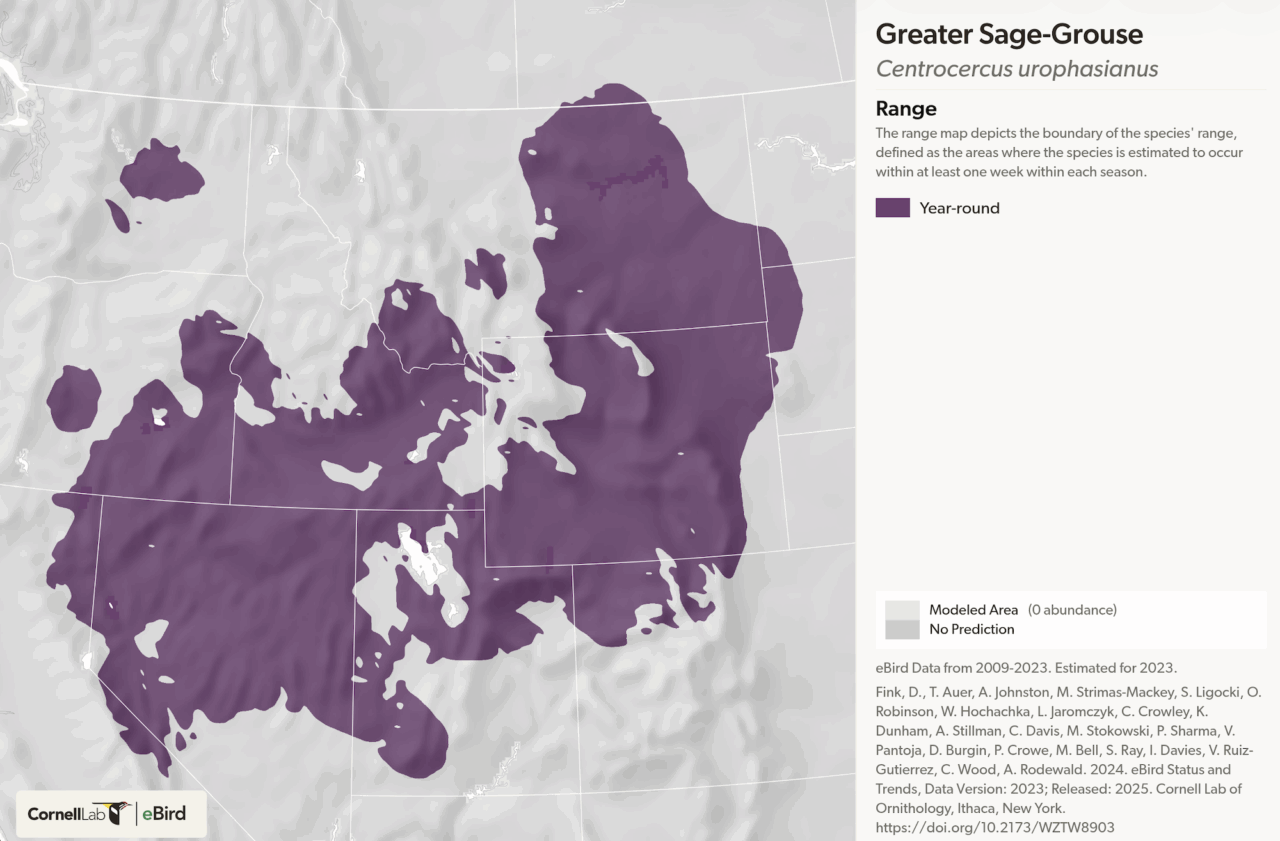
The Greater Sage-Grouse is a nonmigratory bird, primarily inhabiting the northwestern portion of the U.S. All western states aside from Arizona and New Mexico have habitats for these birds, but Nevada, Montana, and Colorado are where they are most commonly found.
Additional Maps
Identification
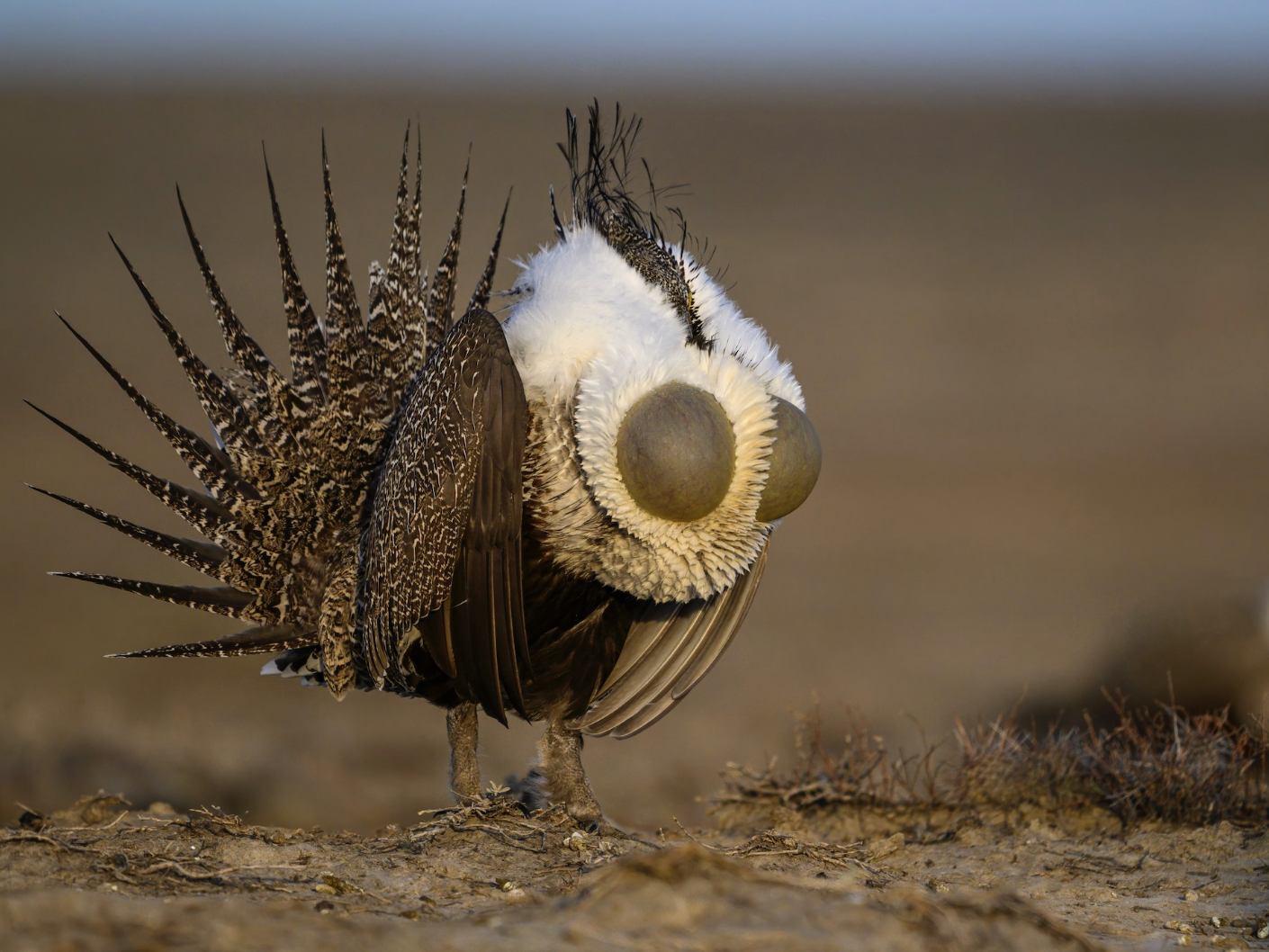
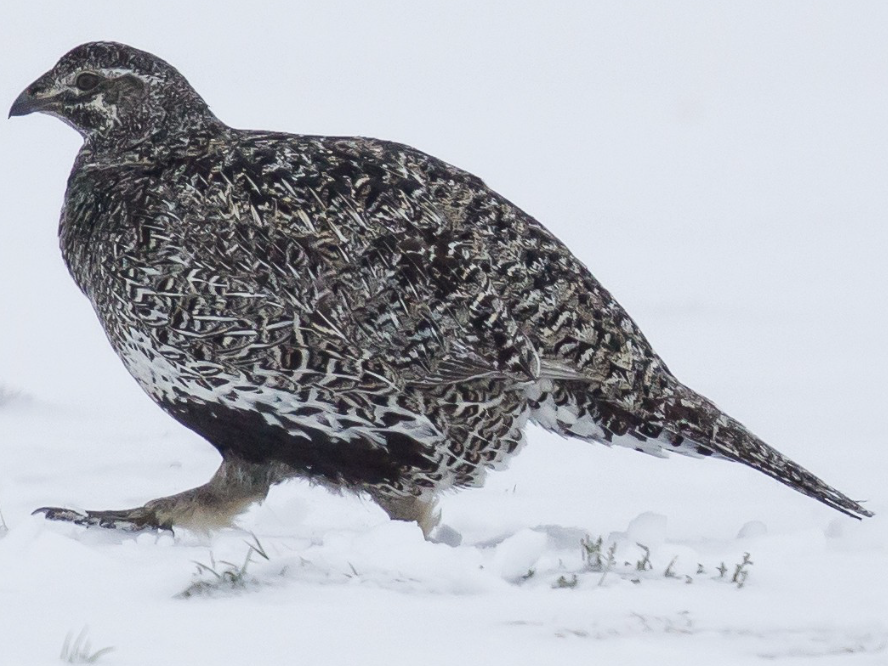
The Greater Sage-Grouse is a striking animal to come across on the prairie. The males are large, stocky chicken-shaped birds with white fluffy feathers around their neck and chest that they puff out, and large sacs on their chest that they inflate when courting. The skin of these sacs ranges from brown to bright yellow. In addition to their inflatable pouches, the males have a fanned out tail with thin pointy feathers, which they stand upright like a peacock’s. When looking at these fancy males head on, only the tips of the tail feathers are visible. In addition, males also sport a tall crown of spiky feathers that stand upright. The body, tail, and wing feathers of these birds are a dark brown mottled with shades of tan, white, and black. Males also have yellow ‘eyebrows,’ or little half circles of skin above their eyes. Greater Sage-Grouse have short, thick, brown legs, rounded wings, and a small head with a short pointy beak. Females share the chicken shape but lack ornamentation. Their short tail points to the ground, and their body is the same patterning as the males, but with more dusty browns and grays. The females do have thin white patterning on their face that streaks across their eyes and throat. Juveniles appear similar to females but appear thinner and look unkept. These birds have various hissing or clucking calls that are used in times of danger, keeping chicks together, or when warning other birds or animals. The males during their courting ritual perform various wing movements that make rustling or swishing sounds, and inflate their air sacs which let out booming or popping noises.
Habitat
Greater Sage-Grouse are strongly associated with treeless sagebrush habitats that provide them with food, cover, and nesting sites. They are typically found in open areas with sagebrush, but also utilize grasslands, wetlands, and even agricultural fields during certain seasons or if unable to find their ideal sagebrush ecosystem.
Conservation Status
- Listed as Decreasing by American Bird Conservancy
- Listed as Decreasing by BirdLife International
- Listed as Vulnerable by California State Species of Greatest Conservation Need (C-20)
- Listed as Vulnerable by Colorado State Species of Greatest Conservation Need (pg 335)
- Listed as Near Threatened by the International Union for Conservation of Nature (IUCN)
- Listed as Vulnerable by Nature Serve Explorer
- Listed as Vulnerable by Nevada State Species of Greatest Conservation Need (pg 7)
- Listed as Vulnerable by Utah State Species of Greatest Conservation Need (pg 14)
- Listed as Vulnerable by Washington State Species of Greatest Conservation Need(pg 3)
- Listed as Vulnerable by Wyoming State Species of Greatest Conservation Need (i-8)
Threats to Conservation
The largest threats to the Greater Sage-Grouse are habitat loss and fragmentation of their sagebrush and grassland ecosystems. Human development like agriculture, urbanization, and energy extraction play a major role in this, but increased natural wildfires and the spread of invasive plant species also affects these birds. Other threats include overgrazing of preferred habitat, collisions with man-made structures, buildings, or cars, and degradation of remaining habitats due to pollution, climate change, human activity, and oil drilling.
Funding Opportunities
- America the Beautiful Challenge
- Community Forest Program
- ConocoPhillips Partnership for Public and Private Land Managers
- Conservation Nation Grant Program
- Conservation Reserve Program
- Environmental Quality Incentives Program (EQIP)
- Fish and Wildlife Grants List for California
- Hewlett Foundation- Western Conservation Grants
- Land Trust Bird Conservation Initiative Small Grant Program
- Neotropical Migratory Bird Conservation Act (NMBCA) Grant
- NFWF- America Restoration Grant
- Pacific Birds U.S. Partnership
- Partners for Fish and Wildlife
- Point Blue California Restoration Grant
- Regional Conservation Partnership Program (RCPP)
- Sage Grouse Initiative
- The Lawrence Foundation- Environmental Grants
- The Migratory Bird Program
- Tribal Wildlife Grants
- Western Habitat Grant Proposals
- Wildlife Conservation Grants for Species Conservation
- Wildlife Diversity Grant Program