
Lewis’s Woodpecker (LEWO)
Melanerpes lewis

Range
Lewis’s Woodpeckers are spread throughout all of the western United States. They are found year-round in parts of California, Oregon, Arizona, New Mexico, and Colorado. They winter in southern parts of California, Nevada, Arizona, and New Mexico. This species can be found while breeding or migrating in between their wintering areas and in other western states.
Additional Maps
Identification
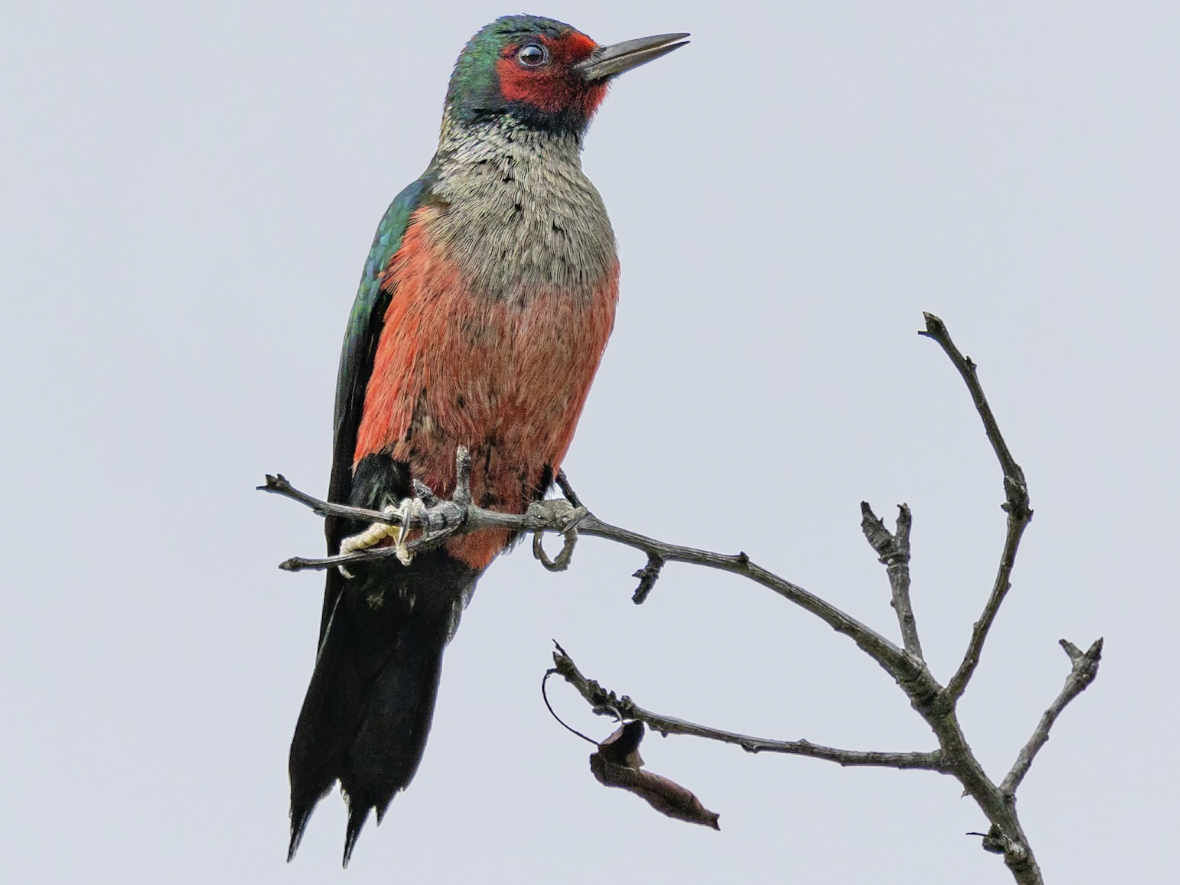
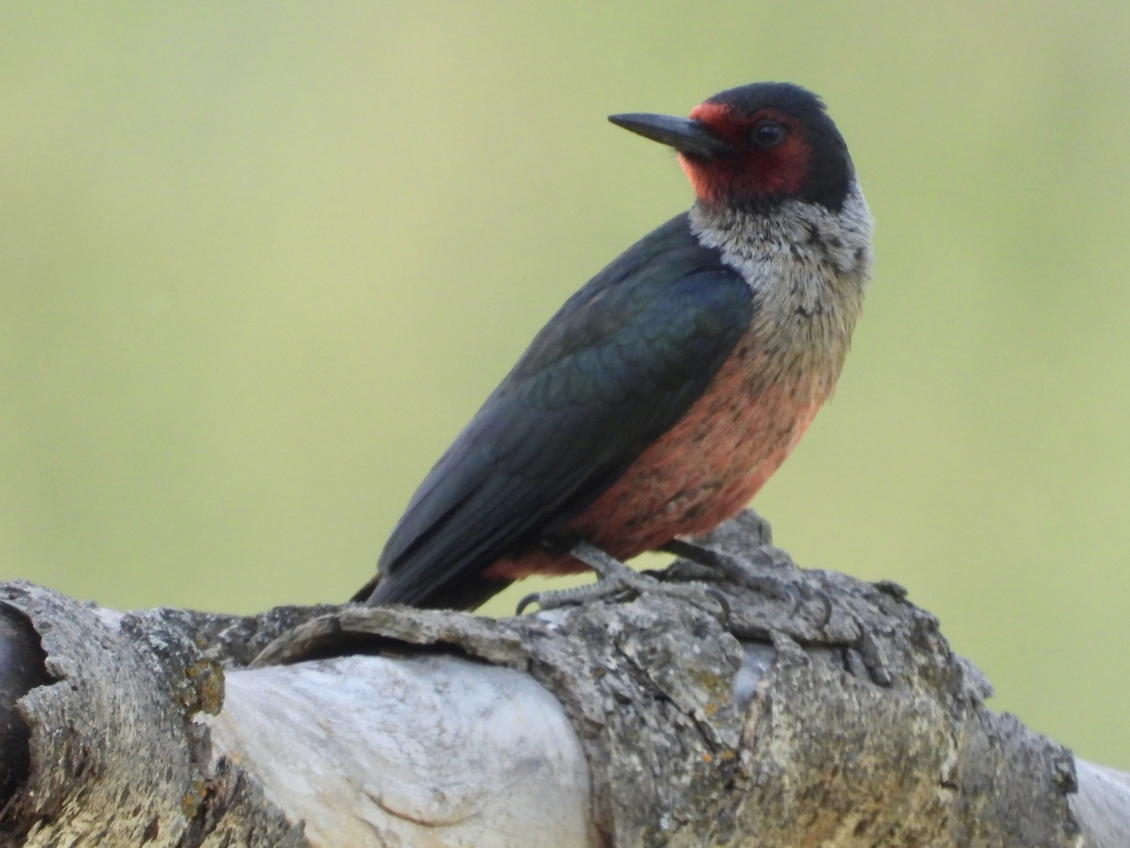
The Lewis’s Woodpecker is a very colorful medium-sized bird, with a long dark gray bill, feet, and black eyes. They have a striking bright red mask, shimmery green head, back, and wings, and an appealing bright orange belly. The chest and neck region is a sooty pale gray or white, depending on the bird. The tail and wing feathers appear darker than the rest of the bird’s back, but are also a shimmery green color. Males and females appear the same, while juveniles sometimes have patchy areas or discoloration in their chest or belly region. The red mask on younger birds is usually not as bright. These birds tend to be quiet, but males occasionally will make a churr-ing sound, or chatter back and forth with females during mating.
Habitat
The Lewis’s Woodpecker breeds in open ponderosa pine forests and recently burned wooded areas that still have a high density of standing dead trees, which are frequently called snags. When breeding they can be spotted in orchards, woodlands near streams, and oak or juniper forests. They prefer more open canopies, and are thus easy to spot in their natural habitat, flying and gliding in between tall trees and aerial foraging.
Conservation Status
- Listed as Least Concern by the International Union for Conservation of Nature (IUCN)
- Listed as an Yellow-Alert Species by Road to Recovery
Status by State
- Listed as Vulnerable by Arizona State Species of Greatest Conservation Need (pg 310)
- Listed as Vulnerable by Colorado State Species of Greatest Conservation Need (pg 376)
- Listed as Vulnerable by Nevada State Species of Greatest Conservation Need (pg 39)
- Listed as Vulnerable by New Mexico State Species of Greatest Conservation Need
- Listed as Vulnerable by Oregon State Species of Greatest Conservation Need
- Listed as Vulnerable by Utah State Species of Greatest Conservation Need (pg 14)
Threats to Conservation
These birds are very vulnerable to agricultural and urban development of their natural habitat and historic breeding grounds. Fire suppression, logging, over-grazing, and the removal of snags severely affects them. The removal of snags is especially detrimental to the Lewis’s Woodpecker, as they prefer these trees for nesting, and will often leave an area without these trees in hopes of finding a better habitat instead of nesting in nearby, “healthier” trees.
Funding Opportunities
- America the Beautiful Challenge
- Community Forest Program
- ConocoPhillips Partnership for Public and Private Land Managers
- Conservation Nation Grant Program
- Conservation Reserve Program
- Environmental Quality Incentives Program (EQIP)
- Fish and Wildlife Grants List for California
- Hewlett Foundation- Western Conservation Grants
- Land Trust Bird Conservation Initiative Small Grant Program
- Neotropical Migratory Bird Conservation Act (NMBCA) Grant
- NFWF- America Restoration Grant
- Pacific Birds U.S. Partnership
- Partners for Fish and Wildlife
- Point Blue California Restoration Grant
- Regional Conservation Partnership Program (RCPP)
- Sacramento California Grant and Funding
- Sonoran Joint Venture Awards Program
- The Lawrence Foundation- Environmental Grants
- The Migratory Bird Program
- Tribal Wildlife Grants
- Western Habitat Grant Proposals
- Wildlife Conservation Grants for Species Conservation
- Wildlife Diversity Grant Program