
Northern Harrier (NOHA)
Circus hudsonius
Range
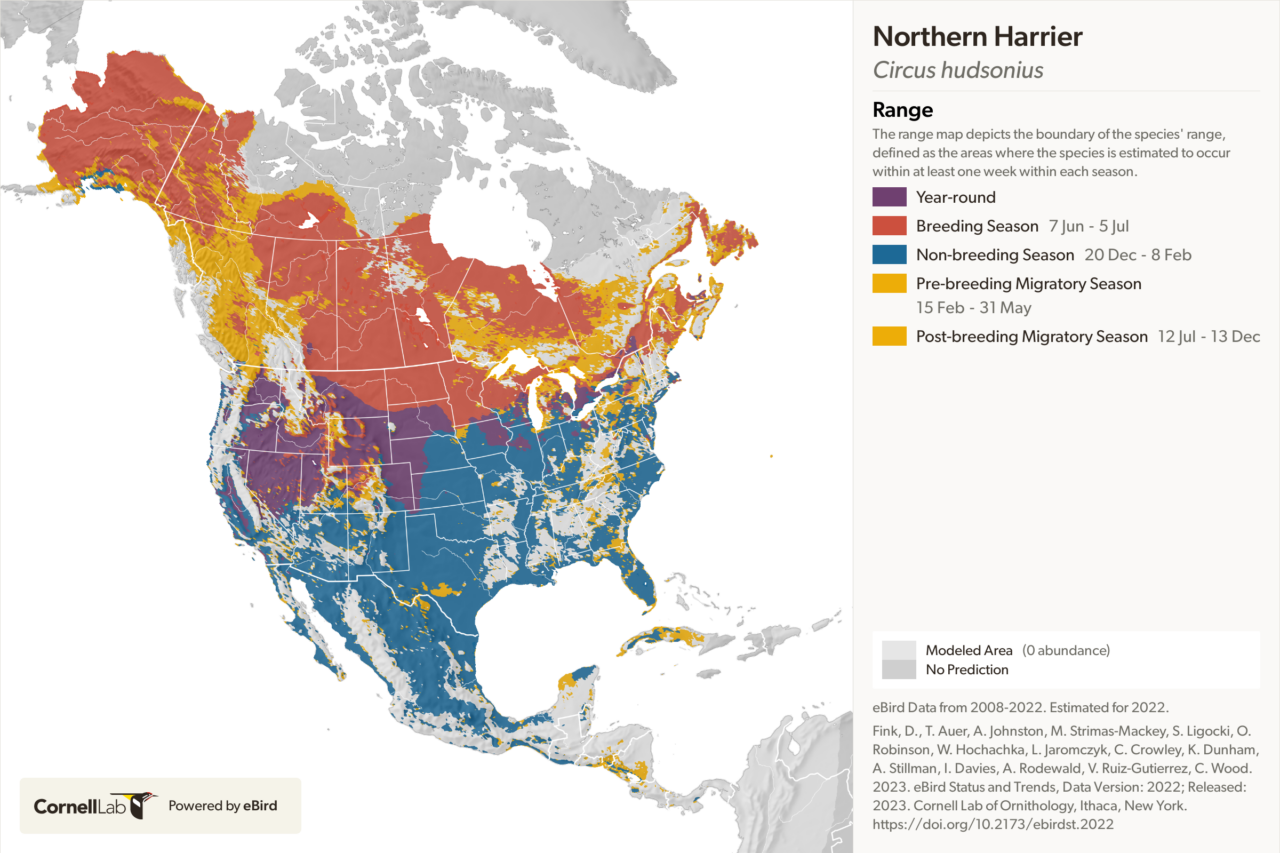
The breeding range of the Northern Harrier spans across North America, from northern Alaska and Canada south to Mexico, and east to parts of the central and eastern United States. It is also a rare and erratic breeder in some areas, including portions of the Northeast, Labrador, and mountainous or desert regions of the west coast.
During winter, the Northern Harrier migrates primarily from southern Canada through the U.S., Central America, and the Caribbean islands.
Additional Maps
Identification
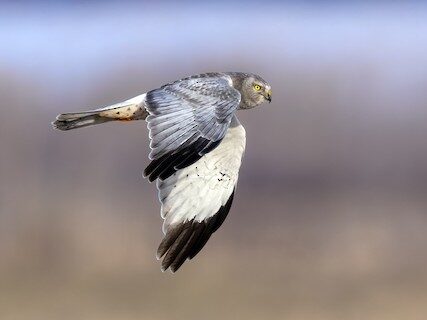
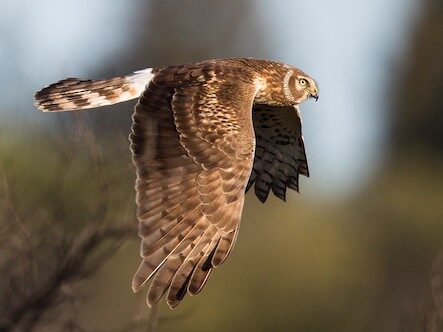
The Northern Harrier is a medium-sized hawk with owl-like traits, V-shaped wings, and a long tail. Adult males have gray upperparts, whitish underparts, and black wingtips, while females and juveniles are warm brown. Juvenile males have pale greenish-yellow eyes, while juvenile females have dark chocolate-brown eyes. As they mature, both sexes develop lemon-yellow eyes. All ages and sexes have a distinct white rump patch. Females are also larger than males, allowing differentiation between the two genders.
The Northern Harrier is known for its slow, low flight. Males court females with sky-dancing displays. Both are protective of the nest, with females incubating eggs and caring for the chicks, while males provide food. They nest on the ground, often in dense vegetation, either alone or in loose colonies. Occasionally, they walk or hop while retrieving prey or nesting materials. Juvenile harriers play and practice hunting skills by pouncing on objects. In winter, they roost in groups, sometimes with Short-eared Owls.
During courtship displays, both male and female Northern Harriers emit a rapid series of kek notes lasting one to two seconds. When threatened, they use higher-pitched kek notes. During the breeding season, the female Northern Harrier emits a piercing scream that serves as a signal to the male for either mating or bringing food. Listen to its calls here.
Habitat
The Northern Harrier breeds in a wide range of habitats across Canada and the northern United States, including open wetlands, grasslands, meadows, tundra, marshes, old fields, prairies, and riparian woodlands. They prefer large, undisturbed areas with dense vegetation. In the winter, they occupy open habitats dominated by low vegetation, such as deserts, sand dunes, grasslands, estuaries, floodplains, and marshes.
During migration, they are seen in both wetlands and uplands, and they forage in various habitats like wheat fields and cotton fields. Their overwintering range includes a variety of open habitats with herbaceous cover, and they concentrate in areas with low vegetation, particularly in the semiarid scrub and grasslands of the Great Basin and the southern Great Plains.
Conservation Status
- Listed as Decreasing by Bird Life International
- Listed as Least Concern by the International Union for Conservation of Nature (IUCN)
- Listed as Secure by NatureServe Explorer
Status by State
- Listed as Endangered by the Connecticut Department of Energy and Environmental Protection
- Listed as Species of Greatest Conservation Need by the 2015 Delaware Wildlife Action Plan (pg 20)
- Listed as Bird Species of Greatest Conservation Need by the 2015-2025 Maryland State Wildlife Action Plan (pg 42)
- Listed as Threatened by the NYSDEC
- Listed as Species of Greatest Conservation Need by the 2015-2025 Pennsylvania Wildlife Action Plan (pg 101)
- Listed as High Priority by the Vermont Department of Fish and Wildlife (pg 29)
Threats to Conservation
Northern Harrier populations are under significant threat due to the loss and degradation of grassland habitat caused by intensified farming practices, hayfield conversion, and land abandonment. Frequent mowing of remaining hayfields for increased production leads to high mortality rates for young and adult harriers. Wetland habitat loss through draining and dredging further exacerbates the challenges. The remaining habitats are suffering from fragmentation, exotic plants, and nutrient enrichment. Reduced prey availability from overgrazing, pesticides, and crop expansion also contributes to the decline. Additionally, nests in agricultural areas face destruction from livestock trampling.
Funding Opportunities
- Agricultural Conservation Easement Program (ACEP)
- EPA Federal Funding for Marshlands
- Land Trust Bird Conservation Initiative Small Grant Program
- The Migratory Bird Program
- NFWF National Coastal Resilience Fund
- Northeast Forests and Rivers Fund
- Partners for Fish and Wildlife Grant
- United Nations Ecosystem Restoration Wetlands Grant
- U.S. Fish and Wildlife Service National Coastal Wetlands Conservation Grants