
Pyrrhuloxia (PYRR)
Cardinalis sinuatus


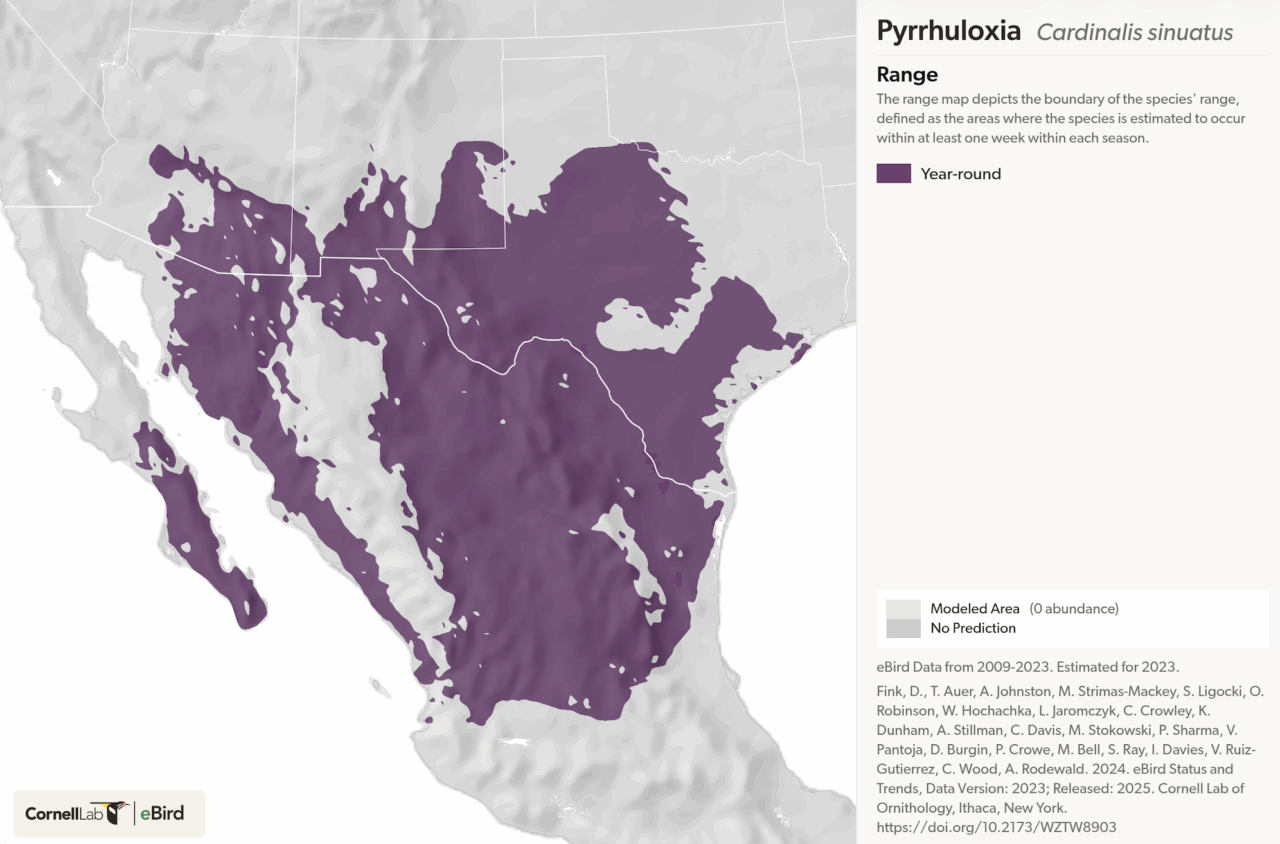
Range
These birds are nonmigratory. In the U.S. they can be found in the southern portions of Arizona, New Mexico, and Texas. This range extends into most of Mexico.
Additional Maps
Identification
The Pyrrhuloxia is a stunning small bird that is commonly mistaken for a Northern Cardinal. Although both species have a similar large broad bill and a tuft of feathers on the top of their heads, their colorations are very different. The male Pyrrhuloxia is mostly a silvery shade with some mottled brown patches. The top of the crown of feathers, most of the face, the top of the wings, parts of the chest and throat, and the sides of the tail, however, are a vivid bright red. Both males and females have the same bright yellow bill, but females lack most of the vibrant red patches. They are overall a much darker silver or gray color, and have some dark maroon feathers on their crest, near their eye, and sometimes on their tail and sides of wings. Their chest is a most yellowish shade of brown. Juveniles appear similar to adults but are more dull colored and appear to be more skinny and unkept. The songs of the Pyrrhuloxia are similar to that of the Northern Cardinal, but sound softer. One familiar song is the repeated what-cheer song.
Habitat
Pyrrhuloxias thrive in arid, brushy habitats, particularly those with mesquite and acacia scrub. They are commonly found in desert scrub, dry grasslands, and open mesquite forests. They prefer areas with dense brush-like groves, desert washes, and canyons, but can also be found in more open areas during winter. They favor spaces with dense vegetation in order to forage, hide, and build nests within. If their preferred vegetation is nearby, they can also be spotted in residential areas or agricultural fields.
Conservation Status
- Listed as Decreasing by American Bird Conservancy
- Listed as Decreasing by BirdLife International
- Listed as Least Concern by the International Union for Conservation of Nature (IUCN)
- Listed as Secure by Nature Serve Explorer
- An Orange-Alert Species by Road to Recovery
Status by State
- Listed as Vulnerable by Arizona State Species of Greatest Conservation Need (pg 312)
- Listed as Vulnerable by New Mexico State Species of Greatest Conservation Need
- Listed as Vulnerable by Texas State Species of Greatest Conservation Need (pg 36)
Threats to Conservation
The Pyrrhuloxia faces conservation threats primarily from habitat loss and fragmentation, mainly driven by agricultural development, urbanization, and invasive plant species taking over their historic ranges. This birds’ population has been in a long-term decline, and conservation efforts are necessary now more than ever to protect its habitats before the historic plant and tree species are lost forever.
Funding Opportunities
- America the Beautiful Challenge
- Community Forest Program
- ConocoPhillips Partnership for Public and Private Land Managers
- Conservation Nation Grant Program
- Conservation Reserve Program
- Environmental Quality Incentives Program (EQIP)
- Hewlett Foundation- Western Conservation Grants
- Land Trust Bird Conservation Initiative Small Grant Program
- Neotropical Migratory Bird Conservation Act (NMBCA) Grant
- NFWF- America Restoration Grant
- Pacific Birds U.S. Partnership
- Partners for Fish and Wildlife
- Regional Conservation Partnership Program (RCPP)
- Sonoran Joint Venture Awards Program
- The Lawrence Foundation- Environmental Grants
- The Migratory Bird Program
- Tribal Wildlife Grants
- Western Habitat Grant Proposals
- Wildlife Conservation Grants for Species Conservation
- Wildlife Diversity Grant Program