NBHCI Resource Hub
Northeast U.S. Priority Breeding Bird (NBHCI) Mapping Tool
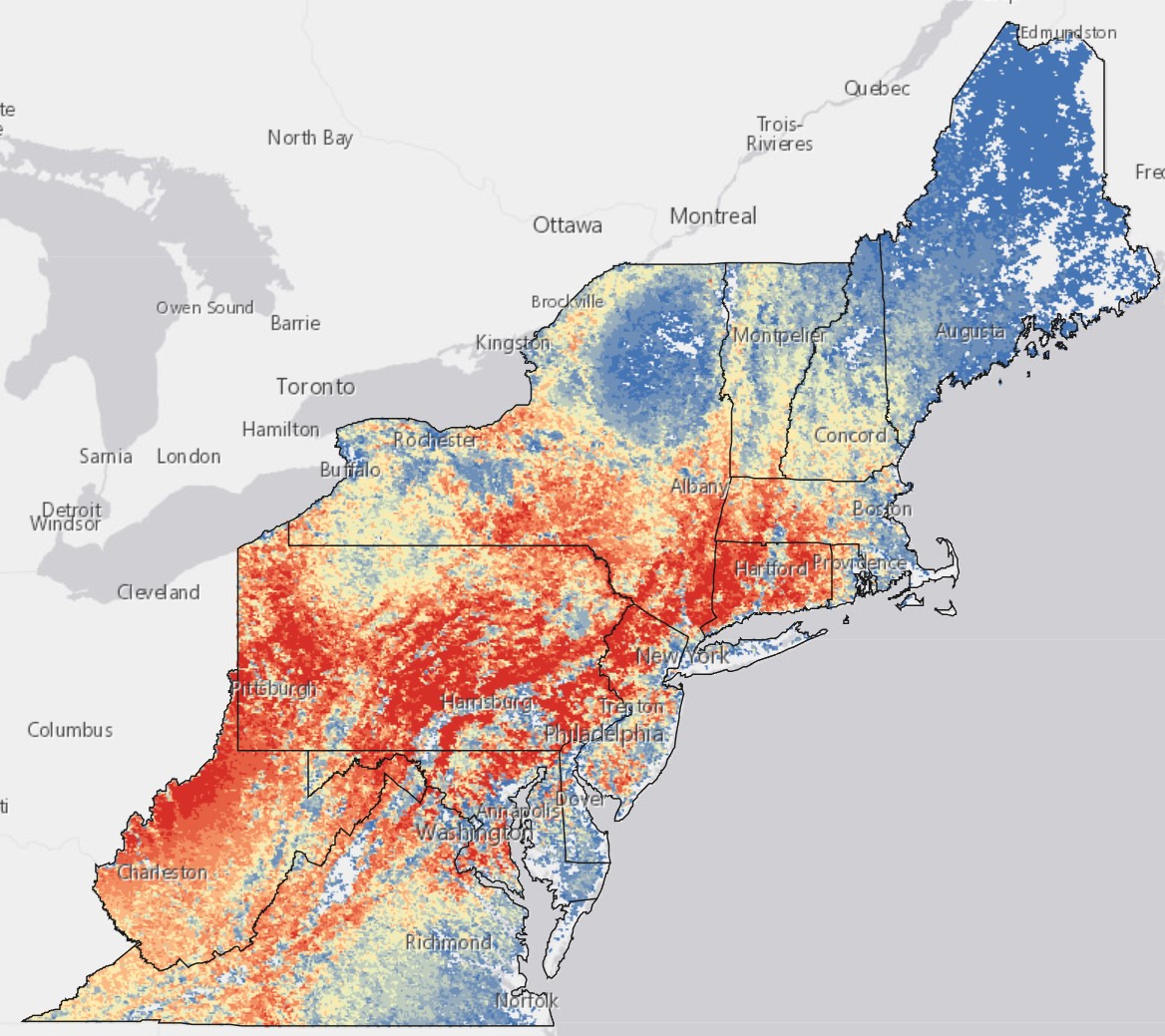
The NBHCI Mapping Tool was created by partners in the Northeast Bird Habitat Conservation Initiative (NBHCI), a collaborative effort between The Regional Conservation Partnership (RCP) Network, Audubon groups, Highstead, and the Cornell Lab of Ornithology. It is an easy to use, interactive mapping tool designed to help Regional Conservation Partnerships, land trusts, and practitioners use birds as tools to support activities such as habitat management plan and stewardship development, land prioritization and acquisition strategies, and landowner and community engagement, all through the lens of bird conservation.
This product showcases eBird Status & Trends (S&T) breeding season data in 13 states for 43 bird species in five habitat types: forest, grassland, shrub/scrub and young forest, wetland/marsh, and coastal/shoreline, and projects these data as GIS layers. The target species were selected based on their high priority status or climate vulnerability. The map includes strategic land conservation data layers, such as The Nature Conservancy’s (TNC) Resilient and Connected Landscapes Climate data, TNC Protected Open Spaces, and Audubon Important Bird Areas that can be overlaid with eBird data to help inform land planning and bird habitat conservation efforts. A user can also download the S&T data to add into preexisting GIS and land prioritization projects to help support the best use of limited conservation dollars.
The NBHCI Mapping Tool was launched and shared with the conservation community in 2022. After realizing the impacts and successful use of the tool in the Northeast, the partners decided to adapt it for other areas the U.S., developing a total of four regional Priority Breeding Bird Mapping Tools.
NBHCI partners wish to showcase ways in which users can interact with eBird modeled data combined with strategic land conservation data layers to look at high value habitats to inform land planning, bird habitat conservation efforts, and connections with communities through birding, increasing both local and regional conservation impact. Please contact us if you have a case study to share.
NBHCI Mapping Tool in the News:
New Conservation Mapping Tool Helps Visualize Opportunities, Highstead Conservation, October 2022.
Free Mapping Tool Merges Data to Improve Bird Conservation and Land Protection in Northeastern States, Cornell Lab of Ornithology, October 2022.
Webinars
Recent Webinars
-
Renewable Energy Ecology in the Northeast—Grassland Birds and Solar Energy Development in New York
February 26, 2026
Learn about the value of working lands for grassland bird communities in New York and the impacts solar energy development is having on their populations; presenters share current research by the New York Cooperative Fish and Wildlife Research Unit and the Department of Natural Resources and the Environment at Cornell University.
-
Conservation Speed Dating Training Webinar
February 12, 2025
Learn how to host a Conservation Speed Dating Workshop, a creative way to connect landowners with conservation professionals; presented by October Greenfield, Co-coordinator of the Virginia Grassland Bird Initiative.
eBird & Mapping Tool Webinars
-
NBHCI Mapping Tool Webinar
February 14, 2024
Provides an overview of the Mapping Tool’s data and layers, explores the tool’s functions, and showcases five land conservation professionals who are using the tool and data.
-

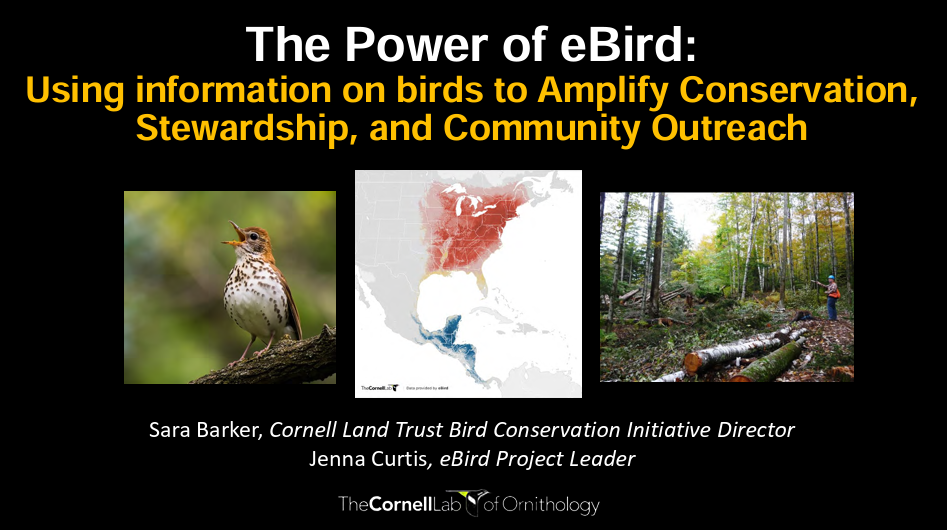
The Power of eBird: Using Information on Birds to Amplify Conservation, Stewardship, and Community Outreach
June 8, 2021
Demonstrates the power of eBird and how to teach eBird basics at your own workshop; presented by Sara Barker, Cornell Land Trust Bird Conservation Initiative Director and Jenna Curtis, eBird Project Leader.
-
Conservation Applications of eBird Data and Products
June 15, 2021
Discover how to use eBird science data to support activities such as land acquisition, monitoring, and engagement with landowners, stakeholders, and the birding community; presented by Jenna Curtis, eBird Project Leader and Orin Robinson, Research Associate, Cornell Lab of Ornithology.
Forestry Webinars
-
The Power of Birds in Driving and Sustaining Forest Management within the RCP Network
September 15, 2021
Learn how RCPs can utilize birds as ambassadors for sustainable forest management; presented by Steve Hagenbuch, Senior Conservation Biologist and Forester, Audubon Vermont and Annette Goyne, Cold Hollow to Canada RCP Woodlots Program.
-
Habitat Requirements and Management Considerations for Forest Birds in New England
September 22, 2021
Helps develop an understanding of what forest conditions and attributes provide high-quality nesting and foraging habitat for a range of priority bird species found in the northeast; presented by Steve Hagenbuch, Senior Conservation Biologist and Forester, Audubon Vermont and Dan Kilborn, Forester, Vermont Land Trust.
-
Bird-Friendly Forestry Practices and Strategies for Landowners
September 29, 2021
Explores specific forest management activities and silvicultural options designed to enhance bird habitat while also achieving timber and non-timber forest product, climate adaptation and mitigation, and other ecosystem services goals; presented by Steve Hagenbuch, Senior Conservation Biologist and Forester, Audubon Vermont and Nancy Patch, Cold Hollow to Canada RCP and County Forester with Vermont Department of Forests, Parks, and Recreation.
-
Technical and Financial Assistance for RCPs, Conservation Partners, and Landowners
October 13, 2021
Representatives from Maine and Mass Audubon, as well as Audubon NY, VT, CT, and Mid-Atlantic present various services and learning opportunities to help landowners understand where to begin when managing their forest with birds in mind and how to make the process financially viable; presented by Steve Hagenbuch, Senior Conservation Biologist and Forester, Audubon Vermont and partners from the organizations listed above.
Grassland Webinars/Workshops
-
Grassland Bird Conservation
March 16, 2022
Slides highlighted the decline in grassland bird species, described the Bobolink Project, and previewed the new “North Quabbin Grassland Birdscape” initiative headed by Mass Audubon through the NBHCI. Presented by Jeff Ritterson, field ornithologist at Mass Audubon, at a North Quabbin Regional Landscape Partnership meeting.
-
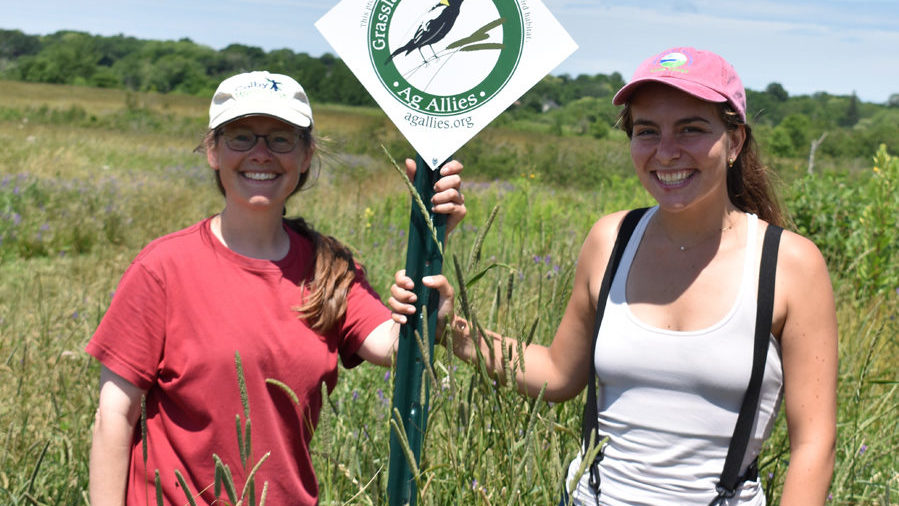
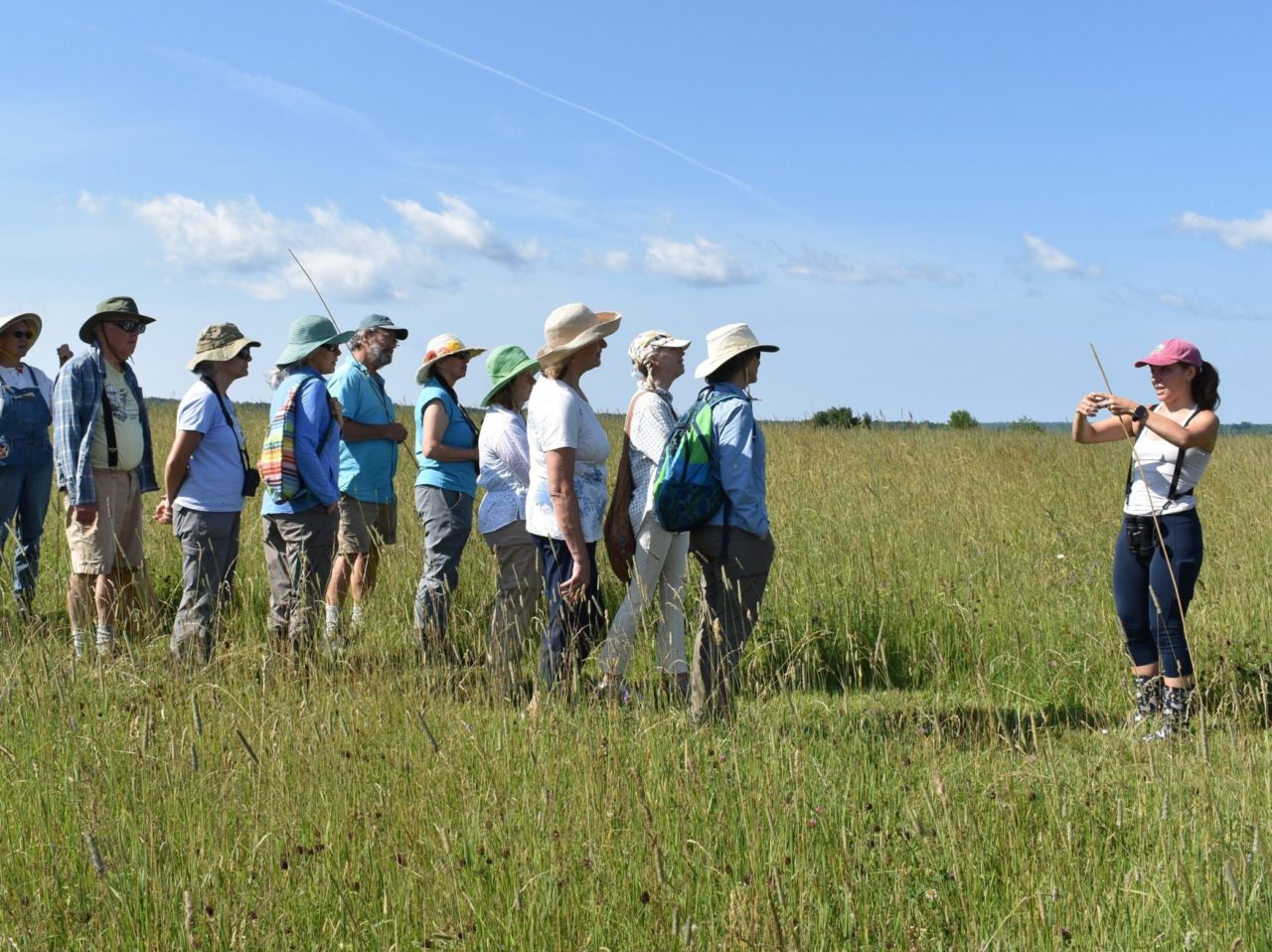
Maeve McGowan explains Bobolink life history to grassland workshop attendees. Photo by Laura Lecker/Ag Allies. Workshop held at Bascom Hollow Farm
September 8, 2022
Brought farmers, land trusts, and service providers together to discuss the connections between grassland bird conservation, soil health, and hay and pasture productivity.
-
Grassland Bird Programs
June 24, 2020
Learn about accelerating farmland protection and management for both birds and farmers through the Ag Allies and Bobolink Projects; presented by Jon Atwood, Director of Bird Conservation for Mass Audubon and Laura Lecker, Technical Director, Ag Allies.
Other Webinars
-
Migratory Bird Treaty Act
October 1, 2020
Explore perspectives on the Migratory Bird Treaty Act; presented by David Mears, Executive Director of Audubon Vermont.
-
Forestry for Maine Birds
May 28, 2020
Discover how to effectively manage forests with birds and other wildlife in mind, through the lens of Maine Audubon’s Forestry for Maine Birds initiative; presented by Sally Stockwell, Maine Audubon and Amanda Mahaffey, Forest Steward Guild.
Presentations
-
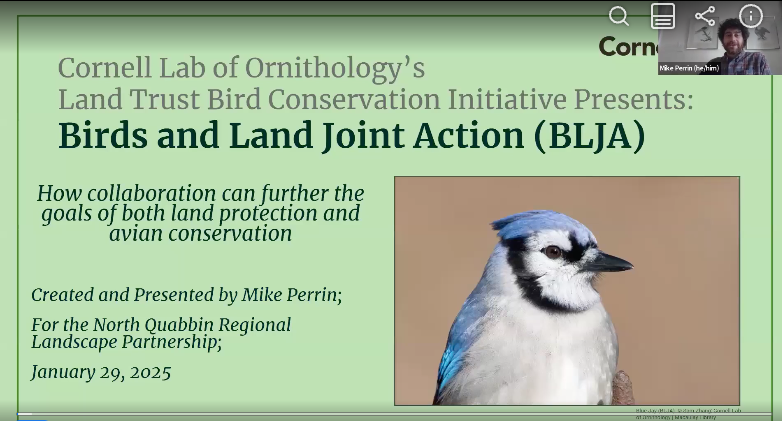
Birds and Land Joint Action
January 29, 2025
A presentation to the North Quabbin Regional Landscape Partnership about how collaboration can further the goals of both land protection and avian conservation. Presented by Mike Perrin, speaker for the Northeast Bird Habitat Conservation Initiative.
-
Northeast Bird Habitat Conservation Initiative
November 15, 2018
Slides from a presentation at the 2018 RCP Network Gathering Conference in Amherst, MA during the emerging landscape initiatives workshop; by Bill Labich, Senior Conservationist Highstead; Sara Barker, Cornell Land Trust Bird Conservation Initiative Director; Matt Strimas-Mackey, Data Scientist at the Cornell Lab of Ornithology; and Hallie Schwab, Conservationist Highstead.
Other Presentations
Building Strategic Bird Conservation Partnerships with Private Land Networks (3/25/23) presentation at the Connecticut Land Conservation Conference in Middletown, CT, on the power of birds to guide collaborative conservation to effect local change on private forests and grasslands throughout the Northeast while providing opportunities to scale lessons across a larger landscape. Presented by Katherine Blake, Conservationist, Highstead; and Eileen Fielding, Center Director, Sharon Audubon Center, Audubon Connecticut.
Building Strategic Bird Conservation Partnerships with Private Land Networks (9/16/22) presentation at the Land Trust Alliance Rally 2022 in New Orleans, LA, on how partnerships, such as the Regional Conservation Partnership Network, can lead to more collective climate resiliency across a larger landscape through bird-focused land prioritization, healthy forest, and sustainable grassland practices. Presented by Steve Hagenbuch, Senior Conservation Biologist and Forester, Audubon Vermont; Sara Barker, Director of Cornell Land Trust Bird Conservation Initiative, Cornell Lab of Ornithology; Julia Fitzpatrick, Land Conservation Coordinator and TerraCorps Member, Mount Grace Land Conservation Trust.
NBHCI Mapping Tool Focus Group (7/20/22) presented the NBHCI Mapping Tool to a group of conservation professionals in the Northeast, including members of NBHCI not directly involved in the project and Regional Conservation Partnership coordinators, to receive constructive feedback on the tool as well as insight into how conservationists can implement the tool to further their strategic planning and goals.
Zoom Meetings with RCPs and Audubon groups in CT, NY, MA, VT, and ME (March 2020) facilitated discussions between RCPs, Audubon groups, Highstead, and the Cornell Lab of Ornithology in each listed state around opportunities for collaboration, goal alignment, and potential pilot projects to use as proof of concept.
Northeast Bird Habitat Conservation Initiative Summit (9/5/19) held at Harvard Forest offered a presentation to help summit meeting participants better understand Regional Conservation Partnerships, the background of the NBHCI, identify partner overlap and priorities, and generate ideas for actionable pilot projects and funding opportunities.
Meetings
NBHCI All Partners Meeting (9/17/24)
On September 17, 2024, partners gathered at Merck Forest and Farmland Center in Rupert, Vermont, for a day of learning, including a field trip to showcase collaboratively managed bird-friendly landscapes.
At the meeting, conservationists from Ag Allies, 12 Rivers Conservation Initiative, Mass Audubon, Mid-Champlain Valley RCP, North Quabbin Regional Landscape Partnership, the Piedmont Environmental Council, Audubon Vermont, Cold Hollow to Canada, and Litchfield Hills Greenprint Collaborative presented their work in protecting and stewarding private lands, engaging private landowners, and collaborating with partners to support their work. Attendees shared resources and discussed opportunities for collaborative conservation projects.
Additional themes included:
- balancing the need to generate more renewable energy while also protecting critical bird habitat, such as grasslands;
- concerns about the impact of delayed mowing on hay quality, and how Ag Allies is working with farmers in Maine to increase nesting success of grassland birds and improve economic viability;
- fostering more effective landowner engagement using models such as Cold Hollow to Canada’s Woodlots Program and outreach events like the Conservation Speed Dating Workshop developed by the Virginia Grassland Bird Initiative;
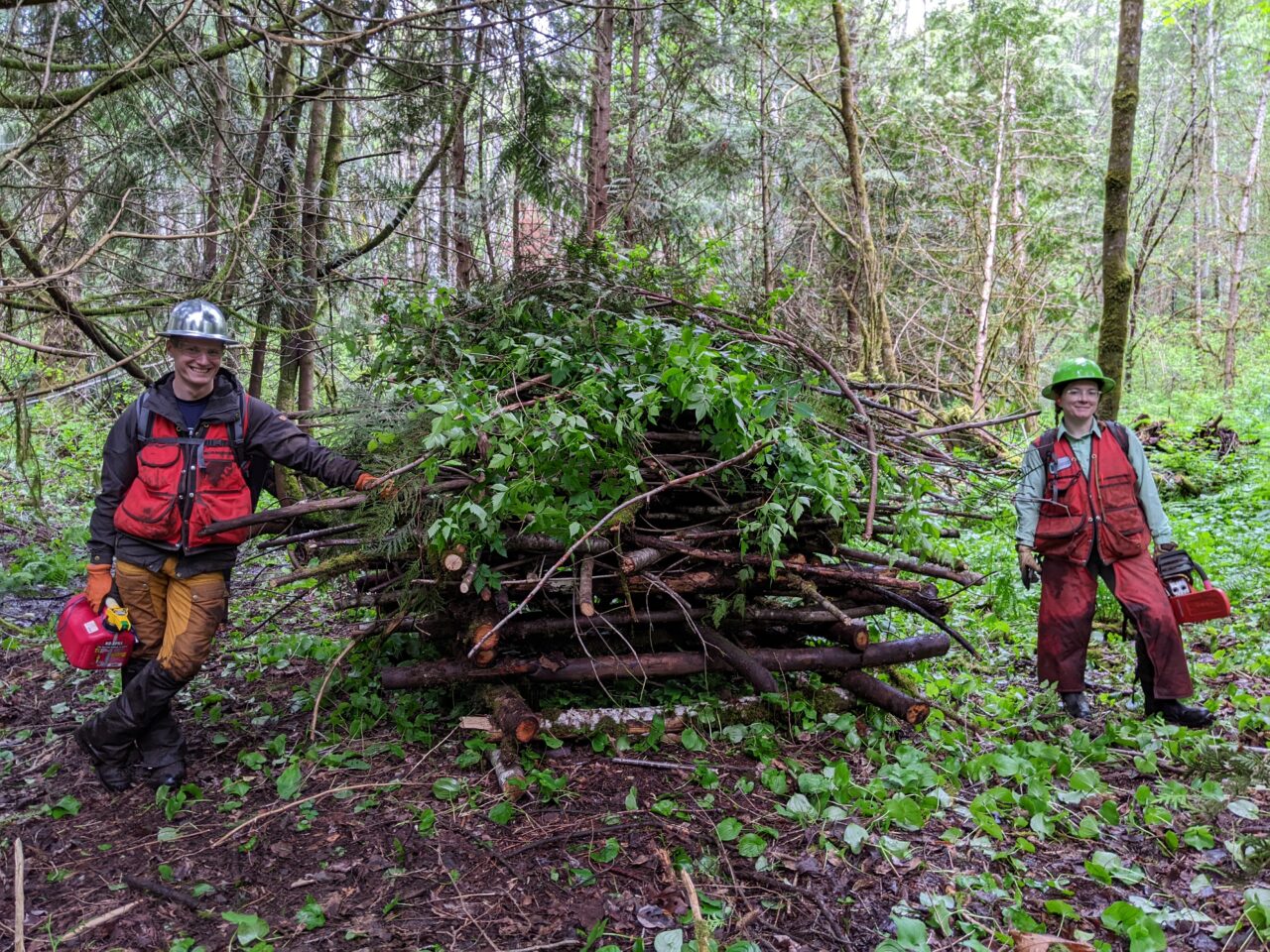
- tapping into youth leaders to accomplish projects like Audubon Vermont’s work with the Vermont Youth Conservation Corps;
- how to continue to think creatively about connecting resources for shrublands and other habitats that can benefit multiple species, such as both Bobolinks and Golden-winged warblers; and
- using tools like eBird to promote awareness of the role of birds in activities like land planning and community engagement.
One thread throughout the day was how partnerships are essential not only to protect ecological resources but also to support local economies and livelihoods, address growing energy demands, grow healthy food, and reinforce people’s sense of community.
NBHCI All Partners Meeting (1/19/23)
On January 19, 2023, partners gathered from the Northeast and Mid-Atlantic to connect with each other and learn about the NBHCI and inspire one another for new on-the-ground bird-friendly management practices.
Recordings
- Main Meeting Recording
- Bird-friendly Forestry Project Breakout Group Presentation– Steve Hagenbuch- Audubon Vermont and Nancy Patch- Cold Hollow to Canada Forest Link Project
- Maine Grassland Birds Project Breakout Group Presentation– Laura Lecker- Ag Allies, Irene Flynn- 12 Rivers Conservation Initiative, and Jean-Luc Theriault- Kennebec Woodland Partnership
- Massachusetts Grassland Birds Project Breakout Group Presentation– Jeff Ritterson- Mass Audubon and Sarah Wells- North Quabbin Regional Landscape Partnership
- eBird Training, Mini-Grant, and Workshop Breakout Group Presentation– Connie Manes- Litchfield Hills Greenprint Collaborative
Resources
-
eBird Webinar Series Resource List
June 2021
eBird training resources that accompany the webinar series are available for RCP leaders and land trusts to use when conducting their own training sessions within their communities.
-
Bird-friendly Forestry Webinar Series Resource List
September/October 2021
Resources provide information to help advance bird-friendly forestry opportunities in your region.
eBird Mini-grants
-
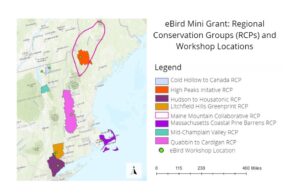
eBird Mini-grants Empower RCPs to Create an eBird Ambassador Network Among Partners
April 2022
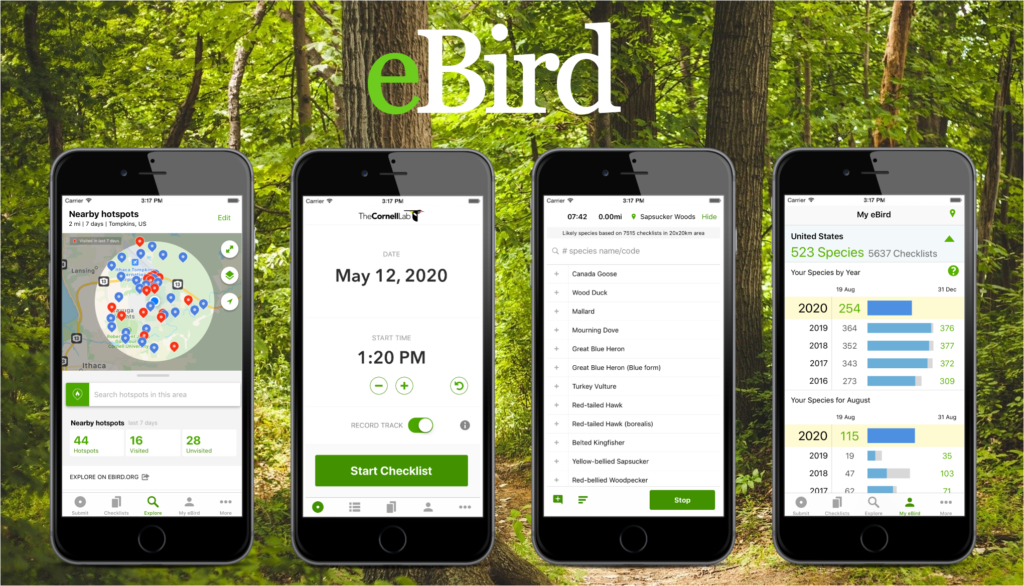
With funding from the Sarah K. de Coizart Perpetual Charitable Trust, eBird mini-grants of $500 were awarded to nine Regional Conservation Partnerships (RCPs) so they can host workshops that train participants within their networks on how to use eBird. The goal is to create an ambassador network that promotes the effectiveness of this birding tool for conservation, monitoring, and community engagement. This article introduces the RCP recipients and their eBird workshop plans.