Cornell Lab of Ornithology Awarded Bezos Earth Fund Grant to Advance Biodiversity Monitoring for Conservation
The Phase II award supports innovative use of artificial intelligence to protect biodiversity and advance climate solutions worldwide
October 23, 2025
Ithaca, NY—Today, the Cornell Lab of Ornithology’s K. Lisa Yang Center for Conservation Bioacoustics received a catalytic $1.8 million grant from the Bezos Earth Fund to help address global biodiversity decline through the development of cutting-edge wildlife monitoring technologies. The Cornell Lab was one of 15 recipients in Phase II of the Bezos Earth Fund’s AI Grand Challenge for Climate and Nature to scale artificial intelligence solutions that address the world’s most pressing environmental challenges—from biodiversity loss and food insecurity to climate change.
The Cornell Lab, in collaboration with Mongabay; the Wildlife Conservation Society; Chemnitz University of Technology, in Germany; the Programa de Pesquisa em Biodiversidade do Pantanal, and the Federal University of Mato Grosso do Sul, in Brazil; will develop cutting-edge bioacoustic technology to advance conservation monitoring in the Global South, a missing link in addressing the planet’s current biodiversity crisis. The project seeks to deploy acoustic sensors and AI analytics to identify real-time threats to forests from illegal activities and provide insights into ecosystem health.
More Cornell Lab News

“Right now, we simply don’t know how wildlife populations are doing, particularly in some of the most biodiverse areas such as in South America, Southeast Asia, and Africa,” says Ian Owens, director of the Cornell Lab of Ornithology. “Satellite images help us monitor habitat change, but that’s not enough to uncover what’s happening across all species and research indicates that drastic declines are underway. We need to figure out what’s causing the declines and how we can reverse them. We can’t do that using traditional methods. This support from the Bezos Earth Fund will help us unlock exactly the kind of efficient, scalable approach we need.”
Traditional biodiversity monitoring relies on humans to count or observe changes in wildlife populations, but these methods often fall short in delivering solutions at the scale needed for conservation. Traditional methods are also difficult to scale up—only small portions of the land can be monitored at any given time.
“Conservation Technology is key to enable a comprehensive and timely understanding of wildlife in these regions, and bioacoustics is the best tool for doing that,” says Owens.
“The goal is to develop fast, accurate, scalable, and affordable methods to monitor biodiversity using microphones to eavesdrop on the world,” says Holger Klinck, director of the Cornell Lab’s K. Lisa Yang Center for Conservation Bioacoustics. Bioacoustics, the study of sounds in nature, is one of the “very few technologies that enable us to do what is beyond the scope of human observations,” says Klinck.
The research team from the Cornell Lab will address real-world conservation challenges using state-of-the-art bioacoustic technology in two highly threatened biodiversity hotspots: Guatemala’s Maya Biosphere Reserve and Brazil’s Pantanal wetland.
“In Guatemala, we will be working with a real-time version of a new acoustic recorder that we’re developing with Analog Devices Inc. that will run and analyze data in the field, and then report back what’s happening to park managers in real-time,” says Klinck. “It’s this kind of groundbreaking technology that is needed to really protect the ecosystem and the people that work in those areas—no commercial product out there can do what we’re proposing.”
Farther south in Brazil’s Pantanal wetland, the team will deploy new technology to monitor wildlife in the world’s largest tropical wetland. The team will develop the first foundation model for natural sounds, providing a fast and flexible tool for sound classification of many species across all types of habitats. “This bioacoustic model will enable a much more comprehensive assessment of ecosystems, representing a turning point in biodiversity monitoring and conservation,” says Larissa Sayuri Moreira Sugai, the interim assistant director at the Yang Center.
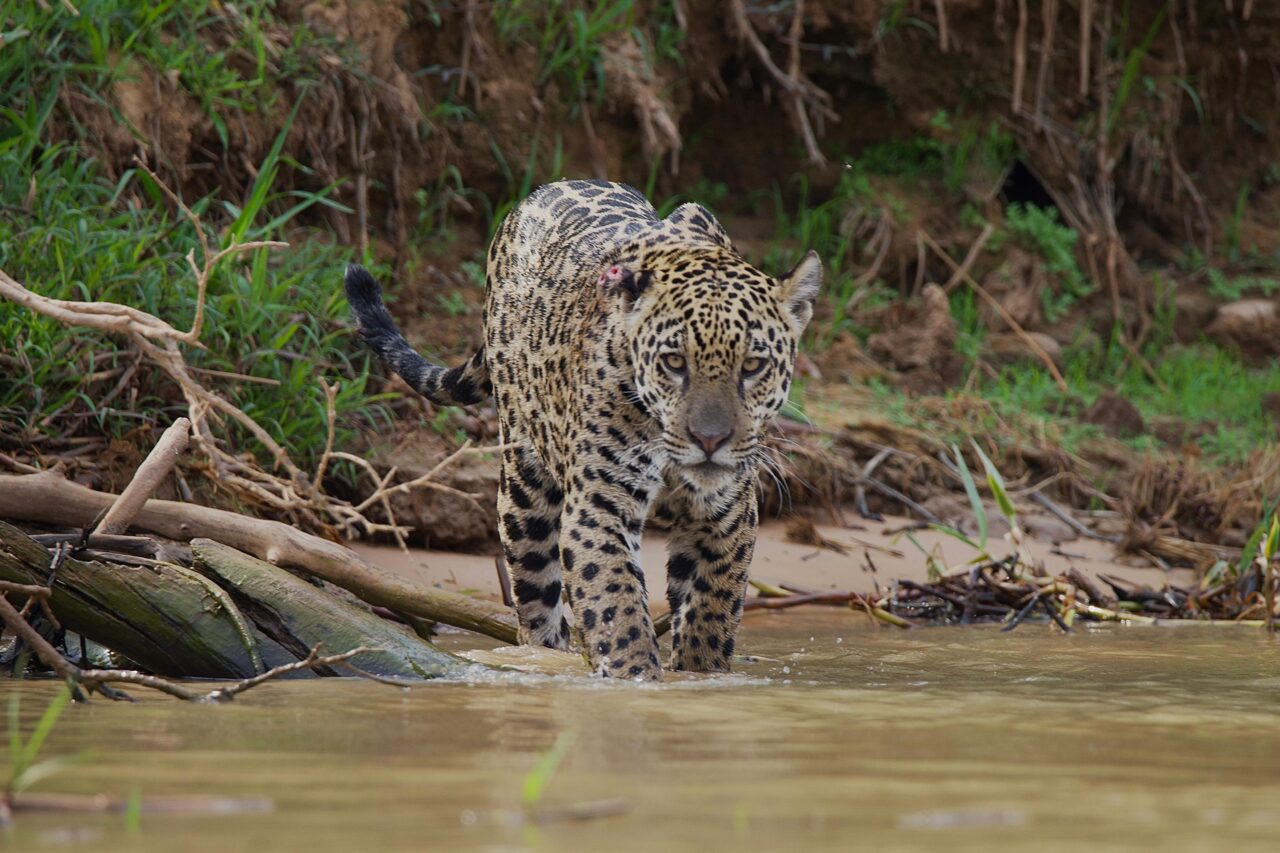
“The groundbreaking aspect of this initiative in the Pantanal is that it marks the first-ever biome-wide assessment of ecosystem health conducted in the Global South using acoustic monitoring techniques,” says Klinck. Effective conservation hinges on a deep understanding of what exists and what is at risk. These innovative tools will empower managers to take informed actions to protect and sustain biodiversity around the world.
Funding from Bezos Earth Fund will also allow the team to transfer knowledge to local partners to deploy the technologies to assist in conservation and decision-making. “Our goal is to distribute the technology to other folks around the world,” says Klinck. This latest grant follows the Cornell Lab’s Phase 1 award announced earlier this year in May.
“Bioacoustics has been the silver bullet of hope for conservationists for some time, but right now it takes an expert team to do the work at scale,” says Owens. “We’re going to put together the hardware, software, and interfaces to allow conservation decision makers and researchers to use the technology easily to help reverse biodiversity declines.”
###
About the Cornell Lab of Ornithology
The Cornell Lab of Ornithology is a nonprofit, member-supported organization dedicated to the understanding and protection of birds, wildlife, and our shared planet through research, education, participatory science, and conservation. The mission of the Cornell Lab of Ornithology is to interpret and conserve the earth’s biological diversity through research, education, and citizen science focused on birds.
Editors: Download images. The use of this material is protected by copyright. Use is permitted only within stories about the content of this release. Redistribution or any other use is prohibited without express written permission of the Cornell Lab of Ornithology or the copyright owner.
Media Contact:
Kathi Borgmann, Cornell Lab of Ornithology, (607) 254-2137, klb274@cornell.edu
Join Our Email List
The Cornell Lab will send you updates about birds, birding, and opportunities to help bird conservation. Sign up for email and don’t miss a thing!
Golden-cheeked Warbler by Bryan Calk/Macaulay Library