
Record-breaking Night of Bird Migration Detected with Radar
September 26, 2025
Ithaca, NY—A record-breaking night of bird migration was detected last night by BirdCast, a platform that uses the same weather radar technology behind daily forecasts to track migrating birds.
On its live migration map, BirdCast tracked more than 1.2 billion birds streaming south to their wintering grounds after sunset Thursday—the largest single-night total ever recorded since the collaborative research project began mapping live migrations in 2018. This surge surpasses the previous milestone of one billion birds, first observed in October 2023.
More Cornell Lab News

“These numbers are almost inconceivable,” said Andrew Farnsworth, a visiting scientist at the Cornell Lab of Ornithology and longtime BirdCast researcher. “They’re enormous. They grab your attention, even for people that study migration regularly. The scale of how many organisms that this represents, it is just mind blowing.”
Farnsworth said this seemingly rare night captured about 10% of the continent’s birds in flight at the same time. On an average fall night during peak migration, only about 400 million birds are detected in flight at the same time above the United States, but on this night, the number was three times that. “It’s really unbelievable,” he said.
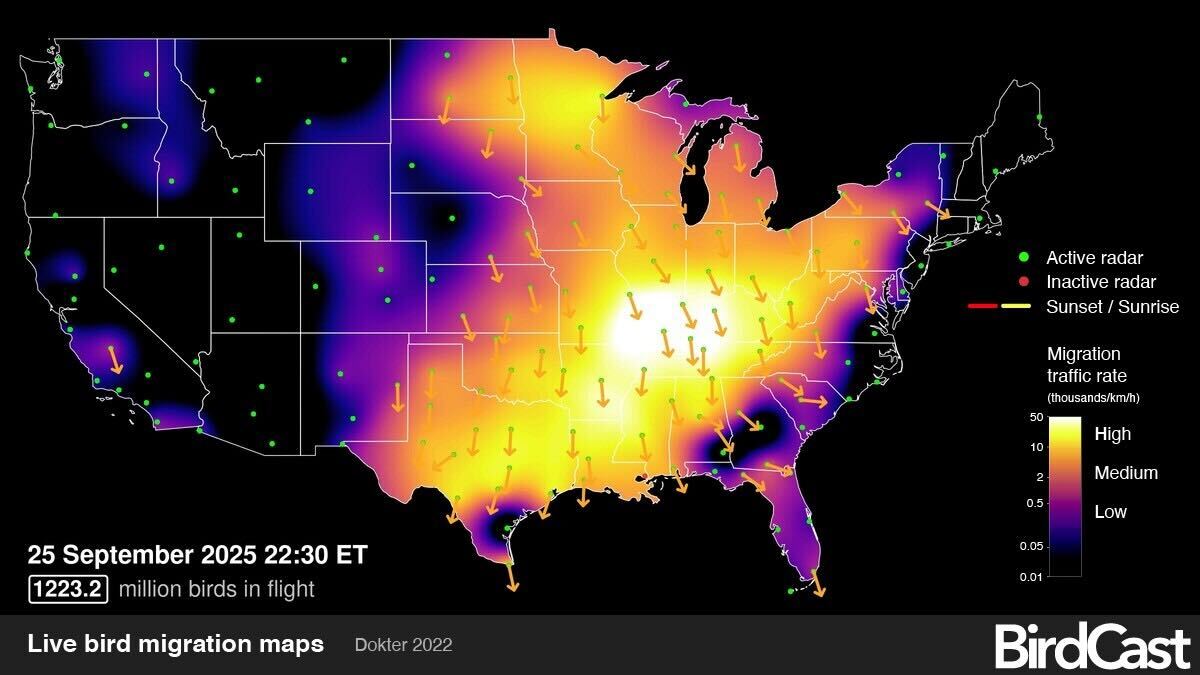
While astonishing to both birders and scientists, Farnsworth said this event was not random. It resulted from a combination of ideal migrating conditions coinciding with the peak of fall migration.
Thursday night’s weather was perfect for travel, he explained, with calm winds—including tail winds that helped push the birds along their migratory paths across much of the center of the country and the Mississippi River valley.
BirdCast is a collaborative research project that uses weather radar and machine learning to track and forecast bird migration patterns, with research contributions from the Cornell Lab of Ornithology, Purdue University, University of Illinois Urbana-Champaign, and University of Massachusetts Amherst.
Farnsworth said this record-breaking migration—documented by radar technology that was never intended to track birds—is a chance to not only to marvel at the immense magnitude of bird migration but also a chance to remind the public that the data is freely available and accessible in real time. The technology at BirdCast.org allows anyone to view forecast maps that predict the number of birds migrating while live migration maps show migration happening in real time. Both tools let people know when birds are moving nearby, so they can take necessary precautions to protect them.
“BirdCast gives the ability for more people to engage in and participate in this incredible spectacle,” Farnsworth said, “and understand that it’s happening.”
It’s also a timely reminder that people across the continent can help make birds’ journeys safer. Every year, more than one billion birds die in collisions with windows in the United States.
Bright lights can disorient birds migrating at night, drawing them into areas where collisions with glass are common. To help, turn off nonessential lights at night and add bird friendly film or other markings spaced no more than two inches apart on the outside of windows. Learn more at stopbirdcollisions.org.
Media contact:
Kathi Borgmann, Cornell Lab of Ornithology, (607) 254-2137, klb274@cornell.edu
Join Our Email List
The Cornell Lab will send you updates about birds, birding, and opportunities to help bird conservation. Sign up for email and don’t miss a thing!
Golden-cheeked Warbler by Bryan Calk/Macaulay Library